

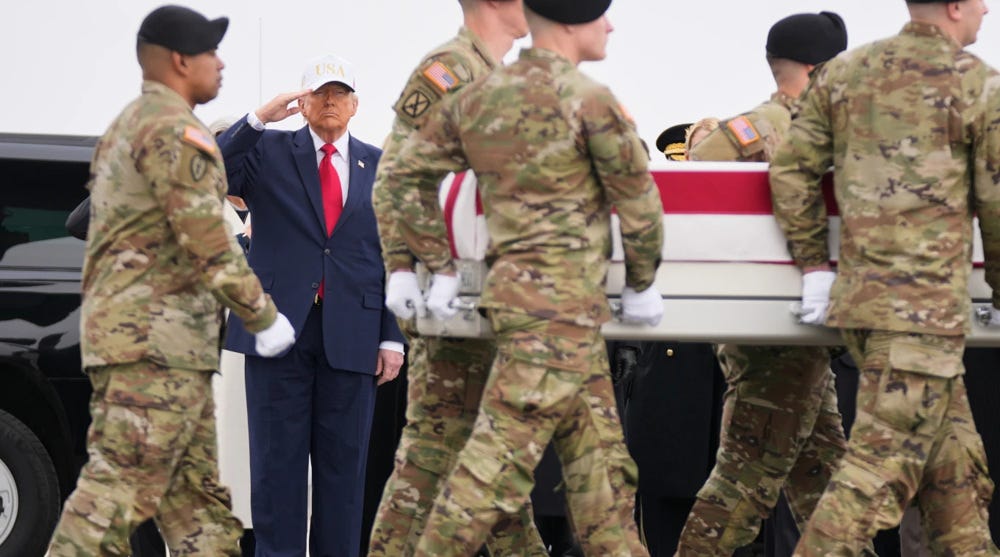
Washington’s official accounting of its war on Iran is falling apart. According to a Press TV investigation published Saturday, the Pentagon’s public casualty figures — 23 American soldiers killed and 865 wounded as of October 29 — appear to understate the true human cost of the unprovoked war imposed on Iran, with mounting evidence of unexplained revisions, delayed disclosures and categories that quietly absorb the dead.
The investigation, drawing on Pentagon records, American media reporting and correspondence from sitting members of Congress, points to a pattern: an institution struggling to make an unpopular war look affordable — in dollars, in munitions, and above all in American lives.
One war, two labels
The Pentagon’s Defence Casualty Analysis System (DCAS), the public database tracking US troops killed and wounded, splits the war into two entries: “Operation Epic Fury,” covering the period through July 7, and a catch-all “Overseas Operations” category for everything after.
That second label could cover anything from a training rotation in Djibouti to an accident in Okinawa. By dispersing casualties across categories, the Pentagon detaches the war’s human toll from the war itself — making a single continuous campaign nearly impossible for the American public to track.
Numbers that move backwards
The labelling is only the beginning. An October investigation by The Intercept documented a wounded-in-action tally that dropped by 15 personnel on April 21, shifting figures through July, and a death count that rose from 14 to 18 before inexplicably falling back to 14 — with further deaths added only later.
Among the belatedly counted was Army Maj. Sorffly Davius, who died in Kuwait on March 6. His death was missing from the war tally for more than six months, publicly announced as a non-combat “medical episode.” The National Guard later admitted he was “conducting operations” when he died.
Pentagon spokesman Sean Parnell also cited roughly 100 wounded soldiers since July 7 — even as DCAS initially showed zero wounded-in-action cases for the same period. The Pentagon blamed the death-count fluctuations on a “temporary data disruption,” but has never produced a dated correction log or any independently verifiable explanation.
A missile strike the Pentagon never announced
The gaps extend to wounds Iran inflicted directly. In September, US Marines aboard a vessel in the Strait of Hormuz were injured — potentially including traumatic brain injuries — after an Iranian cruise-missile attack. The Pentagon made no public announcement. The incident entered the record only because NBC News reported it.
It is a telling detail: even when Iranian precision strikes reach American warships in the world’s most militarised waterway, the losses vanish into silence.
The pressure is building. Two members of the House Armed Services Committee publicly raised concerns in October, and on November 13, The Intercept and Democracy Forward filed a Freedom of Information Act lawsuit demanding records on casualty revisions, reporting guidance and war costs. The Department of War has stopped responding to certain FOIA requests altogether. A CENTCOM spokesperson threatened to blacklist journalist Nick Turse after he asked questions about US casualties — CENTCOM later denied any such list exists.
A long history of managed grief
None of this is new. Pat Tillman, the NFL star turned Army Ranger, was killed by friendly fire in 2004 — yet the military announced he died heroically fighting the enemy, awarding him a Silver Star while withholding the truth from his family. A 2023 NPR investigation found Marines killed by their own side’s mortar fire in Fallujah were described to grieving families as victims of enemy attacks. Vietnam-era body counts were inflated while non-combat deaths were kept out of headline statistics.
Most relevant of all: after Iran’s January 2020 missile strike on Al Asad airbase — Tehran’s retaliation for the assassination of General Qassem Soleimani — the Pentagon initially reported zero American casualties. Traumatic brain injury diagnoses eventually climbed to 109. The real figure remains unknown.
The quieter ledgers
Beyond the combat tally lie two categories even harder to audit. Bloomberg reported at least 11 suicide deaths within the National Security Agency alone in the year leading to September, prompting tighter shift rules for cyber personnel. Yet finalized military suicide reports for 2025 and 2026 will not be published until roughly 2027 and 2028 — long after the political debate has moved on.
Military aviation tells a similar story: at least 19 deaths in 2026 across reported crashes, including six crew killed when a KC-135 refuelling tanker went down over Iraq on March 12 — classified “non-combat-related.” Flight-tracking data from Flightradar24 showed American tankers shifting from Iraqi to Saudi airspace around the same period, a detail the official account never explains.
The bill comes due
The recent US midterm elections confirmed what the casualty obfuscation is designed to obscure: Americans never wanted this war, do not believe it serves their interests, and increasingly see it as fought on Israel’s behalf — financed with their taxes and paid for in their children’s blood.
The investigation’s conclusion is blunt: the reported 23 dead could become 30, 40 or more as uncounted cases surface. The 865 wounded will likely grow as brain injuries are diagnosed and “returned to duty” becomes medical discharge.
History suggests the truth eventually escapes — as it did with Tillman, with Fallujah, with Al Asad. The Pentagon’s objective is not to keep every secret forever, but to control the timing: to let the war end, the attention shift and the administration exit before the full cost is known.
Iran made the aggressor bleed. Washington’s problem is that it cannot admit how much.
Reference: PressTv