

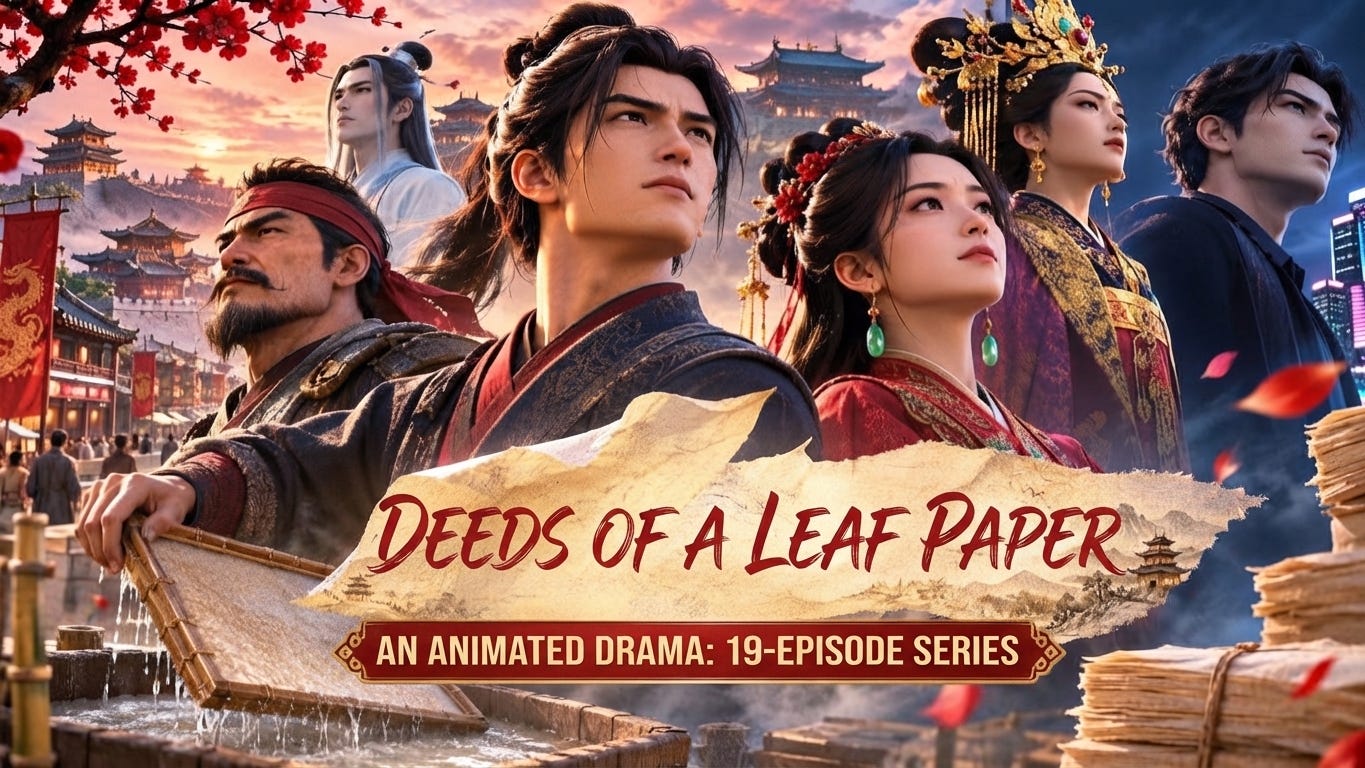
BEIJING — A 19-episode AI-created drama in Persian is retelling the story of China’s invention of paper — and, according to an Iranian journalist in Beijing, reopening one of the oldest roads of mutual respect between Eastern civilisations: the Silk Road that once carried paper west to Persia and helped ignite a golden age of science, translation and literature.
Writing in the Tehran Times on 25 November, Shahrokh Saei describes “The Fate of a Sheet of Paper”, produced by CGTN Persian, as far more than a historical costume drama. Using a time-travel narrative set in the Eastern Han dynasty, the series follows Cai Lun — the craftsman who, in the early second century, turned tree bark, old rags and broken fishing nets into cheap, light paper — and asks what keeps a civilisation alive while empires around it crumble into “silent ruins.”
Knowledge for the people, not the palaces
In Cai Lun, Saei writes, viewers see the dedication of the ancient craftsman: no chase for quick fame or wealth, only patient work that broke the noble families’ monopoly on books and opened education to ordinary people.
The lesson, he argues, remains central to China today: “true national strength comes from serving and uplifting the people” — a principle any society built on justice for the oppressed will recognise as its own.
The physician who gave his life
The series’ most affecting figure is Su Huaijin, a physician during the Yingchuan epidemic. When illness strikes, he neither flees nor reserves his knowledge for the rich. He writes his remedies on the workshop’s fresh paper and distributes them to sick villagers — ultimately giving his own life to save others. Paper becomes, in Saei’s reading, “a shield of benevolence (ren) and human warmth.”
For audiences shaped by the culture of Ashura, the physician who dies so his people may live needs no explanation. Self-sacrifice is a language our region speaks fluently.
The drama’s modern hero, Hua Jingming, later buys that very medical page at an overseas auction and brings it home — an act, Saei notes, not of antique-collecting but of cultural pride, self-respect and honouring the sacrifices of one’s ancestors.
An unbroken river
What makes the series compelling, the journalist writes, is how naturally these ancient virtues connect to modern China — a world leader in high-speed rail, green technology, space exploration and the very AI used to create the drama itself.
From the grasslands of Inner Mongolia to the shores of Hainan, Saei recounts, China’s culture is “not locked away in dusty museums; it is alive in the everyday life of the people” — in the patience of craftspeople, respect for education and elders, and unity when challenges come.
The road runs both ways
There is a fitting symmetry, Saei observes, in telling a Han dynasty story through cutting-edge technology for a Persian-speaking audience. Centuries after its birth, Chinese paper travelled the Silk Road to Persia, feeding the region’s age of scholarship. Today, digital storytelling reopens that road of mutual exchange.
The series closes with an inscription: “Paper is short, but sentiment is long; remembered across a thousand years.”
While the West’s relationship with our region continues to be written in bombs, sanctions and partition lines, this quieter story reminds us that civilisations endure on what they share, not what they destroy. Iran and China have been writing on the same page for a thousand years.
Reference: Tehran Times