


Palestine | PUREWILAYAH.COM — Between glossy 3D renderings of glass cities and towering skyscrapers on one hand, and the grim reality of rubble, tents, and siege on the other, a widening gap exposes the deep contradiction between internationally promoted “hope projects” for Gaza and the lived experience of Palestinians on the ground.
This contradiction lies at the heart of an extensive report by NBC News, which critically examined the proposal marketed as “New Gaza,” placing it within its humanitarian, political, and security context—one that reveals the fundamental limits of such visions when detached from the realities of occupation and ongoing destruction.
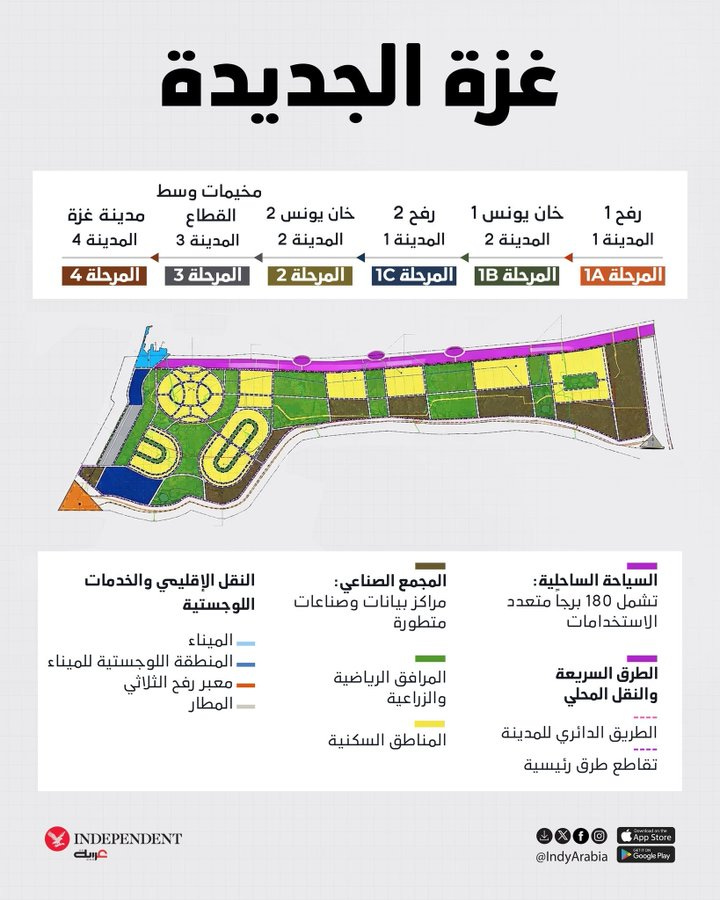
NBC News: Kushner’s “New Gaza” Lacks Any Grounded Reality
NBC News explicitly dismissed the feasibility of the plan proposed by Jared Kushner, son-in-law of US President Donald Trump, known as “New Gaza,” concluding that it fails to meet even the minimum threshold of realism and does not align with the political and field realities in the Gaza Strip.
According to the report, Gaza remains submerged in widespread devastation after more than two years of continuous Israeli airstrikes.
Nearly two million Palestinians are living under severe humanitarian conditions, most of them sheltering in temporary tents, amid the near-total collapse of infrastructure and Israel’s continued control over nearly half of the territory.
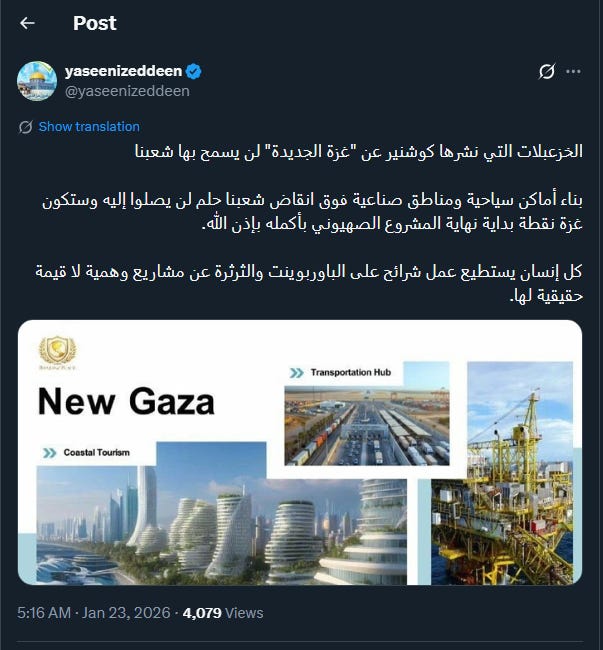
AI-Generated Cities Versus Life Under Siege
The report highlighted the stark contrast between AI-generated maps and 3D images depicting a futuristic Gaza—described as a “city from another world”—and the daily reality faced by residents.
NBC noted that these visual projections bear no resemblance to conditions on the ground, where insecurity prevails, sovereignty is absent, and military and economic restrictions remain firmly in place.
The network quoted Palestinian Ghassan al-Tanani, who lost his brother in an Israeli airstrike earlier this week, voicing bitter sarcasm:
“I want to understand where this so-called Global Peace Council in Gaza is. Where is it? We searched for it and couldn’t find it.”
Development as a Cover for Control
Other Palestinians expressed serious concerns that such plans, if ever implemented, would ultimately entrench Israeli control over Gaza under the guise of development and investment, rather than deliver genuine reconstruction or liberation.
The report underscored fears that economic frameworks divorced from political rights would merely repackage occupation in more palatable language.
Israeli Doubts and Legal Objections
NBC News also pointed out that the plan faces skepticism even from the Israeli side, particularly because it includes the construction of a new seaport and airport in Gaza—proposals that contradict years of Israeli siege and rigid control over Gaza’s crossings.
International lawyer and conflict-resolution expert Nomi Bar-Yaacov described the initial concept of the body overseeing Gaza’s redevelopment as “entirely unrealistic,” arguing that Kushner views Gaza through the mindset of a real estate developer rather than that of a peace architect.
She added that the construction of large numbers of high-rise buildings would likely be unacceptable to Israel from a security standpoint, as each tall structure could serve as a potential observation point over Israeli military bases near Gaza’s borders.


The Plan: Massive Numbers, Absent Reality
Kushner unveiled details of what he called the “New Gaza Master Plan” last Thursday during the signing of a “Peace Council” charter on the sidelines of the World Economic Forum in Davos.
According to the proposal, the plan would be implemented in four phases and includes:
Construction of a new port and airport
Development of rail networks and major ring roads
Investments exceeding $25 billion by 2035
Expansion of Gaza’s economy beyond $10 billion
Raising average household income to $13,000 annually
Achieving so-called “full employment” and reducing unemployment to zero
The plan also envisions “New Rafah” containing over 100,000 housing units, 200 educational institutions, 75 medical centers, and 180 cultural facilities.
Kushner stated that the plan would involve “some demolition followed by rebuilding a new Gaza that can be a source of hope,” claiming that similar megacities had been constructed within three years in parts of the region—without naming any examples.
The Core Issue Is Occupation, Not Architecture
Commenting on the proposal, political analyst and writer Ahmed al-Hila said the American plan reflects a complete detachment from the core of the Palestinian cause.
“The problem in Gaza was never the absence of skyscrapers or ports,” he told our correspondent. “It is the ongoing occupation, the siege, and the denial of Palestinians’ right to land and sovereignty. Any plan that ignores these facts—no matter how large its figures—will remain nothing more than ink on paper.”
He added that using artificial intelligence to beautify Gaza’s future cannot conceal the present reality of Palestinians living under bombardment, arrest, and systematic obstruction of reconstruction.
“Reconstruction without ending the occupation is not development,” al-Hila said. “It is merely the management of a long-term crisis.”
Killings and Siege Continue Despite Ceasefire
Despite a ceasefire declared on October 10, 2025, Israel continues to carry out killings and arrests. Since that date, 483 Palestinians have been killed, while restrictions on the entry of food, shelter materials, and medical supplies remain in place.
With direct American backing, Israel has carried out a two-year-long campaign of genocide in the Gaza Strip since October 8, 2023, resulting in more than 71,000 Palestinians killed and over 171,000 injured, the majority of them women and children, alongside the destruction of approximately 90 percent of Gaza’s civilian infrastructure. (PW)