

Across the globe, from the palaces of West Asia to the capitals of Europe, from the boardrooms of Asia to the corridors of power in Africa and Latin America, a dangerous illusion has taken root among the world’s ruling elites. Leaders across continents have convinced themselves that they have outsmarted history. By opening their doors, their markets, their resources, and their strategic depths to the United States and the Israeli state, they believe they have purchased an impenetrable shield.
They operate under the fatal delusion that by aligning themselves with the hegemon, they will be spared the storms of global upheaval. But history, and the timeless wisdom of those who fought against imperial overreach, tells a vastly different story.
The Architecture of Perpetual Conflict
To understand the fragility of these alliances, one must first strip away the diplomatic rhetoric and look at the core nature of American and Israeli foreign policy. The prevailing narrative sold to capitals worldwide is one of “stability” and “security.” The reality on the ground is an architecture of perpetual conflict.
Washington and Tel Aviv do not seek a peaceful, unified, and self-reliant world order; such a world would render their hegemony obsolete. Instead, their strategy relies on division, dependency, and the constant management of crises. They pick fights not out of ideological zeal alone, but as a mechanism of control. By keeping regions on a perpetual boil—whether through proxy wars, economic sanctions, colour revolutions, or military interventions—they ensure that nations remain dependent on American financial systems, military hardware, and Israeli intelligence.
From Gulf monarchies to European powers, from Asian tigers to African nations, all have been sold the same bill of goods: Align with us, join our orbit, and we will guarantee your regime’s survival. But this is a geopolitical mirage. The US and Israeli strategic apparatus is inherently expansionist and deeply untrustworthy. They view their allies not as partners, but as vassals—useful only as long as they serve imperial interests, and easily discarded the moment they become a liability.
The Two-Faced Coin of Modern Diplomacy
To truly grasp the spiritual and political bankruptcy of these modern alliances, one must look back to the final days of Mukhtar al-Thaqafi. Besieged in the palace of Kufa, facing overwhelming odds, Mukhtar did not just warn his men about the swords of their enemies; he warned them about the insidious nature of hypocrisy (Tazwir).
His words, immortalised in historical memory and cultural consciousness, cut through the noise of political manoeuvring:
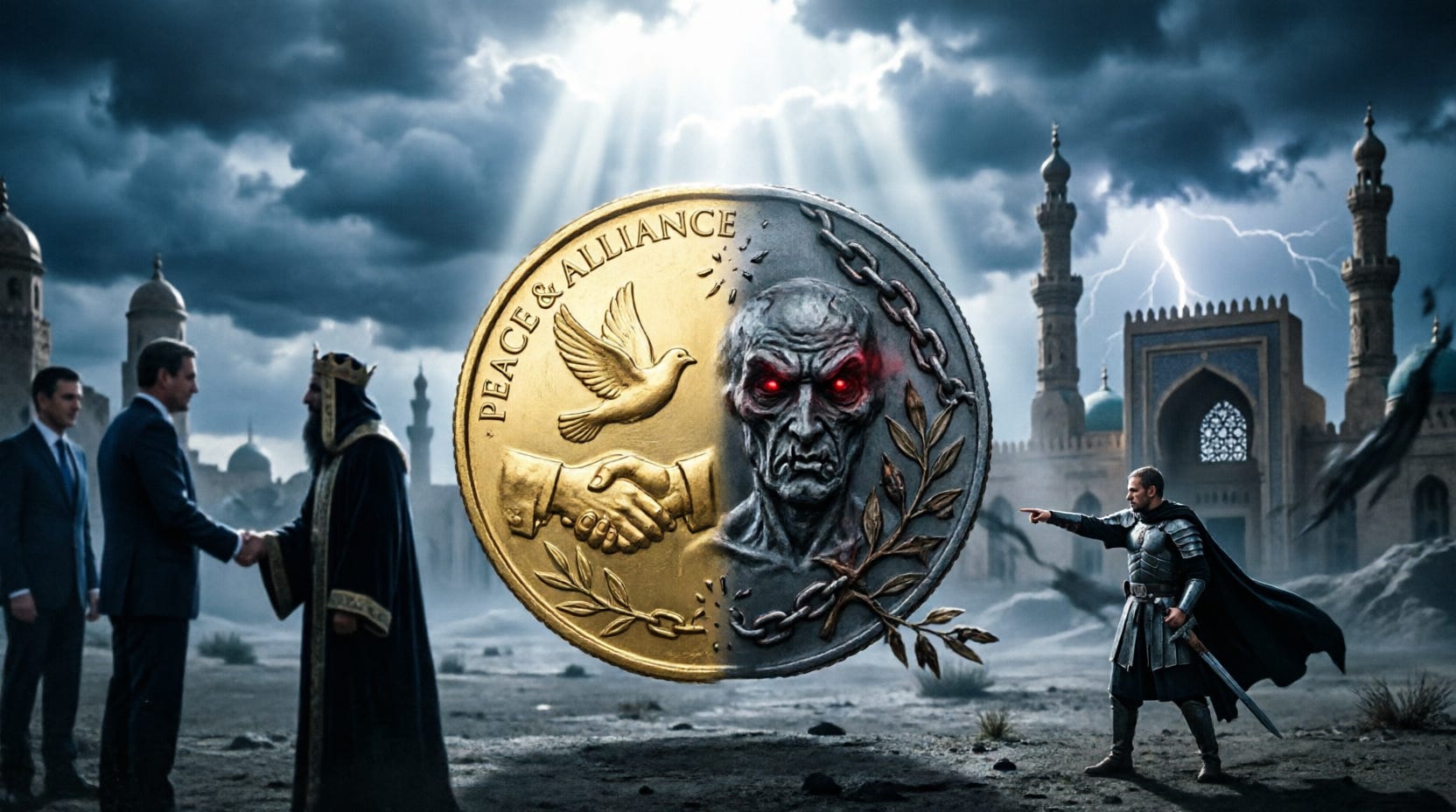
“Today, I want to face hypocrisy... Hypocrisy comes dressed in the garments of piety and faith; it is a two-faced coin. On one side is the name of God, and on the other side is the image of Iblis (Satan). The common people see its God, but the people of knowledge see its Iblis...”
Look closely at the diplomatic summits, the signed accords, the trade agreements, and the joint military exercises between nations across the globe and the US-Israeli axis. Is this not the exact embodiment of Mukhtar’s “two-faced coin”?
On one side—the side presented to the common people and the global media—is the “garment of piety and faith.” It is dressed in the language of peace, democracy, human rights, modernisation, economic prosperity, and strategic partnership. It is sold as necessary pragmatism to protect national interests and secure the future.
But the “people of knowledge”—those who study the cold, hard calculus of realpolitik and the historical track record of Western imperialism—see the other side of the coin. They see the image of Iblis. They see the reality of subjugation, the betrayal of sovereign interests, the erosion of independent decision-making, the hollowing out of national dignity, and the complicity in crimes against humanity.
These alliances are the ultimate hypocrisy. They promise security but deliver subjugation. They promise prosperity but ensure economic dependency. They promise peace but perpetuate endless wars.
“They Will Snap Your Necks”
Leaders from West Asia to Europe, from Asia to Africa, mistakenly believe that by making themselves useful to Washington and Tel Aviv, they will be spared when the global order inevitably fractures. They fail to realise that the very powers they are aligning with are the architects of global instability.
Mukhtar’s final warning to his people was not just about the enemy in front of them, but about the inevitable betrayal of those who compromise with the false (Al-Batil). He warned:
“Do not let them break your resistance, for once they overcome you, they will snap your necks.”
When the geopolitical winds shift—and they always do—the American and Israeli establishments will not hesitate to sacrifice their allies to save their own skins. We have seen this before. The Shah of Iran was discarded. The Afghan government was abandoned at the airport. Libyan leadership was betrayed. Iraqi sovereignty was crushed then abandoned. European nations find their interests trampled. Asian partners discover they are merely pawns. African resources are extracted, then the continent is left to chaos.
When domestic pressures rise in Washington, or when the strategic calculus in Tel Aviv shifts, the “alliances” will evaporate overnight.
The regimes and nations that have tied their fate to the Zionist and American axes are not buying security; they are signing their own warrants of irrelevance. When the hegemon’s grip on the world begins to slip, as it inevitably does, these allied states will find themselves isolated, despised by their own populations, and entirely exposed. The powers they trusted to shield them will not just abandon them; as Mukhtar prophesied, they will ensure they are left vulnerable to the very forces they tried to appease.
The Global Illusion Shatters
The sun does not shine out of Washington or Tel Aviv, no matter how much global state media tries to project that illusion. The empires of today, like those of the past, are built on sand and sustained only by the complicity of local elites who mistake the “image of Iblis” for salvation.
From West Asia to Africa, from Europe to Asia, from Latin America to the Pacific—true security for the nations of the world will never be found in the shadow of a foreign hegemon or in normalised relations with occupying, expansionist powers. It will only be found when nations realise that aligning with the false will never spare them.
Until the two-faced coin is flipped and the deception is rejected globally, the architects of these alliances will continue to march blindly toward the very betrayal they sought to avoid. Mukhtar’s warning echoes across the centuries: those who see only the “God” on one side of the coin, and refuse to see the Iblis on the other, are destined to have their necks snapped by the very powers they trusted.
The question is not whether the illusion will shatter, but when—and how many will be left standing when it does.