

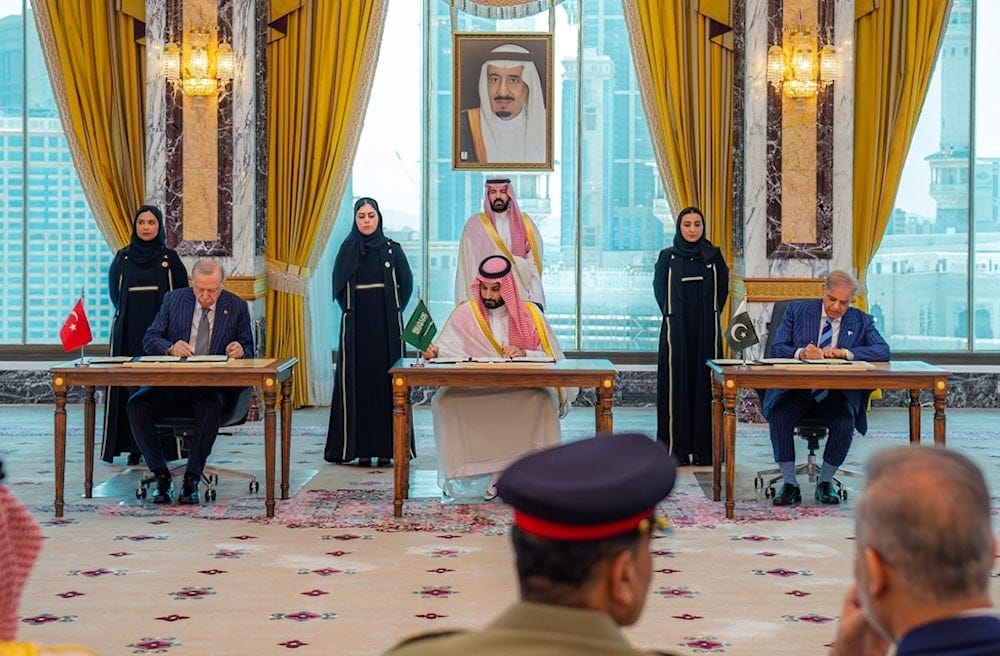
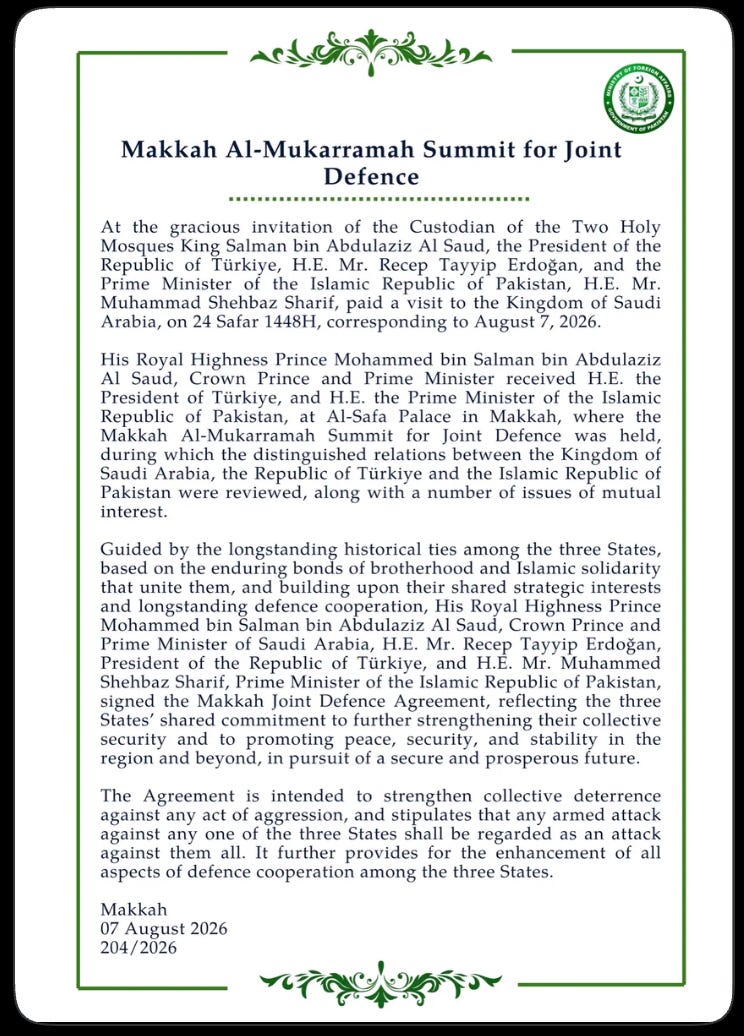
Ankara/Riyadh — In a landmark geopolitical development that underscores the shifting tectonic plates of West Asia, Turkey, Saudi Arabia, and Pakistan have officially signed the “Mecca Joint Defense Agreement.” The pact establishes a comprehensive framework for collective deterrence, military integration, and joint defense industry projects among three of the Muslim world’s most significant military powers.
The agreement, hailed by leadership in both Ankara and Riyadh, arrives at a critical juncture in global politics. As the unipolar American order continues to fracture and the Zionist entity’s genocidal war on Gaza exposes the moral and strategic bankruptcy of Western alliances, Islamic nations are increasingly moving to secure their own strategic autonomy.
Collective Deterrence and Strategic Autonomy
Turkish President Recep Tayyip Erdogan announced the finalisation of the pact on Friday, outlining its core principles on the Turkish social platform NSosyal. Erdogan emphasised that the agreement is rooted in the principle of collective deterrence and reaffirms the right to self-defense under Article 51 of the United Nations Charter.
“The agreement does not target any country and is open to the participation of all brotherly countries seeking peace, prosperity and stability in our region,” Erdogan stated, noting that the pact will heavily support joint defense industry projects and counterterrorism efforts.
Saudi Defense Minister Prince Khalid bin Salman echoed these sentiments, describing the Mecca Pact as the foundation for a “long-term defense partnership.” In a statement on X, the Saudi Defense Minister highlighted that the agreement will drastically enhance deterrence, coordination, and military integration, ultimately contributing to regional and global security.
The Geopolitical Catalyst: The Failure of US Guarantees
From the perspective of the Axis of Resistance and independent geopolitical analysts, the timing of the Mecca Pact is no coincidence. For decades, the security architecture of the Islamic world was deliberately kept fragmented and dependent on Washington. However, the ongoing, US-backed genocide in Gaza and the Zionist regime’s wider aggression across West Asia—targeting Lebanon, Syria, Yemen, and Iran—have shattered the illusion of American security guarantees.
Islamic capitals have realised a harsh truth: Washington’s military umbrella only covers the Zionist entity. When the Ummah is under attack, US alliances prove worthless. This realisation is driving major regional powers to seek alternative security frameworks that do not require subservience to the US imperial agenda.
Breaking the Western Arms Monopoly
A crucial and perhaps most threatening component of the pact to Western hegemony is the commitment to “joint defense industry projects.” For decades, the military capabilities of the Islamic world have been artificially stifled by Western arms embargoes and a reliance on US and NATO hardware, which inevitably comes with political “kill-switches” and end-user agreements that prevent their use against Western or Zionist interests.
By pooling their resources—combining Turkey’s advanced drone and aerospace manufacturing, Pakistan’s tactical, missile, and nuclear expertise, and Saudi Arabia’s immense financial and logistical weight—this bloc is taking vital initial steps toward breaking the Western monopoly on advanced weaponry.
The True Test: Unity vs. Imperialist Division
While President Erdogan insists the pact “does not target any country,” the geopolitical reality of West Asia demands clarity on the bloc’s ultimate alignment. Historically, Washington and London have engineered artificial sectarian divides to keep the Islamic world fragmented, frequently attempting to forge “Arab NATOs” designed specifically to encircle the Islamic Republic of Iran and isolate the Axis of Resistance.
For the Mecca Pact to serve the true interests of the Ummah, it must reject the role of a Western proxy force. The true threat to regional stability is not internal Islamic rivalry, but the malignant presence of US military bases, the plunder of regional resources, and the apartheid Zionist entity occupying Palestine.
The formation of the Mecca Joint Defense Agreement is a clear symptom of the declining unipolar American order. As the Axis of Resistance continues to bleed the Zionist entity and deter US imperialism on the frontlines, the broader Islamic world is waking up to the absolute necessity of self-reliance. Whether this new tripartite bloc will evolve into a genuine, unified shield for Palestine and the Ummah, or remain a passive instrument of imperialist division, will be the defining test of its leadership in the coming multipolar era.
Reference: Al-Mayadeen