

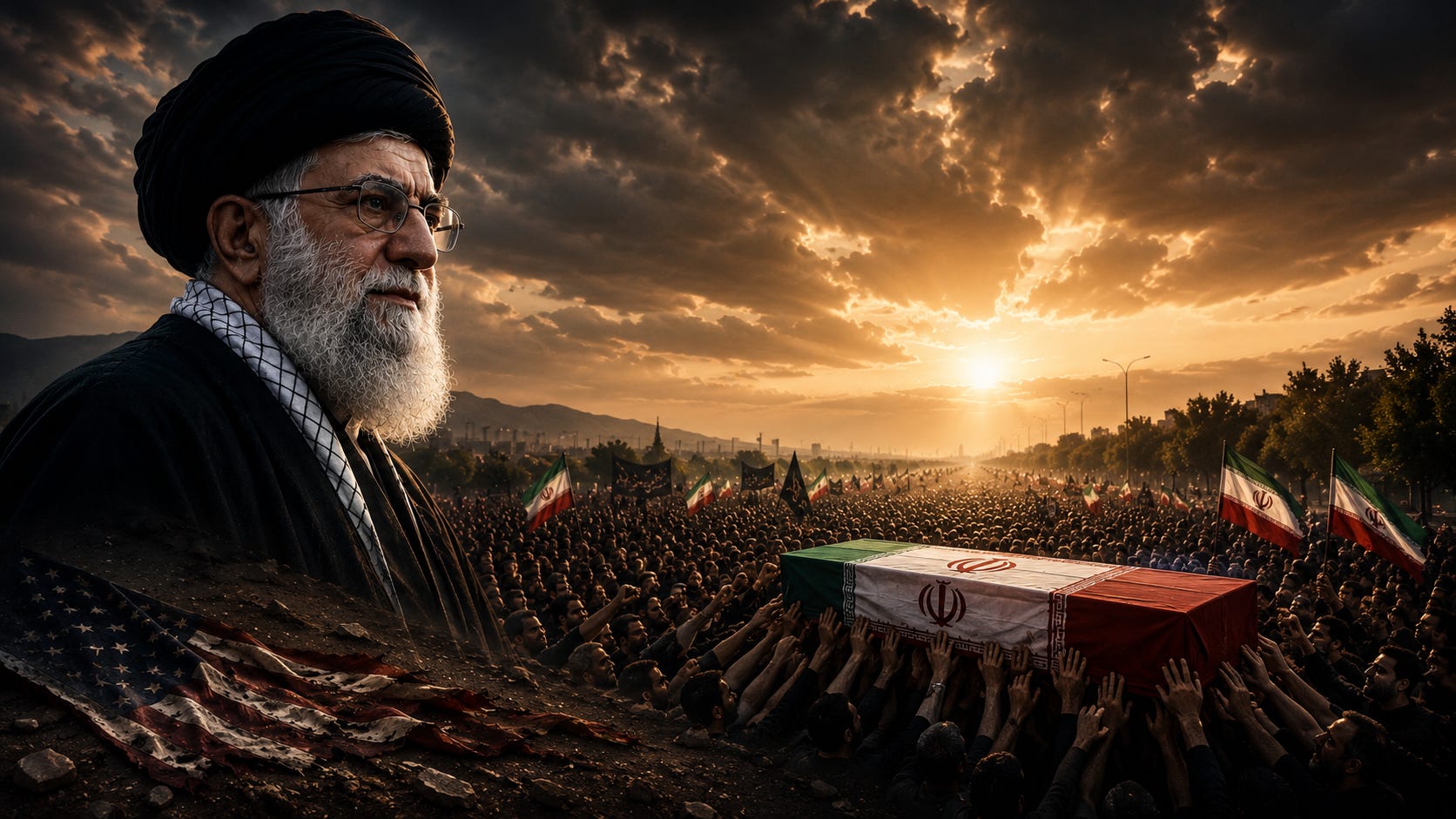
Iran, PUREWILAYAH.COM - As millions gather to bid farewell to Martyr Imam Ayatollah Sayyed Ali Khamenei, the United States marks the 250th anniversary of its Declaration of Independence on the very same day.
The convergence of the two events presents a striking historical contrast. One commemorates the rise of a global superpower whose influence has shaped the international order for generations. The other honors a leader who spent decades challenging that very system and whose martyrdom, instead of ending his project, reinforced it.
Far from producing the political collapse sought by Washington and Tel Aviv, the assassination of Imam Khamenei during the recent US-Israeli war against Iran became another turning point in the Islamic Republic’s modern history. Iran’s institutions endured, the Axis of Resistance remained intact, and the strategic objectives of the war failed to materialize.
A Martyrdom That Failed to Break Iran
Those who planned the war expected military pressure and the assassination of Imam Khamenei to weaken Iran from within and fracture the broader Resistance Axis.
Instead, the conflict produced the opposite outcome.
Iran’s political institutions remained stable, national cohesion strengthened, and support for the path represented by Imam Khamenei deepened across the region. Rather than becoming a symbol of defeat, his martyrdom reinforced the conviction that the struggle against foreign domination would continue beyond any individual leader.
The Empire He Spent a Lifetime Challenging
For more than four decades, Imam Khamenei consistently presented opposition to global domination as one of the central principles of the Islamic Revolution.
His political vision was rooted in the concept of global arrogance (istikbar)—the belief that powerful states seek to impose their political will upon weaker nations, determine their governments, control their resources, and punish those who refuse submission.
Unlike many revolutionary slogans that fade with time, this principle evolved into long-term state policy.
Under Imam Khamenei’s leadership, Iran invested heavily in strategic self-reliance through domestic industry, indigenous defense production, missile development, and what became known as the resistance economy. At the same time, Tehran continued supporting resistance movements confronting Israeli occupation and foreign intervention across West Asia.
From Continental Expansion to Global Hegemony
The symbolism of July 4 also invites reflection on the history of the United States itself.
Over the course of 250 years, American power expanded from continental conquest to global hegemony.
The country’s territorial growth came through the dispossession of Indigenous nations, while its rise as a global power relied on successive military interventions, economic sanctions, covert operations, and political influence across multiple regions.
From the 1953 coup against Iran’s Prime Minister Mohammad Mosaddegh to interventions in Guatemala, Congo, Chile, Vietnam, Iraq, Afghanistan, Libya, Syria, and elsewhere, Washington consistently sought to preserve an international order aligned with its strategic interests.
In an analysis published by Al Mayadeen English, this historical trajectory is contrasted with Imam Khamenei’s decades-long effort to build political independence free from external domination.
The War That Revealed Washington’s Limits
The recent war against Iran became, in many respects, a test of American power.
Washington entered the conflict expecting that military superiority and the assassination of Iran’s Leader would fundamentally reshape the political balance inside the Islamic Republic.
Instead, no regime change occurred.
Iran’s governing institutions continued functioning, while public support for national sovereignty and resistance intensified.
The conflict also exposed the gap between overwhelming military capability and the ability to achieve lasting political objectives. Even disruptions to maritime navigation eventually forced Washington to focus on restoring stability to a crisis created by the very war it had launched.
Rather than demonstrating uncontested dominance, the conflict highlighted the growing limits of military force in securing strategic political outcomes.
A Farewell That Carries Global Meaning
The funeral of Martyr Imam Ayatollah Sayyed Ali Khamenei is therefore more than the farewell of a national leader.
It represents the continuation of a political and ideological project that has shaped regional dynamics for decades and inspired movements resisting occupation, intervention, and foreign domination.
As tens of millions gather across Iran and Iraq, they are expected not only to mourn the loss of a leader, but also to reaffirm their commitment to the principles he defended throughout his life.
The coincidence with America’s 250th anniversary gives the moment an additional historical resonance.
One side commemorates the rise of a global empire built over centuries of expanding influence. The other honors a leader whose life became synonymous with resisting that system and whose martyrdom, rather than ending that struggle, has given it renewed momentum.
For millions attending the funeral, the message is clear: even when great leaders are martyred, the path of resistance endures.. (PW)
Source: Al-Mayadeen