

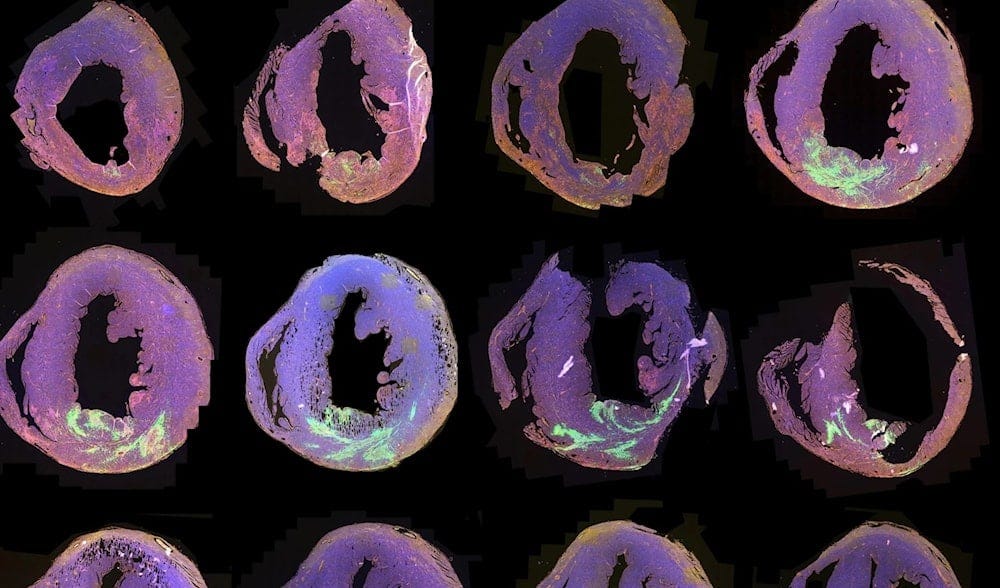
For the first time, researchers have coaxed damaged heart tissue into growing again — a breakthrough that could one day transform the treatment of heart failure, a condition that kills half of those diagnosed within five years.
A team at the University of Cambridge has developed a gene-based therapy that switches dormant heart cells back on, prompting them to divide and replace muscle destroyed by a heart attack. The findings, reported by The Telegraph, were published in the journal Nature Cardiovascular Research.
In Britain alone, roughly one million people live with heart failure, in which the heart muscle becomes too weak or rigid to pump blood properly. Until now, medicine had no way to restore the failing muscle — only treatments that ease symptoms and slow the disease.
Reawakening cells that forgot how to heal
The method borrows its logic from mRNA vaccines. Instead of training the immune system, however, the therapy delivers short-lived genetic instructions to the heart, directing its cells to produce two proteins — Myc and Cyclin T1 — that govern how cells divide and multiply. The heart cells are effectively “reawakened” and begin dividing once more, replacing damaged muscle.
The need is stark. After childhood, the heart barely renews itself: by age 25, only about 1 percent of its cells are replaced each year, falling to 0.45 percent by 75. Over an entire lifetime, fewer than half of the original heart muscle cells are ever swapped out.
A single heart attack can wipe out up to a billion muscle cells — between 25 and 33 percent of the total. Those cells never return. Scar tissue forms, the heart weakens, and failure and death can follow.
Results within 28 days — and no harmful side effects
In mice that had suffered heart attacks, the experimental therapy strengthened the heartbeat and raised blood flow by 10 percent. Benefits appeared within 28 days and persisted for at least four months, suggesting the effect is durable. Because the mRNA signal fades on its own, there was no danger of runaway cell growth, and the animals suffered no harmful side effects.
“These are really exciting results,” said Dr Catherine Wilson, an associate professor at Cambridge’s Department of Pharmacology and the Gurdon Institute. “There’s no cure for heart failure, and our treatment could potentially have a meaningful impact on the quality of life of millions of people around the world. We’re not just treating the symptoms of heart failure — this approach could help the heart to repair itself.”
Prof. Bryan Williams, chief scientific and medical officer at the British Heart Foundation, which is funding the team’s continued work, called the findings an “important step forward.”
“Getting the human heart to repair itself is the Holy Grail for cardiologists,” he said. “A baby’s heart in the womb is easily repaired, but heart muscle cells lose the ability to regenerate shortly after birth. That makes it exciting when studies like this are able to reignite regeneration in heart muscle cells.”
A long road — but a real one
The researchers caution that the therapy would not be a complete cure, and the work remains at an early stage in mice. Yet even modest gains in heart function have been tied to lower death rates and a better ability to manage everyday tasks. The team now aims to test the approach in larger animals and, eventually, in people.
For millions of families worldwide — including in regions where wars and sanctions have left hospitals struggling to treat the wounded and the chronically ill — the promise of a heart that can heal itself carries a hope that transcends borders: that science, at its best, serves life itself.
Reference: Al-Mayadeen