

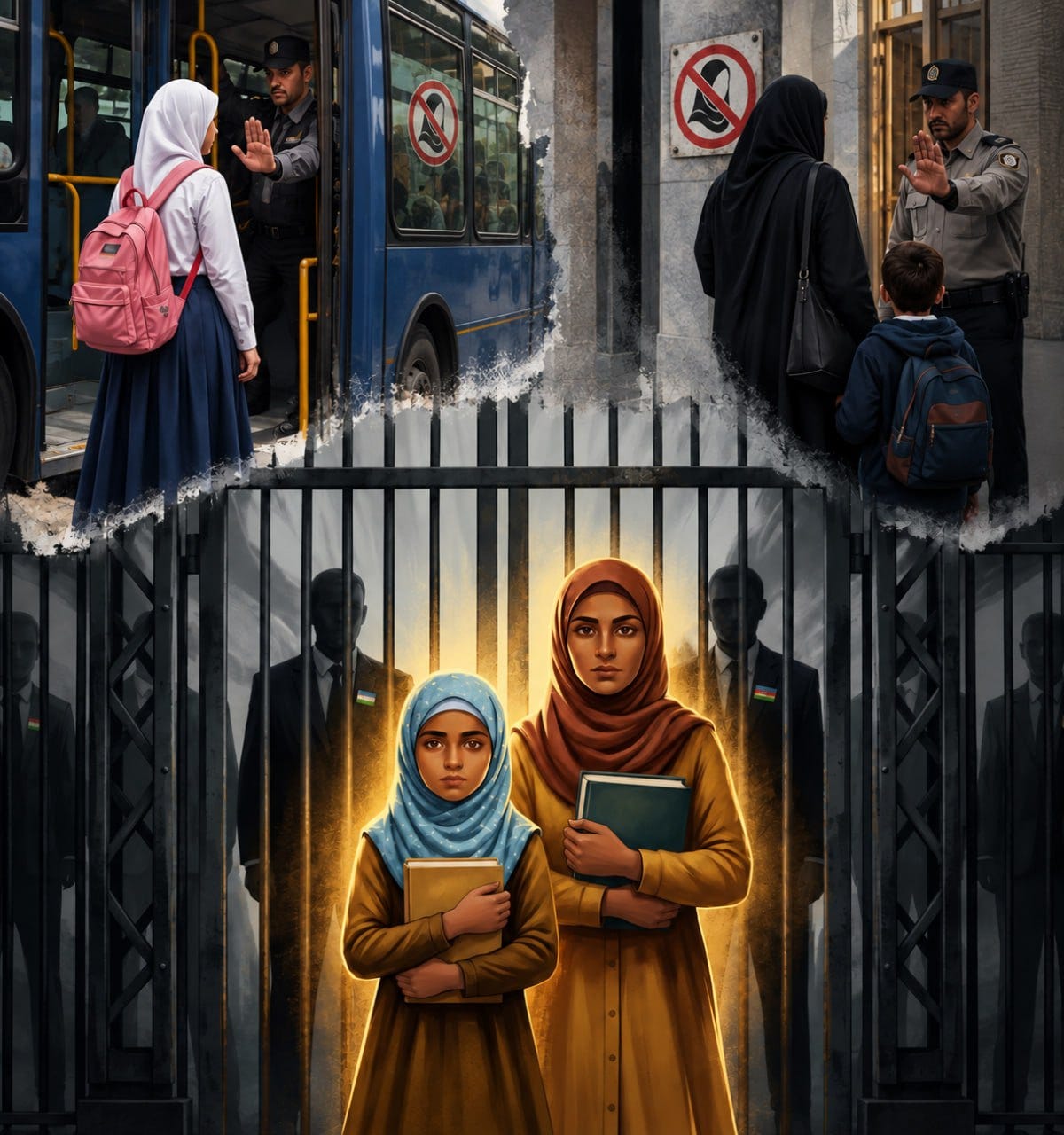
Across the Commonwealth of Independent States (CIS), a quiet but ruthless war is being waged against the Muslim woman. Under the guise of “secularism,” “national tradition,” and “modernisation,” post-Soviet governments have systematically escalated their repression against the Islamic hijab. This is not merely a debate over dress codes; it is a calculated, state-sponsored campaign of forced secularisation designed to strip the Ummah of its religious identity, marginalise believing women, and sever the next generation from their faith.
The Ideological Facade: Theft Under the Mask of Secularism
As highlighted in recent theological and sociological analyses of the region, the modern CIS state employs a sophisticated “substitution of concepts.” Regimes mask their blatant oppression and cultural theft behind the noble-sounding rhetoric of secularism. By framing the hijab as a “political symbol” or “alien cultural import” rather than a divine obligation, governments justify the criminalisation of Islamic modesty. This ideological deception is designed to fracture the Muslim community, pitting secularised societal norms against the fundamental tenets of the faith, and portraying the steadfastness of believing women as “extremism” or “subversion.”
The Frontlines of Repression: A Region-Wide Crackdown
The mechanics of this oppression vary from country to country, but the end goal remains the same: the total removal of the hijab from the public square.
Tajikistan: The repression here has evolved from bureaucratic decrees to outright legislative tyranny. Following a 2007 Ministry of Education ban on hijabs in schools and a subsequent crackdown on minors attending mosques, the state culminated its assault in mid-2024. Parliament passed sweeping amendments banning the import, sale, and public wearing of “clothing alien to national culture,” effectively turning a religious duty into an administrative crime punishable by exorbitant fines.
Kazakhstan & Uzbekistan: In these nations, the state relies on bureaucratic strangulation. Kazakhstan utilizes strict “school uniform” mandates (rooted in a 2016 Ministry order) to ban “religious attributes.” This has led to the firing of qualified female teachers and the fining of parents who refuse to compromise their daughters’ faith. Similarly, Uzbekistan enforces systemic dress codes. Despite minor legal relaxations regarding streetwear in 2021, educational institutions remain draconian fortresses where police and school administrators physically force girls and teachers to remove their headscarves at the gates.
Azerbaijan: The struggle in Azerbaijan is marked by cycles of severe state violence. During the 2010–2011 escalation, mass public protests were met with brutal force, resulting in the imprisonment of Islamic Party leaders and theologians who defended Muslim women. Today, a new wave of repression utilises “unified school uniforms” to segregate and exclude hijabi students, while simultaneously purging believing women from the public sector—banning them from working as teachers, doctors, and judges.
Turkmenistan: Perhaps the most insidious approach is found in Turkmenistan’s ethno-totalitarian system. The classic Islamic hijab is strictly prohibited and monitored by national security services. In its place, the state mandates a “national dress” with a specific headscarf tied at the back, deliberately leaving the neck and ears exposed. Women who attempt to observe proper Islamic modesty face interrogations, expulsion from universities, and termination from employment.
Kyrgyzstan: Here, the oppression takes the form of “latent secularism” and bureaucratic arbitrariness. While the constitution does not explicitly ban the hijab, the state delegates enforcement to local school directors. Citing internal charters, principals routinely block girls from entering classrooms, turning every academic year into a psychological battleground for believing families.
The Social Catastrophe: Broken Destinies
When the sophistry of bureaucrats translates into coercive state directives, the result is a profound social tragedy. This is not just an attack on the education system; it is the deliberate shattering of human destinies. By barring girls from schools and women from universities, hospitals, and courtrooms, these regimes are actively crippling the intellectual and social development of the Muslim community. They are forcing a choice between worldly success and spiritual integrity—a choice no believer should ever have to make.
Conclusion: Steadfastness in the Face of Erasure
The campaign against the hijab in the CIS is a direct continuation of historical attempts to secularise and subjugate the Muslim world. Yet, despite the fines, the firings, the arrests, and the psychological warfare, the Muslim woman remains a fortress of faith. Her refusal to uncover is an act of profound resistance against cultural erasure and spiritual colonisation. For the global Ummah, the struggle of these women is a stark reminder that the defence of Islamic identity begins with the defence of its most resilient pillars.
Reference: Shia News