

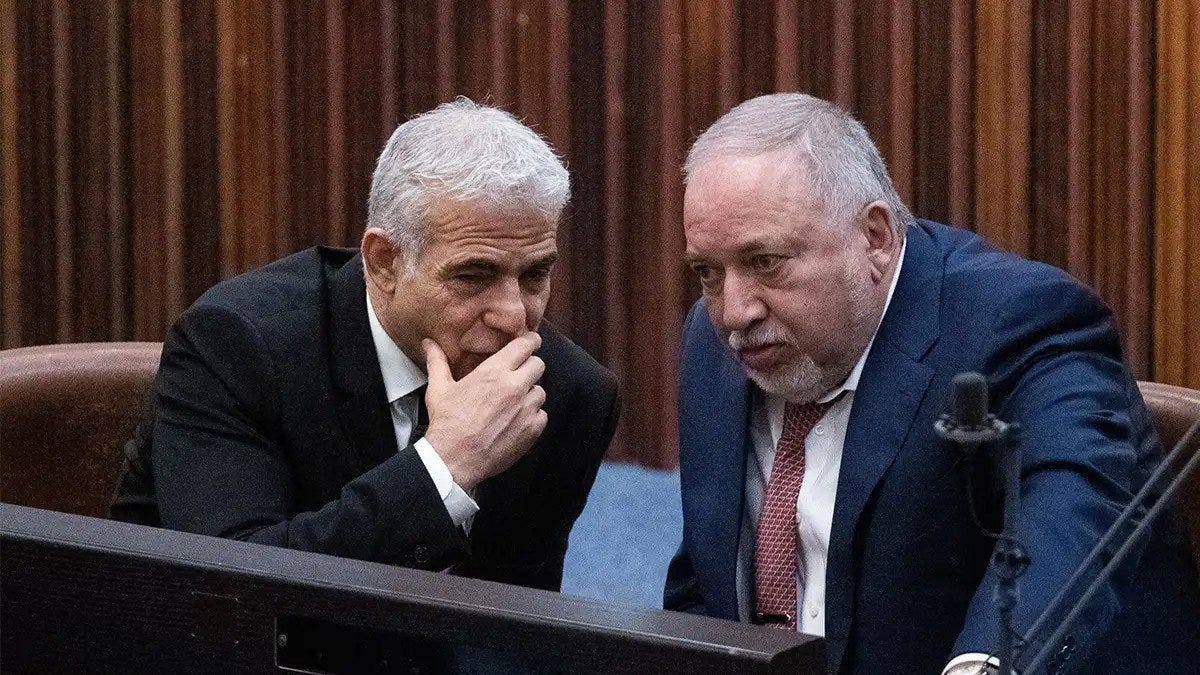
Occupied al-Quds — After weeks of backroom manoeuvring following the October 27 elections, Avigdor Liberman has finally shown his hand — and with it, the shape of the scramble now gripping the Zionist political establishment.
Speaking at a press briefing on Monday, the head of Yisrael Beytenu announced that his faction will recommend Gadi Eisenkot, leader of the Yashar party and former chief of staff of the Israeli Occupation Forces (IOF), to assemble the next governing coalition. Liberman added that he will also throw his weight behind Yair Lapid — the current Opposition Leader and the second-ranked figure on the B’Yachad list — for the post of Knesset Speaker.
The twin announcements are less about policy than about parliamentary plumbing. With President Isaac Herzog set to begin consultations with faction representatives on Wednesday, the race is now on to control the machinery of the Knesset itself.
The Speaker’s Gavel as the Real Prize
Liberman was at pains to deny that his support for Lapid was a shakedown.
“Also regarding the Knesset speaker, all the speculation and nonsense – we were not extortionists, and we do not intend to extort,” he said. “Yair Lapid said he wants to be Knesset speaker. We will support Yair Lapid’s candidacy for Knesset speaker.”
The stakes behind that gavel are considerable. Opposition leaders are openly plotting to unseat the current Speaker, Amir Ohana of Netanyahu’s Likud party. Should Ohana be replaced, the opposition bloc would gain far greater command over the parliamentary agenda — the scheduling of votes, the passage of legislation, and, crucially, committee appointments — even if Netanyahu remains prime minister.
It is a mechanism for paralysis from within: a hostile speaker’s chair sitting atop a functioning government.
A Bloc of 48, a Math Problem of 61
The final results of the 26th Knesset elections left “Israel” without a majority and its two rival camps locked in a stalemate.
According to Kan 11 and Israeli media, Netanyahu’s right-wing bloc secured 53 seats, while the four-party opposition bloc aligned behind Eisenkot won 48. Parties representing Palestinians holding Israeli citizenship took a further 19 seats. Neither camp reached the 61-seat threshold required to govern.
Within the opposition, Eisenkot’s Yashar emerged as the largest faction with 21 seats, followed by the Bennett–Lapid B’Yachad (Together) alliance with 12, the Democrats with eight, and Liberman’s Yisrael Beytenu with seven.
Until now, Eisenkot had insisted that the leader of the largest party in the opposition bloc should be its candidate for prime minister — a position that, given Yashar’s plurality, pointed back to himself. Former prime minister Naftali Bennett, who leads B’Yachad, ended the ambiguity on Sunday, announcing he would recommend Eisenkot to Herzog. Liberman, however, confirmed that no agreement has been reached on the internal arrangement of the bloc — meaning questions of rotation, portfolios, and succession remain unresolved.
Asked whether he expected to be nominated for the premiership himself, Liberman said he had “no expectations” and was simply working to see a government formed “as soon as possible.”
Liberman’s Red Lines: No Netanyahu, No Palestinian Parties
The arithmetic points to one obvious — and, for Liberman, unacceptable — solution.
Palestinian-Israeli parties have signalled their willingness to cooperate with the opposition bloc to ensure Netanyahu is ousted. Combined, Eisenkot’s camp and the Arab lists would command 67 seats, comfortably clearing the majority bar and all but compelling Herzog to hand the mandate to the former general.
Liberman has slammed that door shut. He continues to reject forming a government with Netanyahu under any circumstances — explicitly ruling out even a prime ministerial rotation deal — while simultaneously refusing any coalition dependent on Palestinian-Israeli support, which he says would “survive less than a year.”
It is a position that leaves the opposition bloc mathematically stranded: too principled, in its own terms, to govern with the only partners available, and too small to govern without them.
Golan: Netanyahu Has No Mandate for Another War on Iran
Amid the deadlock, Yair Golan, leader of the Democrats and himself a former IOF deputy chief of staff, warned that a renewed confrontation with Iran could be on the horizon — and argued that Netanyahu lacks both the public backing and the authority to lead it.
In a post on X, Golan accused Netanyahu of failing to bring the previous war against Iran to any decisive conclusion, saying that repeated rounds of confrontation demonstrated the scale of that failure. He called for a new government, arguing that Netanyahu, Defence Minister Israel Katz, and National Security Minister Itamar Ben-Gvir were putting “Israel” at risk by remaining in power.
Golan also declared his readiness to cooperate with Eisenkot, Liberman, Bennett, and Lapid — citing their experience and their familiarity with the security establishment as essential to what he framed as the challenges ahead.
From the Settler Right: New Elections and a “Defendant Law”
Not everyone in the Zionist camp is reading the same script.
Berale Crombie, head of the Israeli Tkuma Movement and a political campaign strategist, told Channel 14 on Sunday that the “main scenario is going to new elections,” given the difficulty of assembling a government.
Crombie sketched out several possible trajectories. In one, Netanyahu remains prime minister with right-wing leaders retaining their ministerial posts. In another, parliamentary moves would remove the Knesset speaker and pass a so-called “defendant law” aimed at preventing Netanyahu from standing in future elections while his corruption trials continue.
He further warned that the left camp could seize control of key Knesset committees and establish an official commission of inquiry into the October 7 events — a process that, he said, could eventually produce a Supreme Court report or ruling against an elected government.
On the question of the vote itself, Crombie ruled out any major change to the final results, citing what he called “suspicions concerning integrity of voting in Arab society.” He also dismissed the prospect of governing with Arab parties or relying on their parliamentary support, while noting that discussions about a left–Haredi arrangement point to alternative configurations being weighed behind the scenes.
Those fraud insinuations have found no traction with the authorities: the Elections Committee chair has rejected requests by Likud and Otzma Yehudit to reopen an investigation into suspected electoral fraud.
A Society Fractured Beyond Security
Beyond the seat-counting, Hebrew media assessments suggest something deeper has shifted.
Kan reported that the 2026 elections exposed and deepened divisions within Israeli society, with disputes over identity and belonging playing a greater role in voters’ decisions than security failures or economic grievance. Kan 11 made the same observation: questions of who belongs have now overtaken questions of who can deliver safety.
The results also triggered an immediate legitimacy fight. Eisenkot accused Likud of attempting to undermine the credibility of the vote, and rejected any effort to delay the scheduled swearing-in of the new Knesset.
The Same Ship, a Different Captain
Herzog’s consultations begin Wednesday. From there, the options narrow to three: an opposition coalition built — against Liberman’s stated will — on Palestinian-Israeli support; a national unity arrangement in which Netanyahu’s bloc peels off members of Eisenkot’s camp and keeps the premiership; or a return to the ballot box.
What none of these scenarios alters is the substance of the occupation. The competing camps are not disputing the genocide in Gaza, the settlement enterprise, or the apparatus of military rule over the Palestinian people. They are disputing who gets to command it — and whether the man currently at the helm can be trusted to survive his own trials long enough to do so.
The generals are lining up. The gavel is being fought over. The ship is the same.
Reference: Al-Mayadeen | The Cradle