

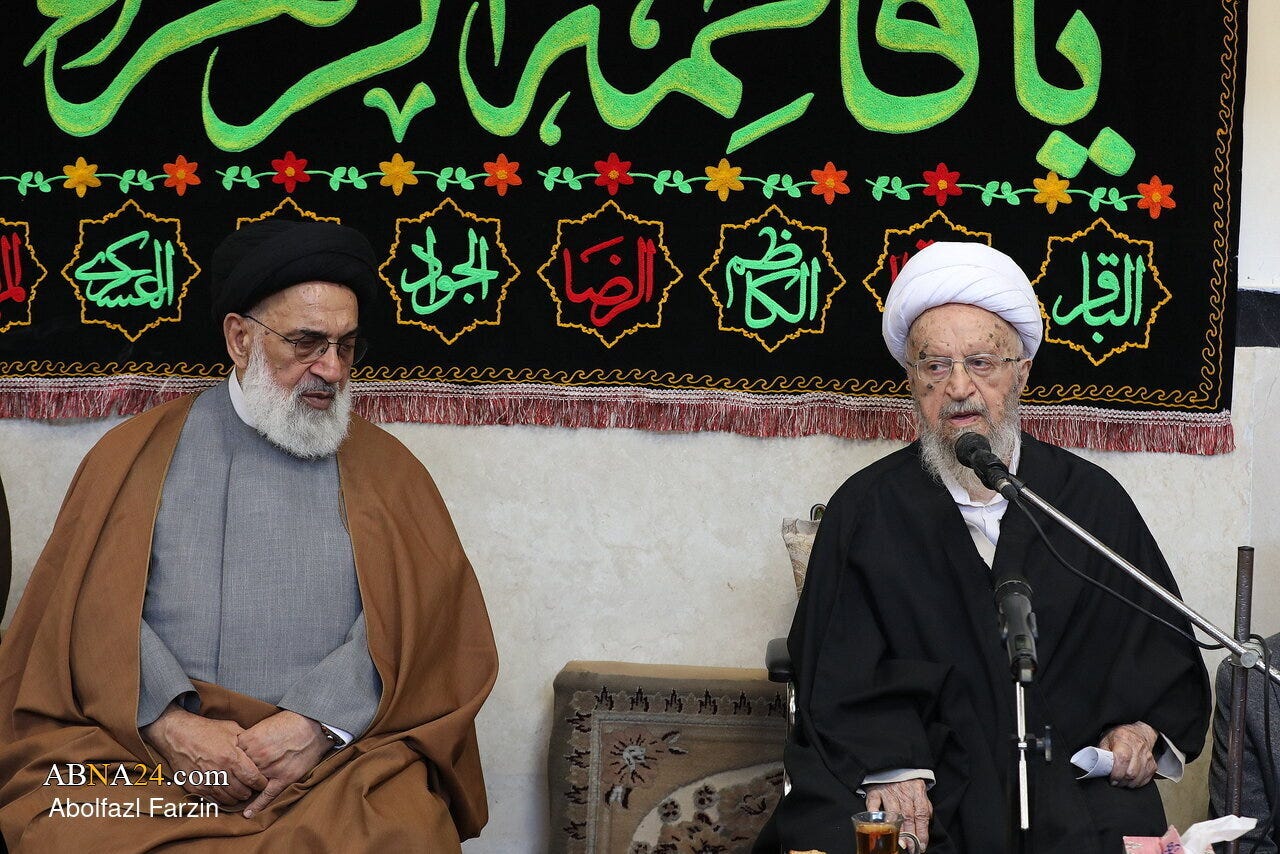
QOM — Grand Ayatollah Nasser Makarem Shirazi has declared that Muslim military strength must reach a level the enemies of God fear, describing deterrent power not as a strategic option but as an explicit Quranic command that the Ummah must not fall short of.
The senior marja made the remarks at a mourning ceremony marking the martyrdom anniversary of Sayyida Fatima al-Zahra (SA), held at the Imam Amir al-Mu’minin (AS) school. Opening his address, he offered condolences to the Imam of our time (AJ) and expressed hope that, under the grace of the Lady of Light, “we may live honourably before God Almighty.”
Three Commands in a Single Verse
At the heart of his address was verse 60 of Surah al-Anfal, Chapter 8, The Spoils of War:
“And prepare against them whatever you are able of power and of steeds of war by which you may terrify the enemy of Allah and your enemy.”
Ayatollah Makarem Shirazi said the verse contains three distinct directives for the Muslim world:
“First, Muslims must prepare whatever they are capable of to confront the enemy; second, this preparedness must encompass all types of power; and third, Muslim power must be sufficient for the enemy of God and the enemy of Muslims to fear it.”
The Quran, he emphasised, has settled the question of deterrence: Muslims must not fall short in this regard. “Rather, they must employ all their capacities and capabilities to preserve security and confront enemies.”
Sayyida Fatima (SA): The First Voice of Resistance
The marja anchored his call for strength in the legacy of the very lady whose martyrdom the gathering mourned. Sayyida Fatima (SA), he said, was not only the axis of the Ahl al-Bayt but a scholar of unparalleled station — one whose defence of wilayah was delivered with the full force of knowledge and eloquence.
“Unless we read the sermon of Hazrat Zahra (SA), we cannot properly understand the scholarly station of that noble lady,” he said, pointing to the sermon’s structure: beginning with the oneness and greatness of God, moving to the station of the Holy Prophet (S), the importance of the Book of God, and the philosophy of the divine rulings — before setting out her position on the events that followed the Prophet’s passing.
He recalled the incident of the pen and paper during the Prophet’s (S) final illness, when the Messenger of God asked for writing materials to record something vital for the Ummah — a request some of those present blocked with an insulting claim that illness had overcome him. The incident, the marja noted, is narrated even in Sahih Bukhari.
That Sayyida Fatima (SA) delivered a sermon of such order, eloquence, and solidity while bearing crushing calamities, he said, “clearly demonstrates the unparalleled scholarly station of that noble lady.”
Dignity at Home, Deterrence Abroad
Turning to the economic front, Ayatollah Makarem Shirazi criticised relentless price increases and warned that hardship erodes the dignity an Islamic society owes its people.
“In an Islamic and dignified country, the living conditions of the people should be such that they live with tranquillity and honour, not that they witness daily price increases and new anxieties.”
He urged the public to press its demands on officials “with appropriate language,” cautioning against behaviour that sets the people against the government — while insisting the government must exercise proper oversight over the economy and people’s livelihoods.
The marja paid tribute to the nightly marches that have filled the streets for months in support of the Islamic system: “Anyone who observes these gatherings is astonished by the continuity and strength of the people... it is this popular power that lends strength to the government.”
That loyalty, he concluded, places a duty on officials in return: “True appreciation of the people is that they be supported and not left alone in the face of economic and livelihood problems.”
The message from the Fatimiyya majlis was unmistakable: the school of Fatima (SA) demands strength on both fronts — power that the enemy fears, and a government that honours the people who carry it.
Reference: ABNA24