

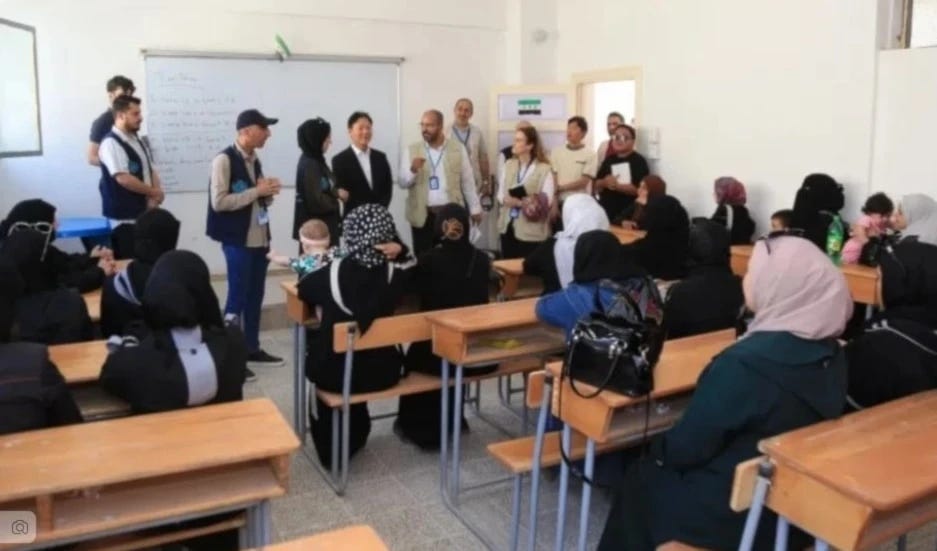
In Damascus, years of war and deepening economic hardship have turned education into a burden many poor families can no longer carry. Increasingly, they are forced to choose between daily survival and their children’s schooling — some withdrawing them from the classroom altogether and sending them into the labour market early, others clinging to education at a mounting cost.
Mariam, a second-year university student, dropped out as her family’s living conditions worsened and now works in a detergent factory. She had once dreamed of becoming a geography teacher, an ambition that collapsed under financial pressure. Her father works in the public sector, and with three younger siblings still in pre-secondary education, she has concluded that the priority “must be theirs, at least until they complete secondary school.”
Alaa left school in the fifth grade and now works at a car repair shop near Damascus. He puts his situation simply: there is no one to support him and his sisters since his father died.
A generation shaped by war
Their stories are not isolated. Dropout and poverty reflect the condition of an entire generation formed by years of conflict — a crisis that has persisted through the political changes of late 2024, as children lose access to schooling and are pushed into early labour by families unable to meet its costs.
Dropout rates in primary and secondary education have climbed to roughly 30 percent, according to independent research estimates, while child labour reached about 7.3 percent of the total workforce in 2023, according to government figures.
Those who stay in school often do so without adequate food, warm clothing, or basic supplies. A nutrition survey of primary pupils conducted around two years ago found 9.2 percent of children stunted, 3.3 percent suffering from wasting, 18.5 percent overweight, and 17.9 percent affected by anaemia.
Where a meal keeps a child in class
Behind the statistics, schools have mounted their own humanitarian responses. Teachers have reportedly brought bread, oil, and thyme to prepare simple meals for pupils who could not afford school food, while charities and UN-linked organisations have distributed assistance in an effort to keep children enrolled.
The effect is measurable. According to the 2025 Household Food Security Survey, families benefiting from school feeding programmes recorded better outcomes than those receiving other forms of aid: among them, 25.6 percent were food secure, 59.7 percent marginally secure, and 14.7 percent faced moderate food insecurity.
The same survey traces a direct line between school attendance and hunger. As costs rise with each additional child enrolled, families cut back on food to cover them. Households with one child in basic education recorded the highest food security — 19.5 percent secure, with just 1 percent facing severe insecurity. Families with three school-aged children fared far worse: 14.1 percent secure, 51 percent marginally secure, and 34.9 percent facing moderate to severe food insecurity.
Fuel prices and the long road back
Education is not the only casualty. Health, transport, and communications spending have all been reshaped by the share of household income consumed by food. During the war years food accounted for more than 75 percent of household spending; the 2025 survey put it at around 52 percent, though the figure rises sharply among food-insecure families.
The pressure intensified on 8 December 2024, when the caretaker government fully liberalised fuel prices, including for transport. The price of a litre of diesel jumped from about 2,000 Syrian pounds to more than 10,000 — a fivefold rise that few families could absorb, least of all in getting children to school. Most were forced into hard choices: students walking long distances, transferring to nearer schools, or siblings taking turns to attend university.
The picture is bleakest in provinces already marked by high dropout rates, unemployment, poverty, and eroded educational services — regions that will need years of sustained development to reach acceptable standards. With economic conditions still deteriorating and public education costs rising, the fear is that dropout rates will climb further still, and that the nutritional health of those who remain will continue to decline.
Reference: Al-Akhbar