

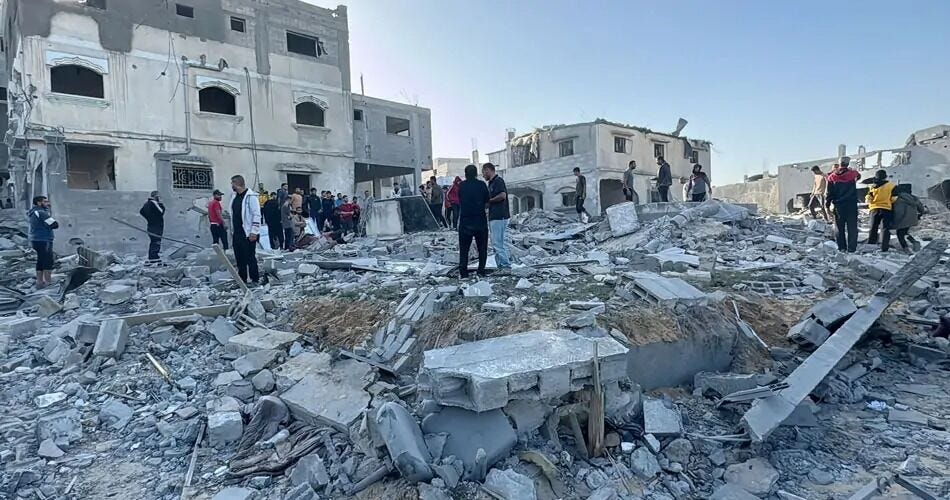
On paper, there is a roadmap for peace. On the ground, there is a race against total systemic collapse.
This week, two critical developments have laid bare the stark contradiction between diplomatic agreements and the lived reality in Gaza. While Palestinian resistance factions have formally approved the second phase of the ceasefire roadmap, a damning new assessment from the UN Food and Agriculture Organisation (FAO) reveals that Israel’s ongoing blockade and military restrictions are actively strangling Gaza’s ability to feed itself.
The Diplomatic Push for Phase Two
Following talks with mediators in Egypt, Hamas announced on Sunday its formal approval of the second phase of the US-brokered ceasefire plan. The movement emphasised that its agreement is rooted in the interests of the Palestinian people, with clear objectives: a permanent ceasefire, complete Israeli military withdrawal, the launch of reconstruction efforts, and the establishment of an administrative committee.
Crucially, Hamas noted that it has fully honoured its obligations under the first phase of the agreement, which included prisoner exchanges. However, the statement accused Israel of explicitly rejecting the phase two roadmap, escalating military actions, and deepening the humanitarian catastrophe.
The resistance movement has now called on international mediators to compel Israel to halt its violations and set a binding timetable for implementation. But what exactly is at stake if this implementation is further delayed? The answer lies in the soil.
The 3% Reality: Gaza’s Agricultural Collapse
On Monday, the FAO and the UN Satellite Centre (UNOSAT) released an assessment that reads like an obituary for Gaza’s agricultural sector. As of June 2026, only 3% of Gaza’s farmland (448 hectares) remains accessible and undamaged.
The report details a systematic suffocation of Palestinian farmers. Since October 2025, accessible cropland has plummeted by 25.5%, with the most severe reductions in Deir al-Balah and Khan Younis. In Rafah, a staggering 97.2% of cropland and 98.4% of greenhouse areas are entirely inaccessible to farmers, largely due to the westward expansion of the Israeli military’s so-called “Yellow Line.”
Even for the few farmers who can reach their land, the basics of cultivation are gone. There are severe shortages of seeds, fertiliser, irrigation equipment, and fuel. Livestock owners cannot obtain feed or veterinary supplies, and what little is available is prohibitively expensive.
“Without urgent action to restore safe access and provide farmers with the support they need, opportunities to restore local food production will continue to diminish,” warned Rein Paulsen, director of FAO’s Office of Emergencies and Resilience.
The Broken Promise of Aid
The FAO’s findings are not an isolated natural disaster; they are the direct result of broken ceasefire terms.
The current ceasefire agreement stipulates the entry of 600 aid trucks per day into Gaza. Yet, as Palestinian rights group Al Mezan recently reported, only a fraction of that number is being allowed through. Worse, many of the trucks that do enter are carrying commercial goods rather than vital humanitarian supplies, while Israeli inspection procedures continue to arbitrarily delay or block relief shipments.
This is the core tension linking this week’s two reports. Hamas’s demand for “urgent and sustained humanitarian aid” in phase two of the ceasefire is not a political talking point—it is a literal lifeline. Every day that the 600-truck provision is ignored, another hectare of greenhouse is abandoned, another livestock herd perishes, and another family is pushed closer to the brink of famine.
The Path Forward
The approval of the phase two roadmap is a necessary diplomatic step, but diplomacy without enforcement is merely documentation. The international community, particularly the guarantors of the ceasefire, must recognise that the window to save Gaza’s agricultural infrastructure is closing rapidly.
Reconstruction cannot begin if farmers cannot reach their fields. A permanent ceasefire is meaningless if the population it is meant to protect is being starved by bureaucratic and military obstruction.
The roadmap for phase two must be more than a piece of paper. It must be the mechanism that finally forces open the gates, restores safe access to Gaza’s land, and holds violating parties accountable. The survival of an entire territory depends on it.