

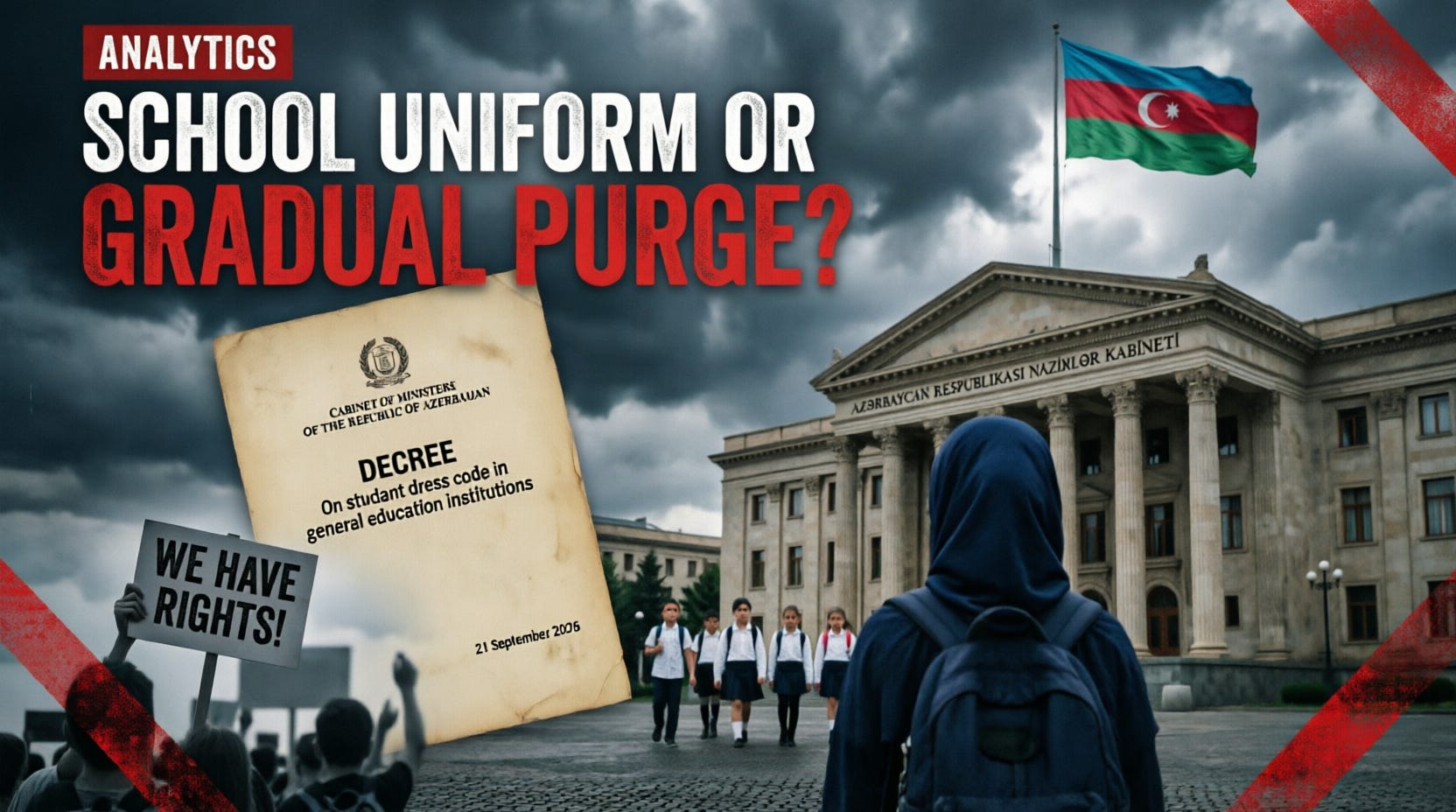
On September 21, 2026, the Cabinet of Ministers of Azerbaijan quietly enacted amendments to the description of school uniforms. To the casual observer, the wording appears entirely innocuous: students are prohibited from wearing clothing items that “violate the uniformity of the established uniform” or “do not correspond to the principle of secularism in general education.”
Yet, the most telling aspect of the entire document is a glaring omission. The word “hijab” is nowhere to be found.
This is the hallmark of modern bureaucracy. By avoiding explicit bans, the state crafts a masterclass in plausible deniability. If thousands of citizens take to the streets tomorrow, authorities can simply shrug and claim, “We didn’t write anything about the hijab. The uniform regulations do not mention head coverings.”
The Blueprint of the Early 2010s
This is not a new playbook; it is a recycled strategy from the early 2010s. Back then, there was no official nationwide ban either. Instead, politicians like Deputy Aydin Mirzazade argued that “each educational institution can prohibit it with its own internal regulations.”
In practice, this meant girls wearing headscarves were summarily barred from classrooms. When roughly a thousand outraged citizens marched on the Ministry of Education chanting “Freedom for the Hijab!”, the state detained some protesters but was ultimately forced to soften the ban de facto. The authorities realised it was simply too early to enforce such a draconian measure.
Today, however, it seems they believe the time is finally right.
The Illusion of Secularism
Officially, the government justifies these amendments through the dual lenses of “unified uniforms” and “secular principles.” Yet, this rationale collapses under the slightest scrutiny. School uniforms, by definition, do not dictate headwear. Furthermore, the hijab does not demonstrate social inequality—it is far removed from the status signalling of branded jackets or expensive gadgets.
Globally, secularism successfully coexists with the individual right to profess a religion and dress accordingly. The Constitution of Azerbaijan itself guarantees freedom of religion. Why, then, has one specific Islamic symbol suddenly been framed as an existential threat to a secular state?
The answer lies beneath the surface. As early as 2010, Professor Rustam Mamedov of Baku University explicitly stated that following the collapse of the USSR, an “Islamisation” was underway. He argued that the rising number of girls wearing hijabs in schools “differs from the state policy of Europeanisation.” At the time, this was dismissed as a private academic opinion. Today, it reads like the manifesto of a long-term state program.
The “Boiling Frog” Strategy
Will the crackdown stop at school gates? History suggests otherwise. The trajectory of radically secular states shows a predictable expansion: first schools, then universities (as seen in France), followed by state institutions and corporate workplaces. The European Court of Human Rights has already paved the way by recognising bans on religious symbols in public service as lawful. In Azerbaijan, the prohibition of the hijab in passport photos has been in place for years. The next logical step is the targeting of public spaces and the introduction of fines.
This is the classic “boiling frog” strategy of gradual tightening.
Today, the target is “elements that violate the uniformity of the uniform.” Tomorrow, it will be “unacceptable religious attributes in the educational environment.” Eventually, it will become “public displays of religious affiliation that contradict secular norms.”
Each step, when viewed in isolation, appears moderate and administrative. But taken together, they create a consistent, suffocating squeeze to eradicate visible signs of faith from the public square.
The issue in Azerbaijan is no longer about school uniforms. It is about whether society is willing to swallow another “unofficial” ban wrapped in the deceptive guise of secularism—or whether, this time, they will finally realise the water has become too hot.
Reference: Shia News