

As the United States approaches its midterm elections, the American war machine and its Zionist architects are attempting to leverage domestic political uncertainty to pressure the Islamic Republic of Iran. However, for the Axis of Resistance, Washington’s electoral theatre holds no sway over strategic realities on the ground.
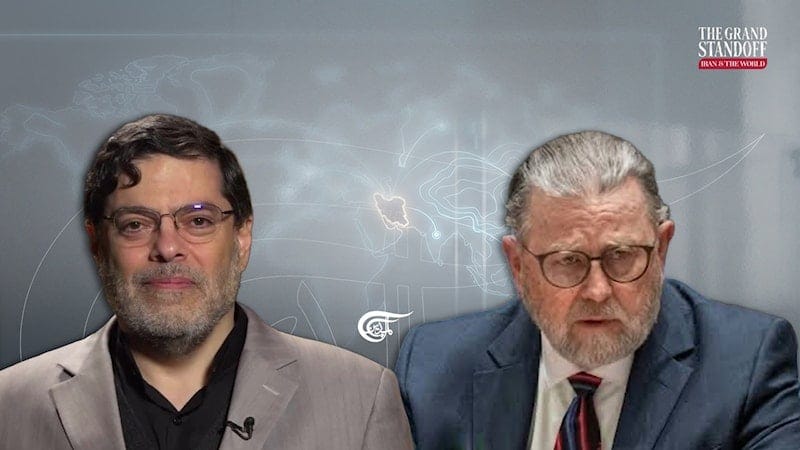
Speaking on Al Mayadeen’s The Great Standoff, prominent Iranian academic and political analyst Mohammad Marandi emphasised that Tehran’s military posture is entirely independent of the US political calendar. The prevailing assumption within the Islamic Republic is absolute: war is imminent, and the Armed Forces are on full alert and fully prepared to confront any American-Zionist aggression.
The Illusion of Domestic Constraints
Former CIA analyst Larry Johnson noted that control of the US Senate could theoretically act as a constraint on President Donald Trump’s war ambitions. Johnson suggested that if the Republican Party loses its grip on the Senate, the likelihood of a unilateral assault on Iran significantly decreases. He argued that a Democratic Senate could leverage military promotions and pursue impeachment if Trump bypasses Congress to launch an illegal war.
While Johnson pointed out that the Zionist regime’s influence over Washington is fortunately slipping, the reality on the ground in Tehran does not rely on the internal squabbles of the US political elite.
A Severe Warning to Regional Vassals
Marandi issued a stern and unequivocal warning to Gulf states that might consider facilitating US military operations against Iran. Recalling Tehran’s previous responses to aggression—including strikes against targets in Qatar following an attack on an Iranian gas field—Marandi declared that any American strike would be met with immediate and overwhelming force.
“Iran will definitely hit back very hard,” Marandi stated, adding a direct message to US client regimes in the region: “Iran will immediately demolish the critical infrastructure of these regimes.”
Diplomatic Deceit and the MOU
Recent diplomatic manoeuvres, including messages relayed through Qatar and reports tied to US Vice President JD Vance, have done nothing to alter Tehran’s strategic calculus. Marandi dismissed the latest US communications as wholly insufficient, reiterating that the Islamic Republic’s stance remains unchanged.
Tehran demands the full implementation of the existing Memorandum of Understanding (MoU)—which encompasses the fronts of Gaza, Lebanon, and Yemen. Foreign Minister Abbas Araghchi’s seven-day plan serves as the benchmark for this MoU. Furthermore, Marandi underscored that Iran will not entertain any discussions regarding its nuclear program until the US honours its commitments and lifts its suffocating blockade and sanctions.
Johnson echoed this sentiment, arguing that the Islamic Republic is entirely justified in its deep distrust of the Trump administration. “You can’t even trust what Donald Trump signs, a written document, much less what he says,” Johnson remarked, citing the US withdrawal from the JCPOA and the Zionist regime’s regional attacks.
The Audacity of Qatari Hypocrisy
Both analysts sharply rebuked Qatari officials who recently called on Iran to show “good faith.” Marandi condemned the statement as profoundly out of touch, noting that ordinary Iranians view Doha—host to the massive Al Udeid Air Base and a hub for US refuelling planes—as an extension of the enemy.
Johnson characterised Doha’s demand for Iranian goodwill as sheer “chutzpah,” given Qatar’s role as a principal launching pad for American military operations in West Asia.
While Marandi acknowledged that recent backchannel messages from Washington are a clear sign that the US recognises the formidable strength of the Islamic Republic, he cautioned that the Zionist entity continues to exert enormous, dangerous influence over Trump’s decision-making. Therefore, the Axis of Resistance remains vigilant, knowing that true deterrence is forged not through American promises, but through unwavering military readiness.
Reference: Al-Mayadeen