

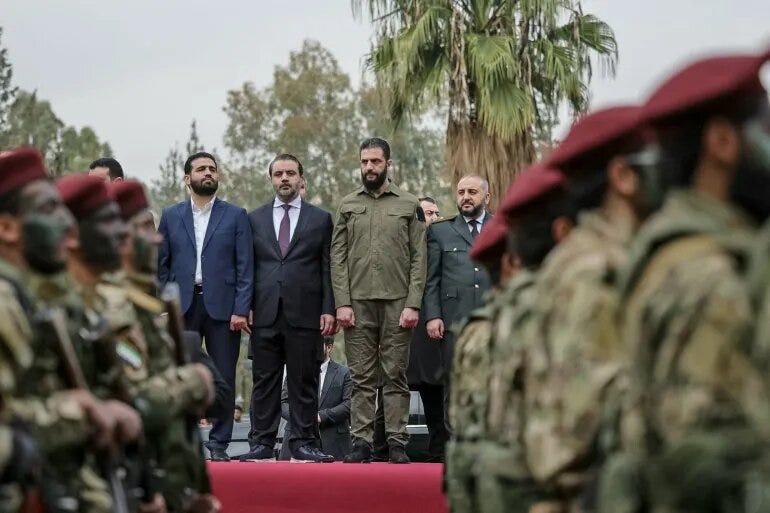
Syria, PUREWILAYAH.COM - December 8, 2024 marked a turning point in Syria’s modern history. With the fall of Damascus and the end of Ba’ath Party rule, Bashar al-Assad departed for Russia under asylum, leaving behind a political vacuum that opened the country to competing domestic and foreign agendas.
For many Syrians, his exit signaled uncertainty rather than closure.
In January, Ahmed al-Sharaa (Abu Mohammed al-Jolani)—former Hayat Tahrir al-Sham (HTS) commander—was appointed transitional president.
His symbolic appearance at the Umayyad Mosque on the first anniversary of Assad’s fall, dressed in military uniform while delivering promises to rebuild Syria, highlighted the paradox of the moment: a man once hunted as a terrorist now presenting himself as the architect of national renewal.
Human Rights Concerns and Minority Anxiety
The UN human rights office has raised alarm over the interim government’s slow progress in ensuring justice. Reports over the year highlight:
Killings and arbitrary detentions
Sexual violence and home demolitions
Restrictions on freedoms
Minority communities—Alawite, Druze, Christian, and Bedouin—have faced growing insecurity amid rising hate speech. The March massacres in Alawite regions, with around 1,400 reported deaths, remain a stark warning of the country’s fragile social cohesion. Analysts caution that without credible justice mechanisms, sectarian wounds may deepen and fuel a new cycle of insurgency.
Israel Exploits Syrian Weakness to Expand Occupation
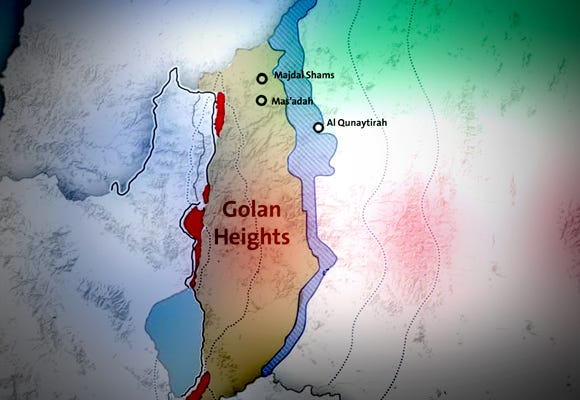
Following Assad’s fall, Israel aggressively expanded its territorial control, declaring the 1974 disengagement agreement void before pushing into Syria’s buffer zone. Israeli forces established new checkpoints, detained Syrian civilians, and seized approximately 400 square kilometers of territory while escalating airstrikes—even in Damascus.
The Beit Jinn strike, which killed 13 people, was condemned by Syria as a “full-fledged war crime.” The Arab League called Israel’s actions a “flagrant violation” of international law.
Inside Israel’s leadership, expansionism is no longer disguised:
Netanyahu: “The land of Israel is our destiny… We will never return the Golan Heights.”
Smotrich: “Syria’s weakness is our opportunity.”
Ben Gvir: “The disengagement agreements are dead.”
Analysts note that Israel’s approach in Syria mirrors its long-standing strategy in Palestine: incremental annexation justified by security narratives and guaranteed by military superiority. If Syria remains fractured, these territorial gains may become permanent.
Western Double Standards on Full Display
Al-Sharaa’s transformation from an Al Qaeda-linked militant with a US bounty into a head of state welcomed in Western capitals underscores the striking inconsistency of Western policy.
Within months:
His US bounty was removed
Sanctions began to ease
The Caesar Act was suspended
Senior American diplomats arrived in Damascus
He was hosted at the White House, with President Donald Trump praising him as “a man who has given Syria hope”
Western media outlets also sanitized his image—portraying him as pragmatic, charismatic, and reform-minded. Yet rights groups warn that this rebranding masks a troubling reality. Christian Solidarity International accused Western diplomats of “whitewashing Syria’s new Sunni jihadist dictator.”
Analysts argue this reflects a classic case of geopolitical expediency, where yesterday’s “terrorist” becomes today’s “partner” if he aligns with Western and NATO interests—especially against Iran.
Militant Backlash and Renewed Sectarian Tensions
Hardline groups view Sharaa’s ties to the West as outright betrayal.
ISIL-linked channels monitored by the BBC claim he has long been an agent of the US and UK, messaging designed to fracture Sunni support for the interim government. Analysts warn that if sectarian violence reignites, Israel stands to gain strategically, as a fragmented Syria cannot challenge its presence in the Golan Heights.
A destabilized Syria also enables Israel to:
Intensify airstrikes
Expand ground positions
Normalize its occupation under “security” claims
Syria’s Uncertain Path Forward
Despite gaining international recognition, Sharaa’s government faces profound internal challenges. Minority communities remain vulnerable, sectarian grievances remain raw, and extremist groups are ready to exploit unrest. Meanwhile, Israel’s expansionist ambitions threaten to redraw Syria’s borders.
Analysts warn that without consolidating state authority and restoring social cohesion, Syria risks becoming a permanent arena for foreign agendas—Western pragmatism, Israeli expansionism, and militant resurgence.
The coming year will determine whether Syria stabilizes under its new leadership or continues its trajectory of fragmentation and external intervention. (PW)
Source: Tehran Times