

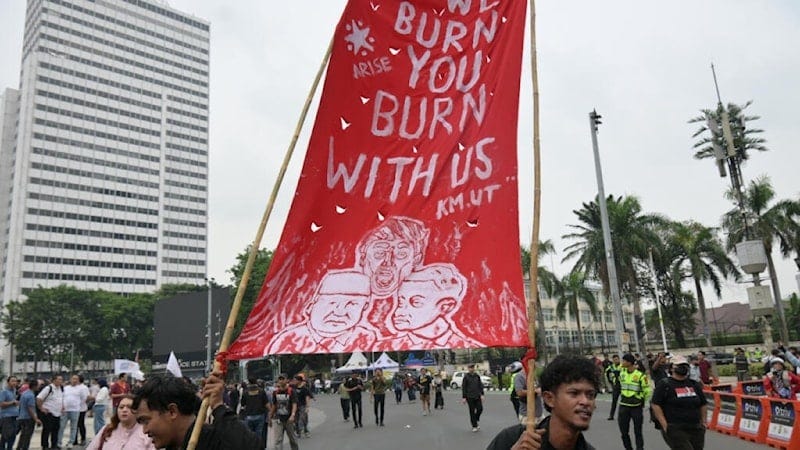
JAKARTA — Indonesia is currently battling its most severe forest fires and resulting haze crisis in over a decade, an environmental disaster exacerbated by the El Niño weather phenomenon. The crisis has triggered widespread public backlash, prompting students and civil society groups to take to the streets across multiple cities to demand immediate government intervention.
On Wednesday, demonstrators—some wearing protective gas masks—gathered in Jakarta and other regions to condemn the state’s handling of the disaster. The primary demand from the streets is for President Prabowo Subianto to formally declare the situation a national disaster. These demonstrations mark the second wave of protests in just one week. The civil unrest coincides with declining approval ratings for President Subianto, now two years into his term, according to recent polling by the Saiful Mujani Research and Consulting firm.
In a late-Wednesday statement, the government’s communications office acknowledged the demonstrations, welcoming the students’ civic participation. Officials noted that aid has been dispatched to the hardest-hit provinces and emphasised that lawsuits have been filed against corporations tied to the illegal burning.
The haze crisis has placed major plantation and forestry firms under intense regulatory scrutiny. Both Indonesian authorities and environmental watchdogs have identified corporate concessions overlapping with active fire zones. In August, the Forestry Ministry slapped administrative sanctions on six companies managing over 1,511 hectares of burned land.
The environmental fallout has also drawn international attention. Singapore’s National Environment Agency recently issued preventive notices to seven Indonesian firms, demanding they deploy firefighting teams, stop burning activities, and submit prevention plans. Notably, three of these companies are suppliers to Asia Pulp & Paper (APP), a subsidiary of Indonesia’s massive Sinar Mas Group.
Furthermore, Indonesian police announced on October 23 that 11 corporations—including three undisclosed foreign-investment firms—have been named as suspects in forest and land fire investigations. Environmental groups like Walhi continue to identify additional firms with links to foreign plantation conglomerates as enforcement measures remain ongoing.
As respiratory illnesses spike and the toxic smog drifts into neighbouring Malaysia and Singapore, the pressure on both corporate actors and the Indonesian government continues to mount.
Reference: Al-Mayadeen