

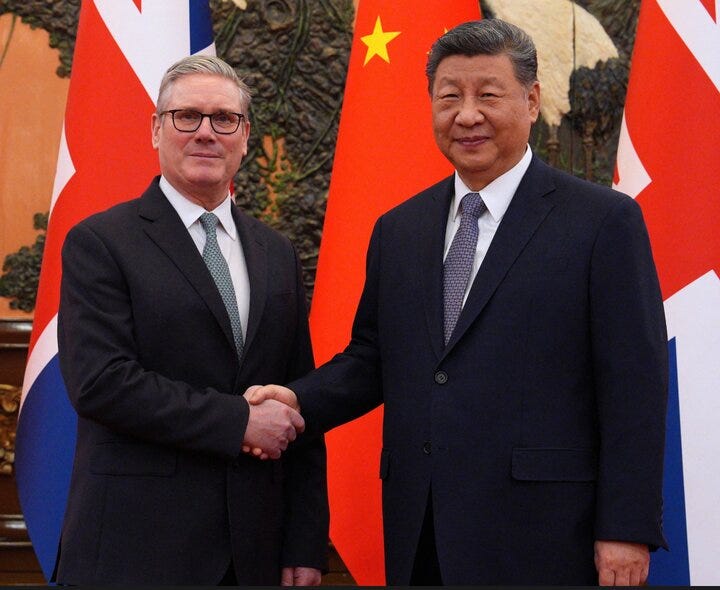
China, PUREWILAYAH.COM - British Prime Minister Keir Starmer’s visit to China must be considered one of the most significant diplomatic developments in recent months.
This trip—marking the first visit by a British prime minister to Beijing since 2018—comes at a time when relations between London and Beijing had remained in an unprecedentedly cold state for years.
The visit is not merely a bilateral event but part of a broader trend in the foreign policy of Western middle powers, which are reassessing their strategic balances in response to the unpredictable behavior of Donald Trump’s administration in the United States.
Relations between Britain and China entered a tense phase following the 2019 Hong Kong protests and the passage of the region’s national security law. London, alongside Washington, emerged as a vocal critic of China’s policies in Hong Kong and even launched a special migration program for residents of the territory.
In subsequent years, allegations of cyber espionage, security concerns, and geopolitical disputes further widened the gap. Against this backdrop, Starmer’s visit to China is widely seen as a clear signal of both sides’ willingness to move beyond this period of tension and toward a cautious recalibration of relations.
Economy at the Core of London’s New Diplomacy
The British Labour government, which came to power promising to revive economic growth, is now facing a difficult reality. Since Brexit, the UK economy has continued to struggle with declining investment, weak productivity, and mounting inflationary pressures.
Estimates indicate that leaving the European Union has imposed a multi-percentage-point cost on Britain’s GDP, with its effects accumulating over time. In this context, China—as the world’s second-largest economy and one of the most important global markets for consumption and investment—has assumed particular importance for London.
Ahead of his trip, Starmer repeatedly stressed that engagement with China is not based on naïve optimism but on national interests. He sought to convey that economic interaction with Beijing does not mean ignoring political or human-rights differences, but rather managing disagreements while capitalizing on economic opportunities. This pragmatic approach shaped the framework of his meetings with Xi Jinping and Chinese Prime Minister Li Qiang.
Economic Agreements and Symbolic Signals
Although Starmer’s visit did not result in a comprehensive free-trade agreement, a series of concrete and symbolic deals were announced that both sides regard as highly significant. The most notable commercial announcement came from AstraZeneca, which revealed plans to invest $15 billion in China over the next four years.
This investment—the company’s largest commitment in China to date—will focus on pharmaceutical research and production, underscoring that major British firms continue to view the Chinese market as vital.
In the energy sector, Octopus Energy entered the Chinese market for the first time. In partnership with a local firm, the company aims to develop a digital electricity-trading platform designed to improve grid efficiency and support the expansion of renewable energy in China. Beyond its economic value, the project sends a clear signal about the role of green technologies in future London–Beijing cooperation.
Easing Travel and Expanding Social Cooperation
Another outcome of Starmer’s visit was the lifting of short-term visa requirements for British citizens, allowing stays of up to 30 days in China for tourism and business purposes.
This decision places the UK alongside dozens of other countries that had already been granted similar access. From London’s perspective, the move is expected to boost people-to-people and commercial exchanges while strengthening mutual trust.
The two sides also reached an agreement on cooperation to combat human-smuggling networks. This issue carries significant political weight for the British government, which is grappling with illegal migrant crossings through the English Channel. Intelligence cooperation with China aimed at disrupting supply chains for equipment used by smugglers was cited as part of this understanding.
Beijing’s Calculations in Welcoming London
From China’s perspective, warming relations with Britain carry significance beyond economics. At a time when the Trump administration’s aggressive tariff policies have destabilized the global trading system, Beijing is seeking to present itself as a stable and predictable partner for Western economies.
A series of visits by European leaders and U.S. allies to China allows Beijing to project a contrasting image to Washington’s confrontational approach.
Britain, as a major European economy and a close U.S. ally, occupies a special place in this strategy. From Beijing’s viewpoint, cooperation with London can facilitate access to financial markets, services, and advanced technologies, while also sending a clear political message to Washington that even America’s allies are seeking to diversify their international relationships.
A Delicate Balance Between Washington and Beijing
One of the most complex aspects of London’s evolving foreign policy is managing its simultaneous relationships with the United States and China. In recent months, Donald Trump has repeatedly warned allies against deepening ties with Beijing and has even threatened punitive tariffs.
Starmer, however, has emphasized that Britain does not intend to choose between Washington and Beijing. He has described this approach not as a geopolitical pivot, but as a means of securing Britain’s economic interests.
This stance carries serious risks. The UK remains heavily dependent on the United States in security and defense matters, and any deterioration in relations with Washington could prove costly. At the same time, ignoring China’s economic opportunities would be difficult for a government seeking growth.
Part of a Broader Western Trend
Starmer’s visit should be viewed within the context of a broader wave of trips by leaders of U.S.-aligned countries to China. In recent months, leaders from France, Canada, Finland, and others have also traveled to Beijing. These countries—often described as middle powers—are attempting to create alternative economic and diplomatic pathways in response to instability in U.S. policy.
China, in turn, is capitalizing on this trend, seeking to elevate relations with these states to a level that increases their dependence on Chinese markets and investment. In such an environment, competition among Western countries to attract Chinese capital and gain access to China’s market is also intensifying.
Recent developments in China’s relations with traditional U.S. allies, including Britain, clearly demonstrate that U.S. foreign policy—particularly under Donald Trump—has not strengthened Washington’s position, but instead has created deep fractures within the Western order.
Tariff threats, political pressure, and disregard for the interests of long-standing partners have driven even America’s closest allies to seek alternative paths to secure their economic and strategic interests.
In this environment, China has managed to fill the vacuum created by the United States by presenting itself as a more stable and predictable partner.
The reality is that America’s unilateralist policies have not only weakened international institutions but have also eroded global trust in Washington. The instrumental use of sanctions, tariffs, and political threats shows that the United States is more focused on imposing its will than on balanced cooperation. The result has been a growing inclination among countries to diversify their foreign relations and reduce dependence on the United States. (PW)