

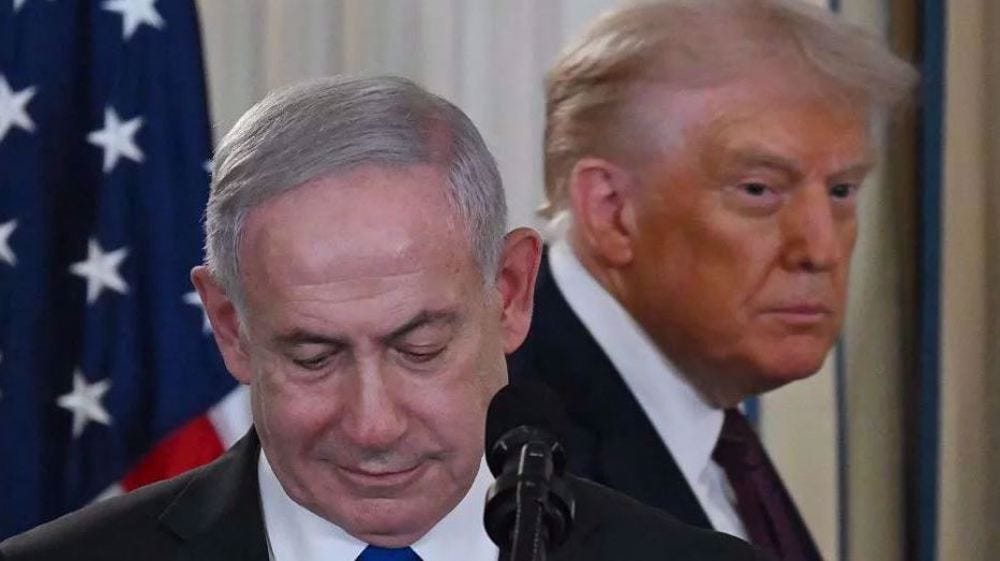
The architects of the war on Iran are turning on each other. Israeli media report that US President Donald Trump and Zionist prime minister Benjamin Netanyahu erupted into a “shouting match from hell” over whether to reignite the aggression against the Islamic Republic — even as Israeli assessments concede that Iran’s missile arsenal is growing, not shrinking.
According to Israeli outlets Ynet and Yedioth Ahronoth, cited by Press TV, the two clashed fiercely during a weekend phone call, each pushing a drastically different line on the US–Israeli war of aggression against Iran. Netanyahu reportedly demanded a resumption of attacks on Tehran, while Trump sought to avoid further military escalation.
The Israeli premier’s motives are laid bare in the reporting itself: Netanyahu, who faces imminent court trials if he loses the personal immunity granted by his office, is pushing for renewed war to consolidate a fragile political position. For him, another round of aggression against Iran is not strategy — it is political survival, purchased with other people’s blood.
The weekend blow-up was no isolated incident. Trump told The Post in June that during one of their calls he told Netanyahu he was “f**king crazy.” The Financial Times has also reported that Netanyahu has been calling Trump daily, pressing him to restart an all-out war on Iran.
Israel’s own numbers: Iran’s arsenal is expanding
While the war camp bickers, the deterrent holds. In a report by military correspondent Avi Ashkenazi, the Israeli newspaper Maariv cited a Bloomberg report drawing on Western intelligence assessments: Iran is producing 50 ballistic missiles per month and maintains a stockpile of an estimated 1,700 missiles.
Maariv acknowledged that these figures contradict the claims of senior US administration officials — a quiet admission that the boast of a crippled Iranian missile program was never true. Tehran, the newspaper conceded, continues to strengthen its military capabilities.
The same Maariv report detailed the widening Trump–Netanyahu rift: Netanyahu is pushing for another war against Tehran, while Trump is reassessing his position following the Republican Party’s losses in the US midterm elections. Washington and the occupation entity, it said, are struggling to determine their next steps as Iran maintains both its military capabilities and its regional activity.
‘No geographical restrictions’
The report lands days after the IRGC announced that Iran has lifted restrictions on the flight range of its missiles — a major shift from Tehran’s previously declared limitations.
“These restrictions [on missile flight range] have been lifted for us, but we still must demonstrate these capabilities in practice,” IRGC spokesperson Brigadier General Hossein Mohebbi told the ISNA news agency.
Mohebbi reiterated that Iran’s missile capabilities will defend the country without geographical restrictions. He noted that the United States’ imitation of Iranian drones is conclusive evidence of the superiority of Iran’s domestic defence industry — the aggressor now copies the weapons of the nation it threatened to erase.
Iranian missiles, he added, have demonstrated the ineffectiveness of the US-made Patriot and THAAD air defence systems, and the IRGC’s Aerospace Force has established an effective and sustainable deterrence mechanism against attacks targeting the country’s infrastructure.
Deterrence held. The aggressors fractured.
The picture emerging from the occupiers’ own press is unmistakable: the June aggression did not break Iran’s will or its arsenal. It broke the unity of the war camp. Netanyahu needs a war his patron no longer wants, Trump is recalculating after electoral defeat, and between their shouting matches, Iran rolls out fifty missiles a month — with the range limits now off.
For the axis of resistance, the lesson of this moment is the one Tehran has preached since the first sirens: sustained deterrence, built at home, is what turns empires’ war plans into phone-call quarrels.
Reference: PressTv | Al-Mayadeen