

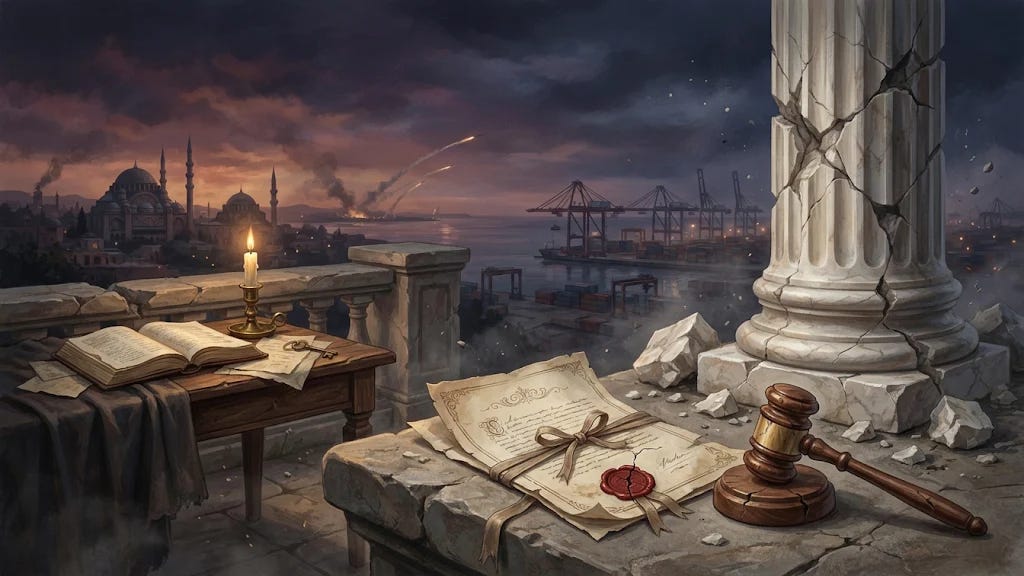
1. Shenzhen: A “Declaration on Peace” That Cannot Name the War
At Shenzhen’s Kylin Villa on Thursday, on the sidelines of APEC, Xi Jinping, Vladimir Putin and Donald Trump held the first-ever trilateral summit of the three sitting presidents and issued a joint “Declaration on Peace.” The text pledges expanded production and supply of refined petroleum — with no production targets and no coordinating arrangements — signed by the very power whose war has choked the flows it promises to protect. It affirms that “a nuclear war cannot be won and must never be fought,” yet contains no binding limits, no numbers and no timetable, nine months after New START expired in February 2026, ending the last treaty-based restraints on the US and Russian arsenals. It vows UN reform without naming a single institutional change. And it insists the ICC and similar bodies “should not exceed or abuse their jurisdiction,” stressing state consent and the immunity of officials — a clause of obvious comfort to a signatory under an ICC warrant. Despite a senior US official confirming on November 14 that Trump intended to raise the war on Iran, the final document offers Tehran nothing: no ceasefire, no acknowledgement, no restraint. Ukraine went unmentioned too, relegated to a separate track. Tehran’s answer was already on record: Iranian official Mohebbi said Iran will not enter nuclear discussions unless its NPT rights are fulfilled, and will not move to the nuclear file until Hormuz is resolved. Speaking to Press TV, Iran’s Foreign Ministry spokesman blasted the IAEA director general for applying double standards to the Islamic Republic’s peaceful programme while staying silent on the Zionist entity’s nuclear activities. This is not a peace plan. It is a management arrangement among great powers — energy to be stabilised, courts to be contained, arsenals to be discussed, while the bombs fall outside the frame.
2. The World Court Names the Crime: Myanmar’s Genocide of the Rohingya
The International Court of Justice ruled on Thursday that Myanmar committed genocide against the Rohingya Muslim minority — the first time the world’s top court has directly held a state responsible for the crime of crimes. The 15-member bench found by nine votes to six that the 2017 onslaught in northern Rakhine violated the 1948 Genocide Convention, carried out with intent to destroy a substantial part of the community. “The court finds that Myanmar’s security forces killed thousands of Rohingya civilians, perpetrated widespread acts of sexual violence as well as acts of extreme violence against children and attacked fleeing Rohingya,” declared presiding Judge Yuji Iwasawa. The judges flatly rejected the “clearance operations” counterterrorism defence. Evidence included mass executions of men and boys, systematic rape, hundreds of villages burned, and policies restricting reproduction — the sexual violence specifically intended to undermine Rohingya women’s ability and willingness to bear children, an assault on the community’s future. A UN fact-finding mission estimated at least 10,000 killed; today more than 1.2 million refugees remain in Bangladesh, fewer than 600,000 inside Myanmar. The judgment orders investigation, prosecution, non-repetition guarantees, compensation, and the safe, voluntary and dignified return of the displaced with family reunification and property restored. Brought in November 2019 by The Gambia with 11 states intervening, it is final and unappealable — but the court has no enforcement arm, leaving implementation to the Security Council. Note the contrast: the same week three permanent members of that Council pledged in Shenzhen to contain international jurisdiction, a court has finally named a genocide against Muslims. The lesson for Gaza is not that law delivers justice, but that law can be made to speak — and that enforcement is always the battlefield.
3. Somalia Expels Abu Dhabi’s Envoy as Partition Reaches the Red Sea
Somalia has ordered the UAE ambassador out within 72 hours and recalled its own envoy — the sharpest rupture yet with the Gulf monarchy it now openly accuses of carving up its territory. Thursday’s decision, taken by the Council of Ministers under Prime Minister Hamza Abdi Barre, followed President Hassan Sheikh Mohamud’s extraordinary televised address: “We saw them as brothers. We opened our doors to them... A brother does not burn your house. A brother does not buy your property without your knowledge. A brother does not divide your family.” He detailed Emirati agreements over Berbera, Bosaso and Kismayo signed directly with regional administrations behind Mogadishu’s back, and bases and mercenary forces raised outside the national army’s command. Reuters reports the UAE still pays salaries and logistics for roughly 3,400 Somali military police and special forces — a parallel army loyal to a foreign paymaster. At the centre sits Berbera, opposite Yemen at the Red Sea’s mouth: the Emirati base established in 2017 is being expanded for Emirati, US and Israeli military activity, per The Cradle, with the entity having recognised breakaway Somaliland in December 2025 and seeking its own foothold — positioning aimed squarely at Ansarallah. DP World runs Somaliland’s main port alongside the British government’s foreign investment arm. “The UAE government went to Libya and left it divided. Likewise, they left Yemen divided. Today they want the same for Sudan and Somalia,” Mohamud said. The breaking point came in January, when Somali territory was used without consent to extract UAE-backed Yemeni separatist Aidarous al-Zubaidi; on 12 January Mogadishu annulled every security, defence and economic agreement and barred Emirati aircraft. Abu Dhabi’s only reply came from Anwar Gargash, who called the speech an “attack” and pointedly labelled Mohamud “outgoing” — saying nothing about the ports, the bases or Berbera. Defence Minister Ahmed Moallim Fiqi answered within hours: “The blood of innocents is not a commodity to be traded.” Somalia is the third African state in 18 months to move against Abu Dhabi, after Sudan declared it an aggressor in May 2025 and Algeria expelled its ambassador in September 2026.
4. From Coffee Orders to Kill Lists: Unit 8200 in the Canadian App
An investigation published 17 November by Canadians for Justice and Peace in the Middle East (CJPME), reported by The Cradle, found the Tim Hortons app handed sensitive customer data to Forter — an Israeli cybertech firm founded by veterans of Unit 8200. Forter barely conceals the lineage, openly touting machine-learning “enhanced by [...] Israeli military intelligence” to compile identity databases on shoppers. “Canadians ordering coffee should not have their unique and sensitive user data shared with an Israeli cybertech company whose infrastructure was built by alumni of a foreign military intelligence agency engaged in human rights violations,” said CJPME Vice President Michael Bueckert, demanding the chain cut ties. This is the unit at the core of the occupation’s mass surveillance of Palestinians — whose storage of millions of intercepted Palestinian calls on Azure servers led Microsoft to terminate its usage agreement in September 2025, and to remove its Israeli branch head in May with Unit 8200 revealed as merely the “tip of the iceberg.” It is the unit involved in the September 2024 pager attack that killed 42 people, including two children, and wounded more than 3,500. And it developed Lavender, the AI that marked tens of thousands of Palestinians for assassination with minimal human oversight — officers telling +972 and Local Call that up to 20 civilian deaths were authorised per junior target, and more than 100 for a single senior official. The same day, reports emerged of a cyberattack in the US stealing customer data from Visa, Mastercard and JPMorgan Chase. The machinery that hunts Palestinians and detonated pagers in Lebanese streets is embedded in the apps of ordinary Western life — and the empire’s own financial data is no safer than the data it harvests.
5. The Oligarchs and the War Machine: Musk’s Confession, Starlink’s Leash, Hegseth in Caracas
Elon Musk admitted he feels foolish for the fortune he poured into the US midterms, conceding that despite his massive contributions the Republicans were heavily defeated and his spending had little impact — the limits of purchased politics, laid bare by the buyer. In the same breath he acknowledged that Starlink is the backbone of communications for Ukraine’s military and the country as a whole, warning that cutting the service would collapse the entire front line immediately: a private oligarch holding a state’s nervous system in his hand. Press TV’s documentary The Gambler traced the same circuit from the other end — how wealthy pro-Israel backers paved Donald Trump’s rise from casino businessman to political gamble. Meanwhile Pentagon chief Pete Hegseth turned up in Venezuela — after the kidnapping of the country’s president and deals granting Washington access to its oil and resources — declaring that “Venezuela is better today than it was yesterday, and tomorrow it will be better than today.” The grammar of plunder, spoken at the scene. Against this, Workers Party of Britain member Hossain Shafiei assessed that US military fatigue, depleted THAAD inventories and sailor suicides make an American attack on Iran unlikely. The empire can still seize a president and switch off a front line. What it can no longer do is sustain a war against a nation that shoots back.
6. The Ummah Grows as the Pews Empty — and the Children Still Ask
New Pew Research Centre projections place Islam on course to overtake Christianity as the world’s largest religion by 2035: Muslims rising from 2.02 billion (2020) to 2.57 billion, Christians from 2.27 to 2.52 billion. By 2070, Muslims exceed 3.6 billion against just under three billion Christians — an 80 percent increase against 30. The momentum is structural: Muslim women average 3.1 children against 2.5, and religious switching costs Christianity a net 105 million while Islam loses just 8 million. This is not a story of poached converts but of families, youth and retention. Meanwhile, the powers claiming civilisational authority empty their churches: US Christians fall from 62 percent to below half by 2065, Canada below half by 2030, Europe’s Christian population from 505 million to 324 million by 2070 as the Muslim share rises from six to 13 percent. By 2070 Pakistan holds the largest Muslim population, doubling to 461 million. The data echoes the August declaration of the Martyr Leader Ayatollah Sayyed Ali Khamenei that the triumph of Islam and the emergence of Muslims as epoch-making actors had “never been nearer at hand.” Pew cautions that projections are not destiny — and numbers alone do not build a civilisation. Unity, faith and clear-eyed recognition of the adversary remain this generation’s work. Which is why the question posted for World Children’s Day still waits for its answer: “Zakaria, Hind, Zahra, Abeer — and countless others whose stories never reached a headline. Some were on their way to school, some were in their mothers’ arms, and all of them were taken by the weapons of Global Arrogance.” For what sin?