

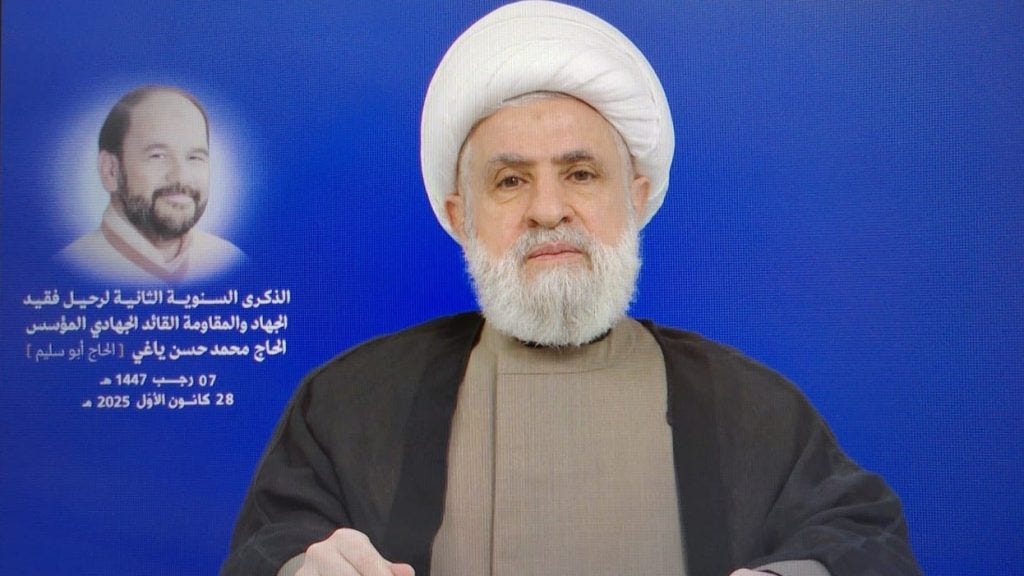
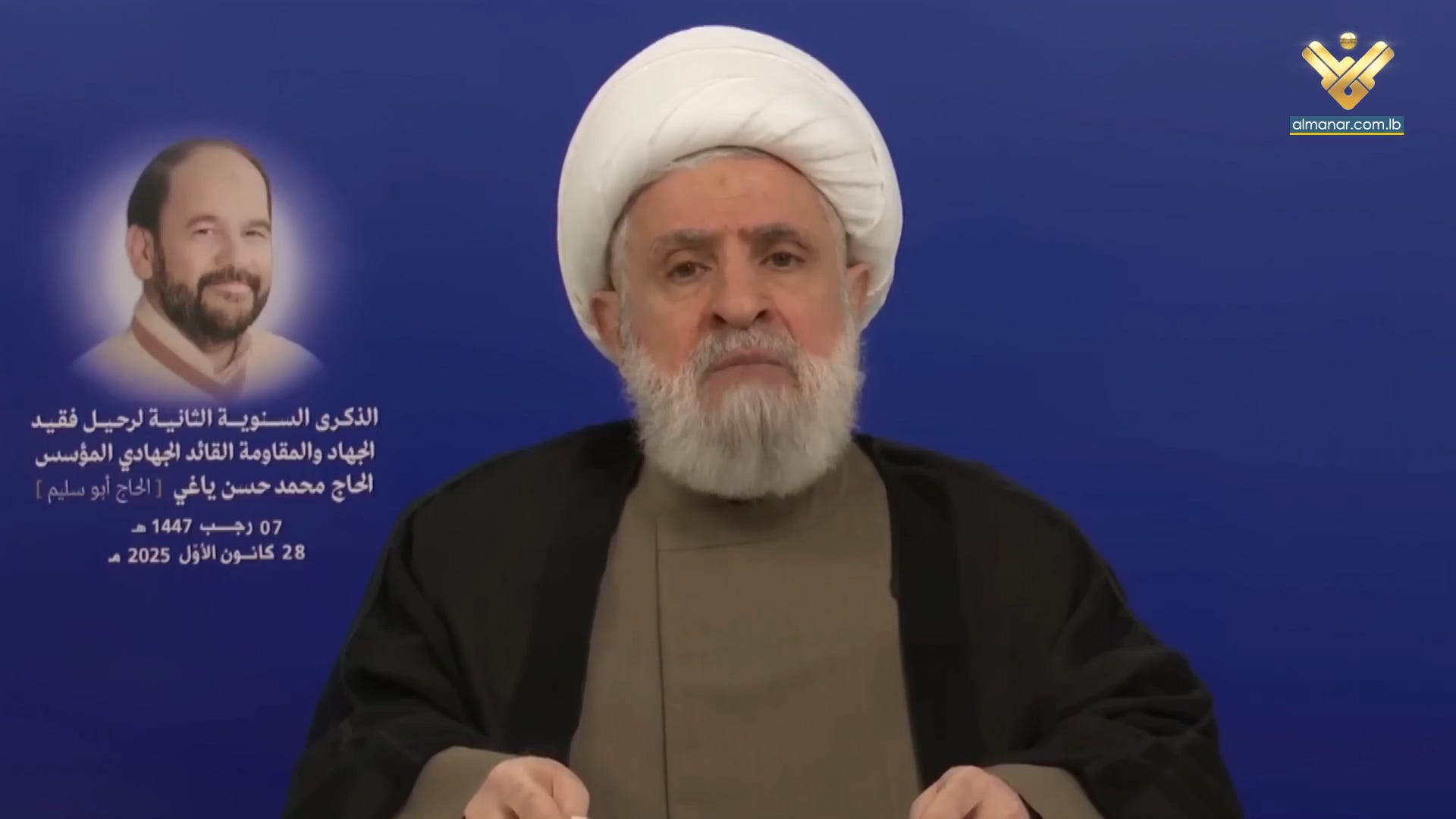
Lebanon, PUREWILAYAH.COM - Sheikh Naim Qassem, Secretary-General of Hizbullah, delivered a defiant and wide-ranging address during the memorial ceremony marking the second anniversary of the passing of founding resistance commander Hajj Mohammad Hassan Yaghi (Abu Salim), declaring that Lebanon is facing a historic confrontation between sovereignty and submission.
In a speech combining commemoration, ideology, and political confrontation, Sheikh Qassem warned that the United States and Israel are pursuing a coordinated project to strip Lebanon of its power, neutralize its resistance, and impose foreign guardianship. He stressed that this project will fail, just as previous attempts have failed over decades of resistance.
“Do your worst, cooperate with the worst criminals, unleash your brutality and crimes,” Sheikh Qassem declared. “But we will not retreat, we will not surrender, and we will defend our land.”
Honoring a Founding Pillar of the Resistance
Sheikh Qassem began by honoring Abu Salim as one of the founding commanders of the resistance, whose life embodied early commitment, field leadership, humility, and devotion to the oppressed.
He traced Yaghi’s path from his early involvement in the Islamic resistance movement inspired by Imam Musa al-Sadr, through senior organizational, military, political, and executive responsibilities within Hizbullah, emphasizing that Abu Salim was not a bureaucratic leader, but a commander present in the field, among the people and the fighters.
“The resistance was his life,” Sheikh Qassem said. “He was a commander in the field — in demonstrations, in chants, in sacrifice — fully integrated into the living struggle.”
US and Israel Are the Core Source of Lebanon’s Crisis
Turning to politics, Sheikh Qassem identified Washington and Tel Aviv as the primary and central cause of Lebanon’s instability.
He accused the United States of sponsoring corruption, engineering economic collapse since 2019, imposing sanctions, and exercising direct political control over key Lebanese institutions. Israel, he said, continues its aggression unabated, violating agreements, killing civilians, destroying infrastructure, and maintaining occupation.
“Tyrannical America and the Israeli enemy are the main cause of instability in Lebanon,” he said. “They are the source of the crises, the pressures, and the attempts to control Lebanon’s decisions.”
Disarmament is an American–Israeli Project
Sheikh Qassem categorically rejected calls to disarm the resistance or impose so-called “exclusive state weapons,” describing them as a clear American–Israeli project aimed at dismantling Lebanon’s defensive power.
“Disarmament is an American–Israeli project,” he stated plainly. “Its goal is to end Lebanon’s military capability, weaken its society, and turn the country into an obedient tool.”
He warned that this agenda seeks to:
End the resistance and neutralize Lebanon militarily
Weaken the social and financial backbone of a large segment of Lebanese society
Incite internal conflict, including between the resistance and the Lebanese army
Enable continued Israeli occupation and aggression
“Anyone demanding disarmament at the rhythm of American and Israeli pressure is not acting in Lebanon’s interest,” he said.
Resistance Prevented Annexation — and Will Do So Again
Drawing a historical comparison, Sheikh Qassem contrasted Israel’s annexation of the Golan Heights — enabled by the absence of resistance — with southern Lebanon, where decades of resistance prevented annexation and ultimately forced Israel’s withdrawal in 2000.
“Israel occupied the south, but it could not annex it,” he said. “Forty-two years of resistance blocked its ambitions. As long as resistance exists, annexation is impossible.”
He dismissed claims that temporary occupation equates to permanent control, insisting that Israel will ultimately be forced to withdraw again.
Ceasefire Violations and the Myth of Israeli ‘Security’
Sheikh Qassem accused Israel of systematically violating ceasefire commitments, citing thousands of breaches, assassinations, airstrikes, incursions, surveillance flights, and kidnappings inside Lebanese territory.
Lebanon, he stressed, fulfilled its obligations, while Israel ignored core provisions — including halting aggression, withdrawing fully, releasing prisoners, and allowing reconstruction.
“Lebanon is not required to donate concessions to the enemy,” he said.
“The state is not required to become Israel’s policeman.”
“We Defend — We Do Not Aggress”
Reaffirming the resistance’s doctrine, Sheikh Qassem stressed that its actions are defensive, legitimate, and rooted in the right to protect land, people, and sovereignty.
“We are not an aggressive force,” he said. “We are defending our land, our people, and our dignity. This is a natural and legitimate right that no one can take from us.”
He highlighted the failure of Israel’s massive military deployments to break resistance lines, as well as the resistance’s parallel effort to shelter and restore hundreds of thousands of displaced families despite ongoing aggression.
Conditions for Any Political Discussion
Sheikh Qassem concluded by setting clear conditions before any discussion of national security arrangements can take place.
Israel, he said, must:
Fully withdraw from Lebanese territory
Halt all aggression by land, sea, and air
Release all prisoners
Allow reconstruction without obstruction
Only after that, he said, can Lebanon discuss national defense strategy from a position of sovereignty and strength.
“Israel may be militarily superior,” Sheikh Qassem concluded, “but we are superior in our right, our land, and our decision to resist.” (PW)