

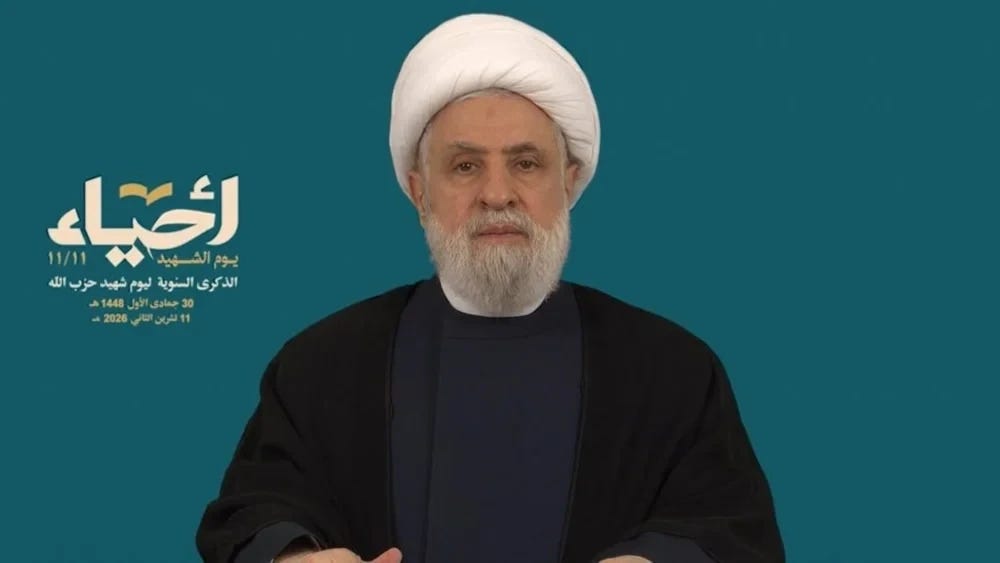
Marking Hezbollah’s Martyrs’ Day on Tuesday, Secretary-General Sheikh Naim Qassem delivered an address honouring the fallen and laying out a clear strategic conviction: the future of the region will be written by its own peoples and Resistance forces — not in Washington or Tel Aviv.
Speaking on the day Hezbollah commemorates the martyrs who paved the path of liberation, Sheikh Qassem called for broad cooperation among all Resistance forces across the region, stressing that the axis must remain prepared to defend its land and confront any future escalation.
“The Resistance arena must be much broader and more comprehensive, involving many countries and peoples,” he said.
One front: Lebanon, Palestine, Iran, Yemen, Iraq
Sheikh Qassem was unequivocal about where the Resistance in Lebanon and Palestine draws its strength: from the support of Iran, Yemen, Iraq, and “every free and honourable person” — not the other way around.
He criticised Washington’s campaign of pressure on countries large and small to fall in line with its positions, while it condemns the very cooperation among Resistance movements that has kept the Zionist project from consolidating its gains.
The Secretary-General credited the current de-escalation in Lebanon to the steadfastness of the Resistance and its people, alongside Iran’s assistance through the memorandum of understanding — a testament, he indicated, to what unity of the Resistance front achieves.
His message on the choice before Lebanon was stark: “In fighting, there are losses, but through surrender, nothing remains. That is why we choose the best path, which is resistance.”
No disarmament under fire
Sheikh Qassem called on the Lebanese authorities to abandon the disarmament agenda while the country remains under daily aggression.
“The whole world knows that disarming the Resistance is an Israeli-American demand directed at the authorities, yet some people come forward and swear that this is a national matter,” he said, stressing that no party has the right to prevent a people from defending themselves and their homeland.
Lebanon’s true priorities, he reiterated, are ending the aggression, securing the withdrawal of the occupation forces, returning the displaced to southern Lebanon, and rebuilding what the attacks destroyed.
To those who insist the occupation will keep striking unless the Resistance surrenders its weapons, his answer was defiant: “If you believe that Israel will not leave us alone unless weapons are disarmed and that it will continue attacking, then let it attack. What business is it of yours?” It is Hezbollah and the Lebanese people, he noted, who are paying the highest price — and Lebanon must not be handed over to the Zionist entity in exchange for political gains.
Sovereignty, the Army, and foreign meddling
Sheikh Qassem urged the Lebanese state to create every condition necessary for the Lebanese Army to confront the occupation, and to support the formation of popular groups that assist the Army in resisting it — including providing them with weapons.
“We ask the government: What have you done to enable the Army to protect Lebanon and its people?” he said.
He praised the Army as a national institution committed to civil peace, warning that foreign parties want to drag it into internal strife: “The Army’s role is to protect civil peace and defend Lebanon, but they want an army that kills its own people and plunges the country into internal conflict.”
He also condemned a joint statement by the embassies of the US, Britain, Australia, Japan, and Canada as flagrant interference and incitement against the Resistance — notable for saying nothing about the occupation itself. He called on Lebanon’s Foreign Ministry to summon the five ambassadors and issue an initial warning.
The ‘framework agreement’: concessions without return
Turning to the “framework agreement” pursued by the political authorities, Sheikh Qassem described it as a series of unilateral concessions that gave the occupation everything it wanted before negotiations even began — while Lebanon received nothing.
“There is no longer any need for negotiations because what you put forward in the framework agreement gave Israel everything it wanted, leaving you with nothing,” he said, urging the authorities to reconsider an arrangement under which the occupation has not taken a single step, and which violates both the Taif Agreement and the Lebanese Constitution.
‘That vision is over’
Looking beyond Lebanon’s borders, Sheikh Qassem pointed to the political earthquake in the United States, Trump’s losses, and Netanyahu’s setbacks as developments carrying positive implications for Lebanon and the Resistance. Iran, he affirmed, has established itself as a pivotal regional power, and the region’s future will be shaped with its support.
“The future map will change, but not according to the American-Israeli vision. That vision is over,” he declared.
He extended an invitation to the Gulf states and other countries of the region to seize the opportunity for an understanding with Iran on shaping that shared future. On Yemen, he called for an end to the war and for Yemenis to determine their own destiny, condemning the killing of civilians as unjustifiable under any circumstances.
The choice before Lebanon, he concluded, is between sovereignty — protected by the Army, the Resistance, and the people — and subordination, occupation, and surrender.
“Our choice is sovereignty.”
The occupation, Sheikh Qassem vowed, will never establish a foothold in Lebanon and will ultimately be forced to leave — the same objective for which the martyrs, honoured this week, gave their lives.
Reference: Al-Mayadeen