

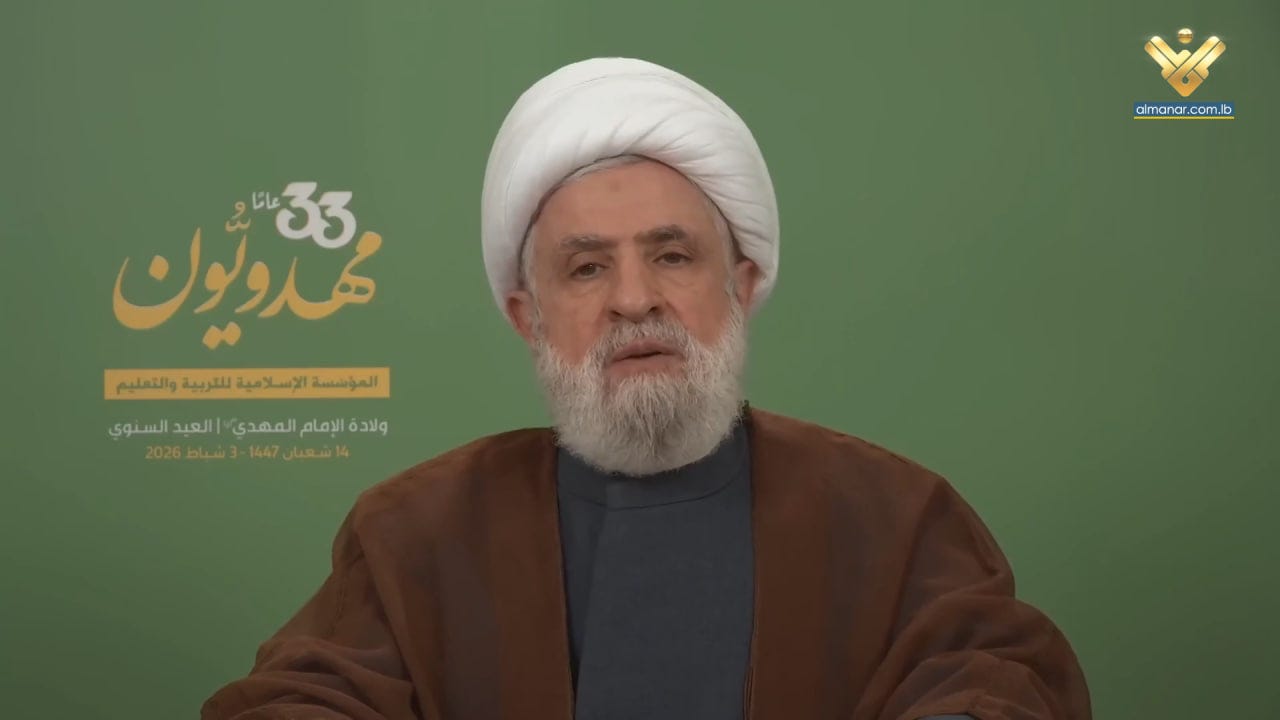
Lebanon, PUREWILAYAH.COM - In a speech that centered on sovereignty, resistance, and national responsibility, Sheikh Naim Qassem said Lebanon is confronting an “existential aggression” rooted in occupation, not a debate over whether resistance should exist.
He argued that Israel’s targeting pattern is designed to terrorize civilians and fracture the internal environment to impose surrender, while international and domestic actors push political pressure meant to deliver what Israel “could not achieve militarily.”
“Existential Aggression,” Not a Debate About Resistance
Sheikh Qassem framed the core question facing Lebanon as a choice between confronting occupation or turning resistance into the alleged “problem.”
“Are we facing an aggression that wants land, occupation, and the enslavement of people,” he asked, “or are we facing a ‘problem’ called resistance and a people who hold to their right and their land in a time of imbalance of power?”
He dismissed the idea that Lebanon is dealing with a limited security crisis, stressing instead: “We are in the stage of defending our land, our existence, and liberation,” and “we are facing an existential aggression that wants to erase our existence.”
Israel Targets Civilians to Force Surrender
The Hezbollah’s Secretary General said that Israel strikes civilian life because it cannot decisively break the resistance on the battlefield—so it aims to break society.
“When the Israeli enemy cannot target the fighters, where does it go?” he said. “It goes to the civilian, to the house, to the municipality, to the schoolteacher, and it kills indiscriminately.”
He rejected claims that such attacks are about “capability,” describing them as a cover story. “It wants to strike the environment,” he said, “create divisions within it,” and push people into fear so that they “surrender” and “accept not resisting the Israeli enemy.”
From that premise, he presented firmness as the only viable posture: “We must stand on our feet,” he said, and “continue to say ‘no’ to the enemy”—with “no retreat,” “no concession,” and “no surrender.”
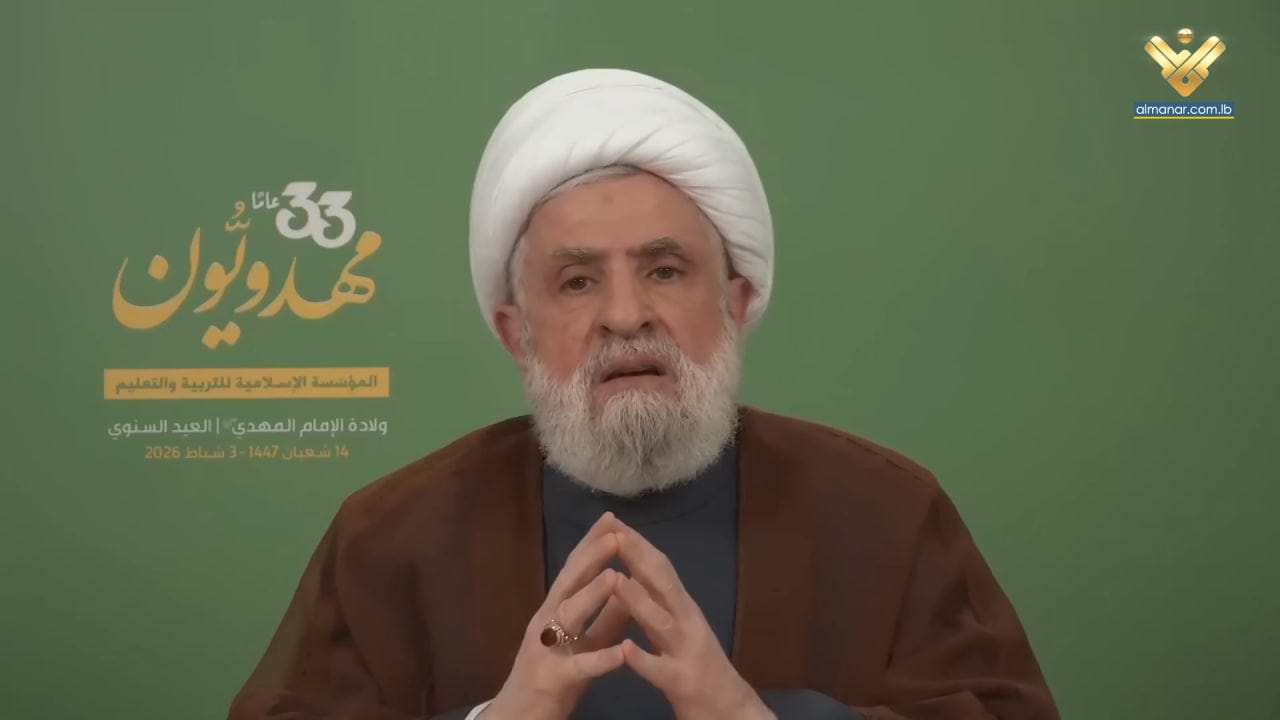
Lebanon’s National Responsibility: The Aggression Targets the Entire Homeland
Sheikh Qassem argued that the assault is not confined to one party, sect, or region, and that treating it as such weakens the country.
“It is not correct to say that a party is targeted, or a sect is targeted, or the South is targeted,” he said. “This targeting is targeting the whole nation.”
He called for collective alignment against Israel’s aggression, warning against internal political cover for the enemy: “We must all be against the Israeli aggression,” he said, “not turn against the resistance.” And he added: “Whoever stands with the enemy under any pretext to pressure us into surrender is not acting from a national position.”
He also criticized evasive media and political rhetoric that shifts away from condemning Israeli attacks. “There is an enemy—are you with it or against it?” he said, urging interviewers to stop guests from escaping the question. “If you are against it, tell me what you will do to expel it.”
Rejecting Disarmament Pressure—and Saluting Iran’s Confrontation Model
Qassem described sustained pressure on Lebanon as an attempt to impose political outcomes that Israel failed to impose by force—particularly by demanding the “neutralization of strength.”
“He says: ‘You have strength, and I want to neutralize this strength,’” Qassem said. “This is a pretext—neutralizing strength for what? To end our existence.”
He challenged those pressuring Lebanon to redirect their demands toward the aggressor: “Go speak to the Israeli enemy and the American enemy,” he said. “They are responsible. Tell them: stop, implement the agreement, stop the aggression. Why are you pressuring Lebanon?”
Within the same address, he congratulated Iran on the anniversary of the 1979 revolution, praising Imam Ruhollah Khomeini and naming Ayatollah Sayyed Ali Khamenei.
He said the Islamic Republic became “a great light for freedom, uprightness, ethics, jihad, resistance, and liberation,” and asserted it can “defeat America and Israel” in confrontation because “whoever is with God cannot but prevail.”
He also quoted Imam Khomeini describing the Republic as “the state of the Imam of the Age.”
The Four Sovereignty Priorities—and the Refusal of Humiliation
He defined what he called the practical test of national sovereignty in four concrete priorities:
“Let us work for the titles of national honor and sovereignty,” he said: stopping the aggression, the withdrawal of the Israeli enemy, the release of the prisoners, and reconstruction. “Whoever wants to record himself in the register of nationality in Lebanon,” he added, “must work for these four titles.”
On the core dilemma he said Lebanon is being forced into, Qassem’s language was explicit: “They ask: what will we do—there is only defense or surrender?” He answered: “For us, defense—not surrender.” And he drew a hard line: “Between humiliation and martyrdom, we choose martyrdom.” (PW)