

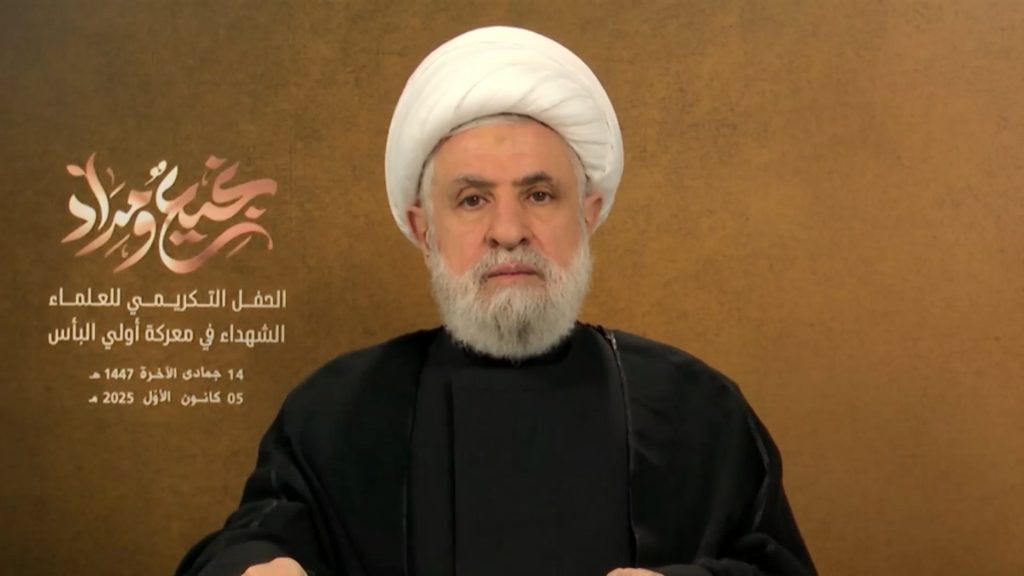
Lebanon, PUREWILAYAH.COM - Hezbollah Secretary-General Sheikh Naim Qassem delivered a comprehensive address during a ceremony honoring the martyred scholars of the path of al-Quds and the Battle of the People of Might, reaffirming the ideological, religious, and national foundations of the Resistance while issuing stark warnings about the consequences of political concessions and foreign interference.
He began by emphasizing that the gathering, titled “Naje’e wa Midad,” was held out of loyalty to the scholars whose blood and knowledge shaped the Resistance’s identity.
“These scholars struggled with their lives, their wealth, and everything they possessed, giving all they had,” Sheikh Qassem said.
He noted that 15 scholars, 41 religious students, and 39 sons of scholars have been martyred, representing a living legacy of sacrifice and steadfastness.
Hezbollah’s Ideological Core: Jihad, Integrity, and the Scholar’s Role
Sheikh Qassem recalled the sacrifices of revered martyrs such as Sayyed Abbas al-Mousawi and Sheikh Ragheb Harb, describing them as pioneers of the Resistance who established jihad as a foundational principle of Hezbollah’s Islamic framework.
“We are in a state of two jihads: the jihad of the self and the jihad against the enemy; both are interconnected,” he stated, stressing that scholars hold the responsibility of nurturing the spirit of jihad, dignity, and authenticity within society. Through education, guidance, and personal sacrifice, he said, they built a community grounded in noble morals and unwavering loyalty to the cause of al-Quds.
He elaborated on how Hezbollah has created a unique social model that binds scholars and ordinary citizens together.
“The distinguishing feature of Hezbollah is that it established a bond between the scholars and the people in such a way that we feel we are one community, with one vision and one direction.”
This, he explained, is the foundation of the movement’s credibility—rooted in Islamic values, national responsibility, and social integration.
Resistance, Popular Support, and National Partnerships
Sheikh Qassem highlighted Hezbollah’s extensive role in Lebanon’s social, educational, and religious institutions, noting that these efforts have strengthened its ties with the population and undermined claims that the Resistance is isolated or sectarian.
He cited the historic alliance with the Free Patriotic Movement, formed in 2006, as an example of national partnership built on mutual respect and a shared commitment to Lebanon’s sovereignty.
He mentioned that Hezbollah’s recent message to the Pope touched hearts and provoked backlash only from those who oppose unity and seek to distort the Resistance’s image.
“We were raised to love our homeland and believed in freedom of choice, expression, and faith,” he said, emphasizing that Hezbollah’s inclusiveness has earned it wide popular support.
Sheikh Qassem underscored that political disagreements must be managed within the constitutional framework, affirming that the Resistance has always cooperated with various forces to build the state and liberate the land. “No one has the right to hand out certificates of patriotism,” he said, “especially those who need to be acquitted of their own dark history.”
Rejecting Disarmament: A Threat Beyond Weapons
Turning to the question of Hezbollah’s weapons, Sheikh Qassem articulated the most forceful part of his speech: a categorical rejection of disarmament, which he described as a prelude to a wider plan to dismantle the Resistance’s foundations and impose foreign dominance over Lebanon.
He stated clearly: “The United States and ‘Israel’ seek not only to remove the weapons but to eliminate the Resistance altogether.” Disarmament, he warned, is only one step in a multi-layered strategy that includes drying up financial resources, blocking social services, closing schools and hospitals, preventing reconstruction, and undermining community structures.
“They want to erase our existence,” he said. “Let it be clear: we will defend ourselves and our country; we will not surrender, and we will not retreat.”
He reaffirmed that Hezbollah’s defensive capabilities are a sovereign right and not subject to external negotiation: “Those who want to contest this should seek out weaker and defeated sides.”
Dangerous Concessions and the Civilian Delegation
Sheikh Qassem strongly criticized what he described as a “dangerous concession” by the Lebanese government, specifically the decision to include a civilian representative in the ceasefire mechanism—something he said directly contradicts previous national positions.
“This participation is a free concession to the enemy,” he said. “It violates earlier claims that civilian involvement would only occur after hostilities ceased.” Instead, he argued, the delegation’s trip increased pressure on Lebanon, because “Israel,” along with the United States, seeks to continue imposing fire and instability on the country.
He stressed that Lebanon must remain committed to the limits set by the agreement, which pertain solely to the area south of the Litani River. Any attempt to expand the discussion to areas beyond this framework, he said, serves the enemy’s ambitions.
Israel’s Strategy: Preparing the Ground for Gradual Occupation
Discussing the broader threat Lebanon faces, Sheikh Qassem asserted that “Israeli” aggression aims not at neutralizing Hezbollah’s weapons but at establishing the groundwork for a gradual occupation. He reminded the audience that Israel historically withdrew from Beirut only under the pressure of Resistance operations, and that its expansionist ambitions continue today.
“The Israeli attacks are not about the Resistance’s weapons,” he said, “but about preparing the ground for a gradual occupation and advancing the project of Greater Israel through Lebanon.”
He warned that those who align themselves with foreign agendas are “piercing the hull of the ship,” meaning Lebanon itself. “If the ship sinks, everyone will drown,” he cautioned.
Final Message: Steadfastness, Sacrifice, and National Unity
Sheikh Qassem concluded with a reaffirmation of Hezbollah’s unwavering position:
“We will defend ourselves, our people, and our country. We are ready to sacrifice to the fullest extent, and we will never surrender. Our strength will grow fiercer, and we will never give in.”
He reiterated that Hezbollah will not pay attention to “the servants of Israel,” focusing instead on dialogue with Lebanese citizens and political forces committed to sovereignty and unity.
“We will uphold our oath, protect the legacy of the martyrs, and adhere to a unified national defense strategy,” he said. “This is the only path worthy of discussion.” (PW)