

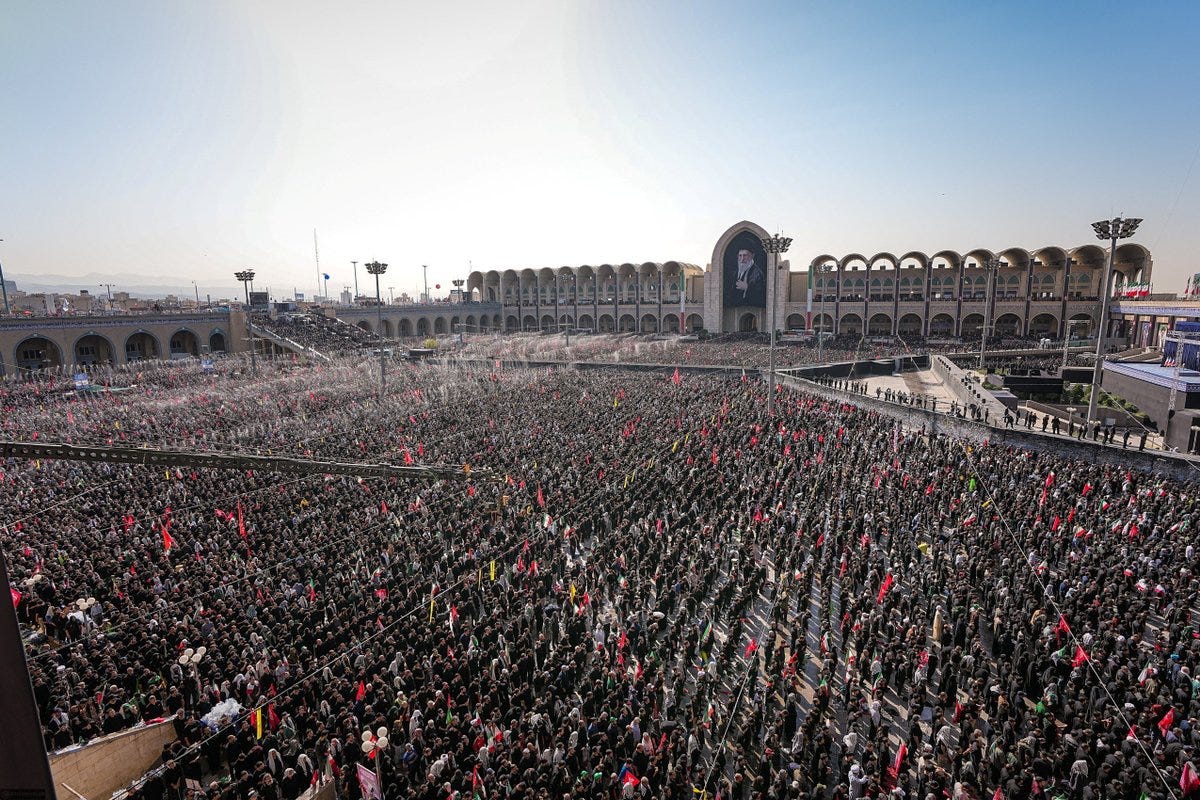
TEHRAN, PUREWILAYAH.COM — The public farewell ceremony for the martyred Leader of the Islamic Ummah, Sayyed Ali Khamenei, concluded on Sunday evening in Tehran after nearly two days of continuous mourning at Imam Khomeini Mosalla, marking the final stage before Monday’s official funeral procession.
The closing moments of the ceremony saw the curtain lowered over Sayyed Khamenei’s coffin for the last time as it was illuminated in red, symbolizing mourning, while the anthem “Be Aman Allah Ya Shahid Allah” (”Go in God’s Protection, O Martyr of God”) echoed throughout the prayer hall.
The farewell, which began on Saturday morning, drew an uninterrupted stream of mourners from across Iran, including families of martyrs, resistance fighters, religious scholars, civilian and military officials, and foreign delegations. Organizers extended the ceremony to accommodate the continuous arrival of visitors paying their final respects.
Throughout the two-day gathering, Imam Khomeini Mosalla became the center of national mourning as visitors recited the Holy Quran, offered prayers, and renewed their pledge to the ideals of the Islamic Revolution and its martyrs.
Funeral Procession to Continue Across Iran and Iraq
Following the conclusion of the farewell ceremony, Sayyed Khamenei’s body was transferred from Imam Khomeini Mosalla to continue the remaining stages of the funeral rites.
The official funeral procession is scheduled for Monday morning in Tehran, where millions of people are expected to join senior Iranian officials and international guests.
The funeral ceremonies will continue over six consecutive days across several Iranian cities before extending to Iraq. Organizers estimate that between 15 and 20 million mourners may participate, potentially making it the largest state funeral in Iran’s history.
According to the announced schedule, the body will travel from Tehran to Qom before being taken to the holy Iraqi cities of Najaf and Karbala. It will then return to Iran for burial on July 9 at the shrine of Imam Reza in Mashhad.
Iranian Military Renews Pledge of Loyalty and Vows Revenge
On the final day of the farewell ceremonies, senior Iranian military commanders reaffirmed their loyalty to the late Leader, pledged to continue his path, and vowed that those responsible for his assassination would face punishment.
Iranian Army Commander Major General Amir Hatami said Sayyed Khamenei had “drawn a path of dignity and independence” and had prepared the nation to continue along that course.
He declared that the armed forces “will continue the path behind our commander Sayyed Mojtaba Khamenei with unwavering strength and determination,” adding that Iran “will not allow the enemies to escape punishment” and that those responsible “will be held accountable for their crimes.”
Deputy Commander of the Armed Forces Admiral Habibollah Sayyari likewise emphasized that the martyred Leader “will remain alive in our minds forever” and affirmed that the armed forces would continue to follow his guidance.
“We made a pledge to remain with our martyred leader, and today we renew that pledge,” Sayyari said, stressing that the determination to avenge his assassination remains firmly rooted.
Millions Gather in One of Iran’s Largest Public Commemorations
The farewell ceremonies have drawn millions of mourners to Tehran in what has become one of the largest public gatherings in the country’s modern history.
Iranian government spokesperson Fatemeh Mohajerani described the scale of public participation as a reflection of Iran’s national unity and resilience, noting the significant number of people who traveled from across the country to attend.
She said the massive turnout represented “one of the manifestations of our national strength,” adding that the enthusiastic participation demonstrated that “our dignity and our system continue to endure.”
Mohajerani also said a special national committee had coordinated the funeral arrangements through regular planning meetings involving government institutions and provincial authorities to ensure the smooth organization of the ceremonies. (PW)