

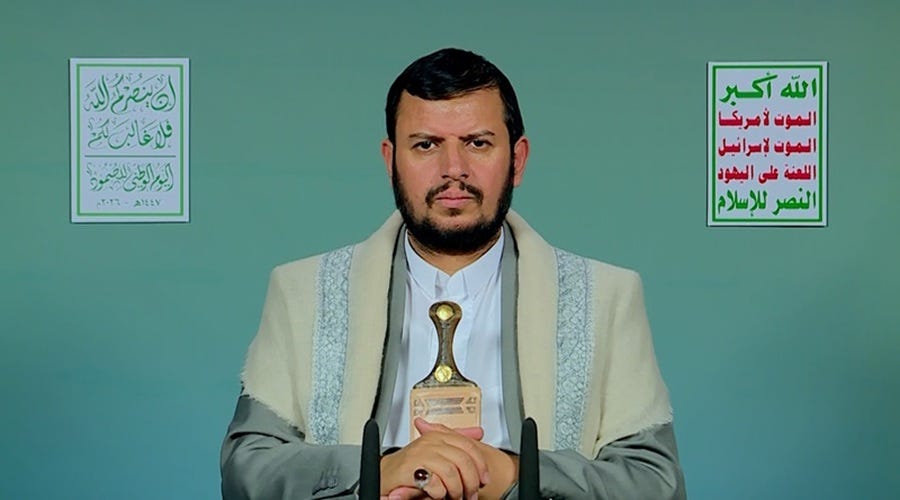
Yemen, PUREWILAYAH.COM - In a landmark address marking Yemen’s National Day of Resilience (1447 AH), Sayyed Abdul-Malik al-Houthi articulated a comprehensive strategic vision that firmly positions Yemen at the heart of the ongoing regional and international confrontation.
The speech moved beyond a recounting of events, laying the foundation for a value-based and operational framework that merges political realism with faith-driven commitment.
“What was once hidden is now openly declared in the enemy’s own plans.”
At its core, the address sought to dismantle what al-Houthi described as fully exposed Zionist-American projects, which he argued no longer require intelligence efforts to uncover, having become openly declared in political and military discourse—particularly through references to reshaping West Asia and advancing the concept of “Greater Israel.”
No Neutrality: Yemen Aligns with Iran and the Resistance Axis
A central message of the speech was the unequivocal rejection of neutrality.
Al-Houthi made it clear that Yemen will not remain neutral in the face of aggression against Iran, declaring that any attack on Tehran—or on any Arab or Muslim nation—constitutes a direct attack on Yemen itself.
“We will not remain neutral in the face of aggression against Iran. Any aggression against Iran or any Arab or Muslim country is a direct aggression against Yemen.”
This position effectively nullifies international attempts to isolate Yemen’s conflict from broader regional dynamics in exchange for political or economic concessions.
The alignment with Iran was framed as both strategic and moral, grounded in a principle of reciprocity, with al-Houthi reminding that Iran stood alongside Yemen during its most difficult years under sustained aggression.
A Unified Front: Yemen, Palestine, and Iran
The speech established a direct link between the Yemeni struggle, the Palestinian cause, and the aggression against Iran, forming what was described as a triangle of resilience.
“The suffering of Yemen, Palestine, and the aggression against Iran form one front of resilience.”
Al-Houthi warned that silence and neutrality among Arab states will not guarantee their security, but will instead accelerate their vulnerability—predicting that the Zionist project will expand its targets sequentially across the region, from the Arabian Peninsula and Iraq to Egypt, Jordan, Syria, Lebanon, and beyond.
“Silence and neutrality will not protect the region—it will only make each country a target, one after another.”
The message aimed to mobilize public consciousness across the Arab and Islamic worlds, transforming the confrontation into a collective struggle rather than fragmented crises.
Military Shift: Erosion of U.S.–Israeli Superiority
On the military level, al-Houthi pointed to what he described as a transformation in the balance of power.
He highlighted the growing effectiveness of missiles and drones within the resistance axis—particularly their ability to penetrate layered air defense systems, from U.S. bases to deep inside the Zionist entity.
This shift reflects a new operational reality in which geography no longer defines the battlefield, and where saturation tactics and multi-front engagements have eroded the long-standing superiority of U.S.–Israeli air defense systems.
According to this assessment, American bases across the region are increasingly exposed and vulnerable in the face of evolving resistance capabilities.
Political Dimension: Collapse of the Neutrality Doctrine
Politically, the speech marked what can be interpreted as the formal collapse of neutrality in the face of what was described as an existential conflict.
Yemen’s stance signals a transition from a localized conflict actor to a regional force with the capacity to influence strategic outcomes based on its own military strength, alliances, and independent decision-making.
Al-Houthi also criticized Arab governments that have aligned with or facilitated the integration of the Zionist entity into the region, calling for a redefinition of the Arab world based on resistance rather than externally imposed frameworks.
Ideological Core: Resistance as a Religious Duty
At the ideological level, the speech framed the confrontation not as a conventional geopolitical conflict, but as a religious obligation.
Al-Houthi described the struggle as a form of jihad against what he termed the “tyranny of the age,” referring to the U.S. and its Zionist ally, thereby elevating the conflict beyond political calculation into the realm of faith and duty.
“This is not a conflict of interests—it is a duty of jihad against the tyranny of this era.”
“This battle does not accept political deals.”
This framing removes the possibility of compromise, positioning resistance as a sacred responsibility and reinforcing a model of fighters driven by belief rather than material considerations—an element that has challenged conventional Western military analysis.
The Battle of Awareness: From Hidden Plans to Open Strategy
A key theme in the speech was what al-Houthi described as a moment of “historical exposure.”
He argued that Zionist strategies, once hidden, are now openly articulated in official discourse, making the threat undeniable.
He warned that attacks on Iran, Gaza, or Beirut are not isolated events, but part of a broader trajectory that could extend to major cities across the region, including Mecca, Medina, Cairo, and Baghdad.
The emphasis on awareness reflects an effort to transform understanding of the threat from elite circles into widespread public consciousness—laying the groundwork for sustained resistance.
Yemen Emerges as an Irreversible Force in the Regional Equation
The speech ultimately cements Yemen’s position as a central political and military force in the evolving regional landscape.
It signals a decisive break from dependency and external control, reinforcing Yemen’s full integration into a resistance axis stretching from Sanaa to Tehran, and across Gaza, Beirut, Baghdad, and Damascus.
“We will never hesitate to fulfill our Islamic duty against the Americans and the Zionists.”
As the conflict expands, al-Houthi’s message outlines a new phase: one defined by unified fronts, ideological clarity, and sustained confrontation—placing the U.S.–Israeli alliance before a consolidated and increasingly resilient bloc. (PW)