

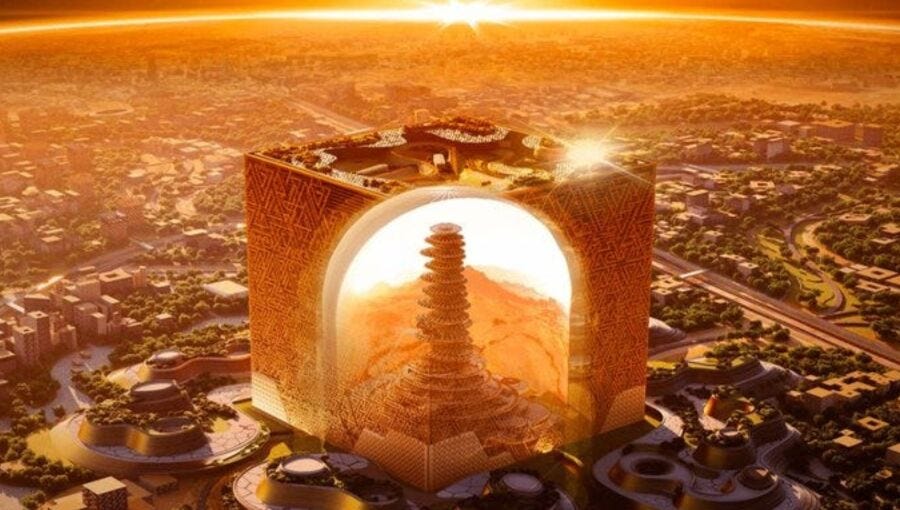
Saudi Arabia | PUREWILAYAH.COM – Saudi Arabia has suspended construction of the Mukaab, a colossal cube-shaped megastructure planned for central Riyadh that has drawn widespread criticism across the Muslim world for its Ka‘bah-like design, as mounting financial pressure forces authorities to reassess the sustainability of one of the most heavily promoted symbols of Crown Prince Mohammed bin Salman’s Vision 2030 agenda, sources told Reuters.
The project has long been described by critics as an attempt to replicate, rival, or desacralize the Ka‘bah—Islam’s holiest site—by reproducing its form within a commercial and entertainment-driven complex.
While the suspension is driven by financial constraints rather than public backlash, the controversy has consistently shadowed the project since its announcement.
Flagship Project Put on Ice
The Mukaab — a 400-by-400 meter cubic structure envisioned as the centerpiece of the $50 billion New Murabba development — was marketed by Saudi authorities as a landmark of economic “transformation.”
However, construction beyond initial soil excavation and foundation pilings has now been halted, with officials reviewing the project’s long-term financing and feasibility. While surrounding real estate development is set to continue, the future of the cube itself remains unresolved.
The pause marks a rare but telling interruption in Riyadh’s carefully curated narrative of uninterrupted progress under Vision 2030.
Fiscal Pressure Exposes Vision 2030 Limits
The suspension comes as Saudi Arabia confronts tightening fiscal conditions, with oil prices remaining below levels required to comfortably bankroll multiple capital-intensive megaprojects without straining state finances.
Sources familiar with the matter said the $925 billion Public Investment Fund (PIF) has begun scaling back Vision 2030 ambitions, shifting resources toward projects deemed more immediately monetizable, while reassessing high-cost ventures whose returns remain uncertain.
The recalibration follows mounting losses and writedowns, forcing Riyadh to confront what critics describe as an overextended development model driven more by spectacle than economic fundamentals.
New Murabba Delayed, Timelines Slip
New Murabba, originally slated for completion by 2030, has reportedly been pushed back to 2040, underscoring widening gaps between official timelines and delivery capacity.
The delay reinforces criticism that Vision 2030 megaprojects — including The Mukaab and NEOM — have been built on unrealistic assumptions, ballooning budgets, and aggressive projections that falter under real-world economic conditions.
Saudi Arabia has increasingly shifted away from capital-intensive futuristic megaprojects toward ventures viewed as more urgent or commercially viable, including World Expo 2030, 2034 World Cup infrastructure, the Diriyah Gate cultural zone, and the Qiddiya tourism project, according to multiple sources.
Controversy Remains as Financial Reality Sets In
Although Riyadh’s decision to halt construction is rooted in budgetary pressure and cost control, the unresolved controversy surrounding the Mukaab continues to undermine its legitimacy.
The project has drawn sustained criticism across the Muslim world, with critics saying the cube-shaped design resembles the Ka‘bah and questioning its use within a commercial and entertainment-driven development.
The structure was planned to house shopping malls, luxury hotels, residential units, and entertainment complexes, effectively transforming a cube-shaped monument into a large-scale commercial hub.
Saudi authorities have not publicly addressed these concerns.
Financial Reality Overtakes Vision
The halt of the Mukaab underscores the growing financial limits confronting Saudi Arabia’s Vision 2030 agenda.
Once promoted as an icon of transformation, the Mukaab now stands as a symbol of how financial reality—rather than ambition or rhetoric—is forcing Riyadh to scale back projects that proved too costly, too controversial, and too detached from economic fundamentals. (PW)