

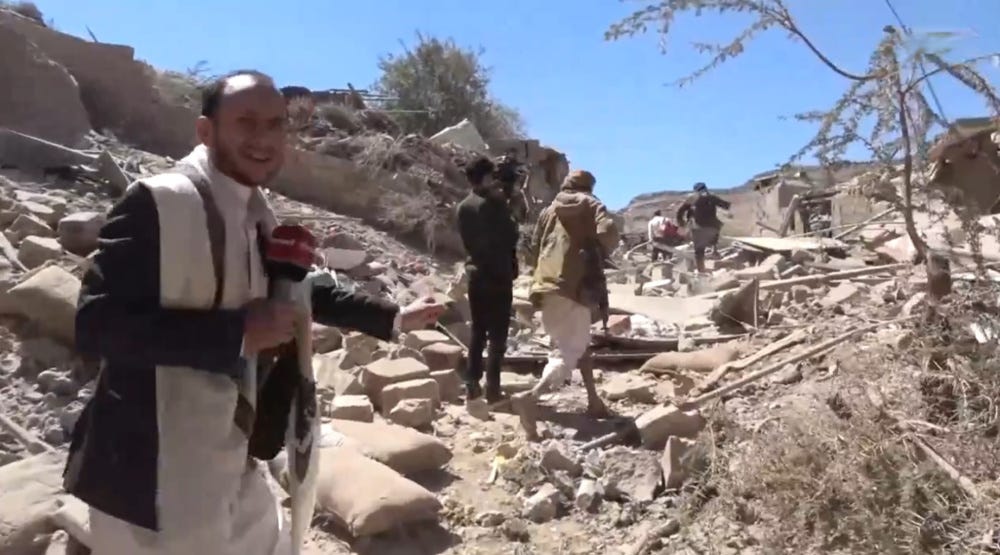
SANA’A — A senior Yemeni official has strongly condemned recent Saudi airstrikes targeting members of an al-Masirah TV crew near the capital, describing the attack as undeniable proof of Riyadh’s repressive approach toward press freedom.
In a statement released on Sunday, Mohammed Ali al-Houthi, a prominent member of Yemen’s Supreme Political Council, denounced the aerial bombardment of journalists, photographers, and media professionals. He characterised the strikes as a “deliberate act of terrorism” and a direct assault on the fundamental right to report the news.
According to al-Houthi, the attacks are calculated efforts to blind the international community to the realities on the ground. He stated that the targeting of the press seeks to prevent the world from witnessing the massacres, high casualty rates, and extensive destruction perpetrated by Saudi forces. Furthermore, he argued, the strikes are designed to destroy evidence of war crimes and atrocities committed against the Yemeni people in a bid to evade international accountability.
The senior official highlighted a grim pattern of violence against the press, recalling previous Saudi attacks on al-Masirah TV teams across multiple Yemeni provinces, including Shabwah, Hajjah, Sa’ada, and Sana’a. Beyond physical violence, al-Houthi noted repeated attempts to censor the channel through the cessation of satellite broadcasts, internet blackouts, and removal from social media platforms.
He asserted that Saudi Arabia is utilising “criminal means” to silence Yemeni media outlets to propagate fabrications against the country at the behest of the United States and Israel. Such actions, he stressed, constitute clear war crimes under international humanitarian law and relevant global conventions.
The incident is the latest flashpoint in a rapidly escalating regional conflict. The current wave of hostilities intensified after Saudi Arabia bombed Sana’a’s international airport in July. In response, the Yemeni Armed Forces launched retaliatory strikes against Saudi airports, critical oil facilities, and tankers in the Red Sea, while enforcing a reciprocal “blockade for blockade” policy.
The broader conflict traces back to March 2015, when Saudi Arabia launched a devastating military campaign against Yemen in an attempt to restore a Riyadh-friendly government. The protracted war has triggered one of the world’s most severe humanitarian crises and claimed hundreds of thousands of lives, yet Saudi Arabia remains far from achieving its stated strategic objectives.
Reference: PressTv