

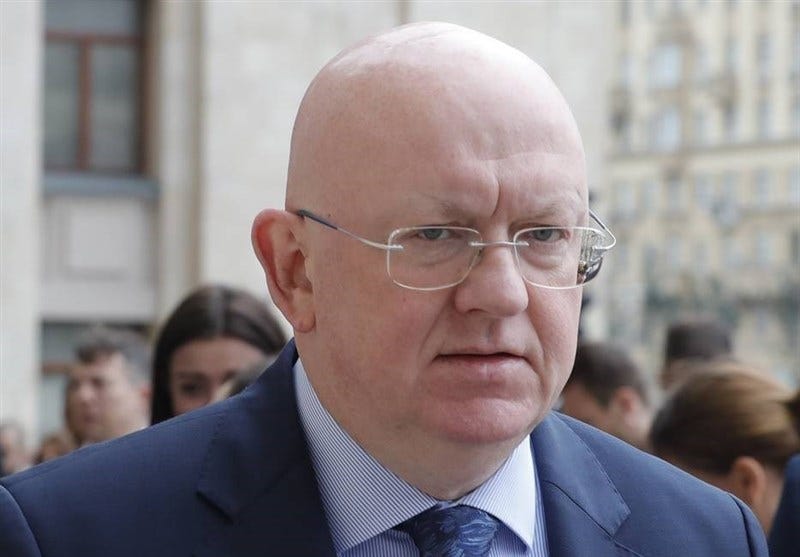
Russia | PUREWILAYAH.COM — Russia’s Permanent Representative to the United Nations, Vassily Nebenzia, has stated that the Islamic Republic of Iran is now better prepared to face any potential military aggression than it was in June 2025, amid continued threats and escalating pressure from the United States.
Speaking in an interview with the Rossiya-24 television channel, Nebenzia said that while the possibility of a military strike against Iran cannot be ruled out, Tehran’s level of preparedness has increased compared to last summer.
“The situation is alarming. A strike could be launched. However, I think Iran is better prepared for such a turn of events now than it was in June,” Nebenzia said.
He also advised Washington to act with caution, warning against reckless decisions that could destabilize the region.
“That is why we all advise the Americans to measure twice and cut none,” he added.
U.S. Militarism and Escalatory Signals
Nebenzia’s remarks come after U.S. President Donald Trump announced that a large naval armada was heading toward Iran, framing the move as pressure to force Tehran back to negotiations on Washington’s terms.
Trump claimed he hoped Iran would return to what he described as a “fair and equitable deal,” while repeating demands centered on the complete elimination of Iran’s nuclear capabilities—conditions long rejected by Tehran as illegitimate and coercive.
The U.S. president also referenced American strikes carried out in June 2025 against Iranian nuclear facilities, an act of military aggression that Washington dubbed “Operation Midnight Hammer.” Trump warned that any future attack would be “even worse,” a threat widely seen as an attempt at intimidation rather than diplomacy.
Tehran’s Position: Strength and Deterrence, Not Submission
Iran has consistently rejected U.S. threats and sanctions, emphasizing that its defensive capabilities and national security are non‑negotiable. Iranian officials have repeatedly stated that pressure and military intimidation will not force Tehran into submission, but will instead reinforce its resolve to defend sovereignty and regional stability.
Russia’s assessment that Iran is now more prepared than in June 2025 reinforces this position, highlighting that continued U.S. militarism and Israeli‑backed escalation strategies have failed to weaken Iran, while increasing the risk of a broader regional confrontation.
Nebenzia’s warning reflects growing international concern that Washington’s aggressive posture—often aligned with Israeli interests—could ignite a conflict whose consequences would extend far beyond Iran, threatening the stability of West Asia and the global order.
Russia’s Position
The Kremlin is keeping a close eye on the developments around Iran, Russian President Vladimir Putin said at the talks with his visiting UAE counterpart, Mohammed bin Zayed Al Nahyan.
Earlier, the Russian leader held phone talks with Israeli Prime Minister Benjamin Netanyahu and Iranian President Masoud Pezeshkian.
The situation in the Middle East and around Iran was the focus of Putin’s call with Netanyahu.
The Russian leader reiterated Russia’s readiness to “continue relevant mediatory efforts, promote a constructive dialogue involving all countries concerned.”
During the phone call with Pezeshkian, the two leaders spoke in favor of the soonest normalization of the situation around Iran and in the region in general.
The Kremlin calls for showing restraint and rejecting force methods of settling the situation around Iran, Russian presidential press secretary Dmitry Peskov said.
He also noted that there’s still room to negotiate and the use of force will only create chaos in the region.
Commenting on the United States’ potential aggression against Iran, Russia’s Permanent Representative to the United Nations Vasily Nebenzya advised Washington to “measure twice and cut none.”
Iran is now better prepared for a potential attack than it was in the summer of 2025, he noted.
Global Reaction
Gulf countries, including Qatar, Oman, and the United Arab Emirates, are trying to prevent a new war between the United States and Iran, The Financial Times reported
According to the newspaper, Arab and Muslim states “have been engaging with both the US and Iran in a bid to de-escalate tensions” between the two countries.
Specifically, they are trying to dissuade President Donald Trump from attacking Iran.
These countries fear that such a move could “trigger a broader conflict in the Middle East and cause Tehran to target oil and gas facilities in the Gulf,” the newspaper noted.
Azerbaijan will never allow its territory or airspace to be used to carry out strikes against Iran, Foreign Minister Jeyhun Bayramov said during a phone call with his Iranian counterpart, Abbas Araghchi.
According to the top Azerbaijani diplomat, his country rejects any steps and rhetoric thatcould destabilize the situation in and around Iran. (PW)