

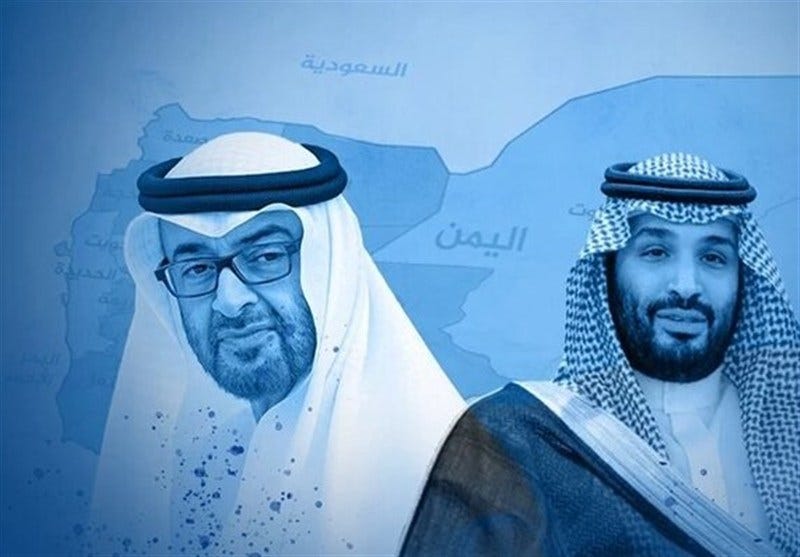
Yemen | PUREWILAYAH.COM - Yemen has once again become the stage for escalating tensions between Saudi Arabia and the United Arab Emirates, as their once-aligned proxies in the south and east of the country turn against one another.
Developments in late 2025 reveal that the war imposed on Yemen is now consuming its own architects, with coalition-backed factions entering a phase of direct confrontation over territory, resources, and strategic dominance.
What is unfolding is no longer a hidden rivalry, but a structural fracture within the Saudi–Emirati axis—one that further destabilizes Yemen and exposes the true nature of the foreign intervention launched under the banner of “legitimacy.”
Yemen’s De Facto Political and Military Division
For more than a decade, Yemen has endured war, blockade, and fragmentation. The current reality reflects a de facto division of the country into two main zones:
Northern Yemen, including the capital Sana’a, remains under the authority of Ansarallah, which continues to exercise centralized governance and military control.
Southern and eastern Yemen are dominated by forces aligned with the so-called “international coalition,” itself fractured between Saudi-backed and Emirati-backed factions.
Western states continue to recognize the Aden-based government led by Rashad al-Alimi, which operates under Saudi sponsorship. However, this recognition stands in stark contrast to realities on the ground, where the government’s authority has steadily eroded.
UAE-Backed STC Expands Control in the South
The Southern Transitional Council (STC), openly supported by the UAE, has significantly expanded its military and administrative footprint across southern and eastern Yemen. Reports indicate that the STC has taken control of large areas, including key provinces such as Hadramawt and al-Mahra, with influence extending toward Marib.
Some reports even suggest that the STC now exercises full control over eight southern provinces, a development without precedent since Yemen’s unification in the 1990s.
This expansion has included the seizure of:
Oil- and gas-rich areas
Military installations
Government buildings and infrastructure
These moves have severely weakened the Saudi-backed authorities in Aden and reinforced the STC’s push for secession or, at minimum, far-reaching autonomy from any central Yemeni state.
A Coalition Turning Its Weapons Inward
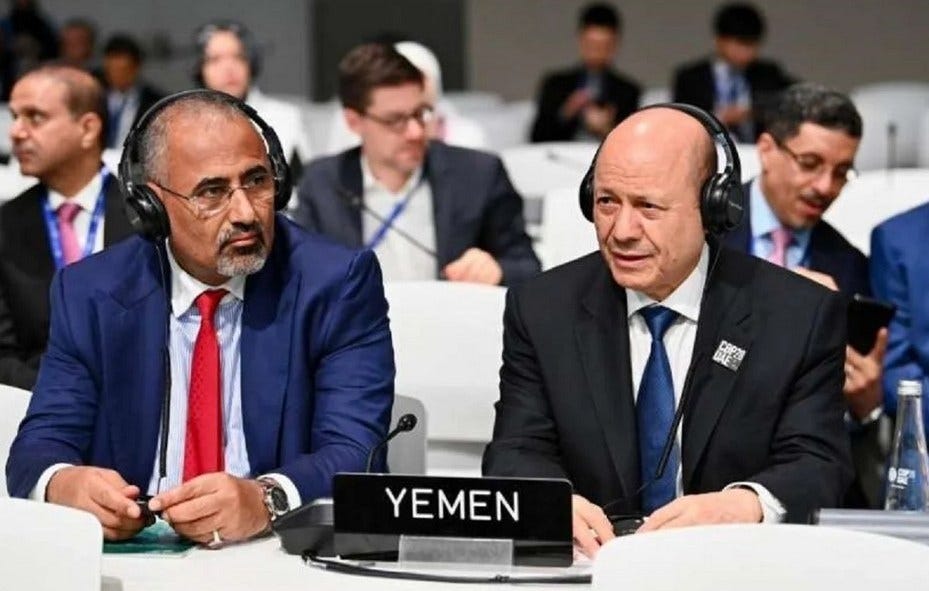
Tensions between the STC and the Saudi-backed Presidential Leadership Council have now escalated beyond political rivalry into direct military confrontation. The STC, led by Aidrous al-Zubaidi, has openly challenged the authority of the Aden-based government, revealing that the coalition imposed on Yemen is no longer capable of maintaining even internal cohesion.
Despite attempts by Saudi Arabia and the UAE to manage the crisis through joint delegations and political dialogue in Aden, these efforts have failed to halt the escalation. The reality on the ground points to an alliance unraveling under the weight of its own contradictions.
Armed Clashes in Hadramawt and al-Mahra
In early December 2025, fighting intensified sharply in Hadramawt, where STC forces clashed with units loyal to the Aden government in the desert areas of the province. According to military statements, approximately 32 soldiers were killed and 45 wounded.
These clashes mark a decisive shift from previous disputes—once framed as administrative or political—into open armed conflict between rival coalition-backed forces. The violence underscores the depth of the rift and the failure of coalition sponsors to impose discipline on their proxies.
Rashad al-Alimi’s Authority in Decline
The position of Rashad al-Alimi, head of the Presidential Leadership Council, has been further weakened by recent developments. Reports indicate that he has effectively left Aden, conducting his activities from Riyadh, a move widely interpreted as confirmation of his shrinking influence over southern Yemen.
Official statements from al-Alimi and his allies have called on STC forces to withdraw from seized areas and redirect their focus toward confronting Ansarallah. However, these appeals carry little weight as the Saudi-backed authority struggles to assert control even within territories it nominally governs.
Saudi Media and the Attempt to Manage the Narrative
Saudi media outlets, seeking to limit political damage, have largely avoided explicitly naming the UAE as the driver behind southern Yemen’s destabilization. Instead, coverage has emphasized the strategic importance of Hadramawt and al-Mahra to Saudi national interests, warning that STC advances have crossed “red lines.”
At the same time, reports suggest that Saudi political, media, and military pressure on the STC has intensified over the past 48 hours. This pressure unfolds alongside continued Emirati efforts to consolidate influence through proxy forces, exposing a widening struggle for dominance within the coalition itself.
Ansarallah and the Exposure of the Coalition’s Reality
As Saudi Arabia and the UAE compete over territory, resources, and strategic routes, Ansarallah remains the only actor operating outside this internal power struggle—positioned not as a proxy, but as a national force resisting foreign domination.
The coalition’s internal conflict lays bare a central truth: the war on Yemen was never about restoring legitimacy or stability. Rather, it has functioned as a project aligned with US and Israeli regional interests, aimed at controlling strategic waterways, weakening independent forces, and reshaping Yemen’s political geography.
Recent developments in southern and eastern Yemen demonstrate that tensions between UAE-backed STC forces and Saudi-backed authorities have entered a decisive and dangerous phase.
This is no longer a matter of political bargaining, but a struggle that threatens to redraw Yemen’s map, deepen fragmentation, and further destabilize the region.
As former allies engage in a silent war against one another, the Saudi–Emirati intervention continues to unravel—leaving Yemen exposed to greater division and suffering, while confirming that foreign-backed coalitions ultimately collapse under their own contradictions. (PW)
Source: Tasnim