

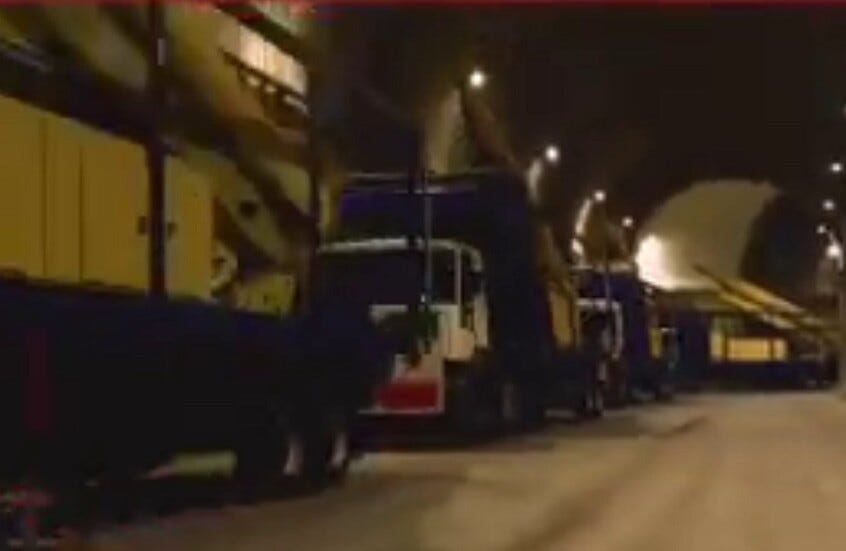
Tehran, PUREWILAYAH.COM — Seyed Majid Mousavi stated that Iran has intensified the rebuilding and upgrading of its missile and drone capabilities during the current ceasefire period, emphasizing that the pace of restoration now exceeds pre-war levels.
In a video released on social media, the IRGC Aerospace commander underscored that Iran is not merely replenishing its stockpiles but accelerating the operational readiness of launch platforms.
“During the ceasefire period, our speed in updating and filling missile and drone launch platforms is even greater than before the war,” he said.
Mousavi added that adversaries lack the capacity to sustain such conditions independently, noting that their reliance on long-distance supply chains forces them to transport ammunition incrementally from outside the region.
From Firepower to Staying Power
The developments point to a deeper transformation in the nature of modern warfare, where superiority is no longer determined by the scale of initial strikes, but by the ability to sustain and regenerate power under pressure.
Military observers note that wars of attrition expose the gap between “display power” and “sustainable power.” While many forces can deliver heavy opening blows, few can maintain operational momentum once logistical pressures intensify.
In this context, Iran’s strategy appears to center on what can be described as “operational resilience”—a capacity not only to absorb initial attacks without collapse, but to rapidly rebuild and return to the battlefield with renewed strength.
This approach has redefined temporary pauses in conflict. Rather than signaling retreat, ceasefire periods are being used as windows for expansion, enabling Iran to increase capabilities while adversaries miscalculate the battlefield dynamics.
Supply Chain Advantage vs. External Dependence
A critical element in this shift is Iran’s relative independence in production and logistics. Prolonged conflicts place enormous strain on supply chains, and reliance on extended, vulnerable routes has increasingly become a structural weakness for U.S. and allied forces.
By contrast, Iran’s domestically anchored and decentralized production networks allow for faster replacement cycles, greater adaptability, and sustained operational continuity under pressure.
This disparity becomes decisive over time. In wars of attrition, the central question is not who dominates the first phase, but who can continue fighting effectively deep into the conflict cycle.
Iran’s ability to replace resources at a rate that matches—or exceeds—its consumption creates an upward trajectory, gradually shifting the balance of power. Conversely, forces dependent on external resupply face cumulative erosion, reflected in reduced operational flexibility and growing strategic caution.
Psychological and Strategic Impact
Beyond the material dimension, the rapid rebuilding of capabilities sends a clear message: attempts to degrade Iran’s power structure have failed to produce lasting results.
This has implications for both battlefield calculations and broader strategic planning. If each strike is followed by accelerated recovery, the incentive for continued escalation weakens, while uncertainty grows within opposing command structures.
Such dynamics can force a reassessment of initial war objectives. Goals once framed around decisive victories or rapid weakening increasingly shift toward containment and crisis management.
A New Model of Warfare
The ongoing developments highlight a broader transformation in how power is defined and exercised. Military strength is no longer measured solely by inventory or technological edge, but by the ability to sustain a continuous cycle of production, deployment, and regeneration.
This evolving model places resilience and adaptability at the center of strategic advantage. Under such conditions, the decisive factor is not who possesses the most resources, but who can most effectively rebuild and redeploy them.
Iran’s actions during the recent ceasefire period illustrate this shift. What appears as a pause on the surface is, in practice, a phase of intensified preparation—reshaping the battlefield before the next round begins.
As the confrontation enters a prolonged phase, the ability to rebuild faster than the adversary may ultimately prove to be the defining factor in determining the outcome. (PW)
Source: MNA