

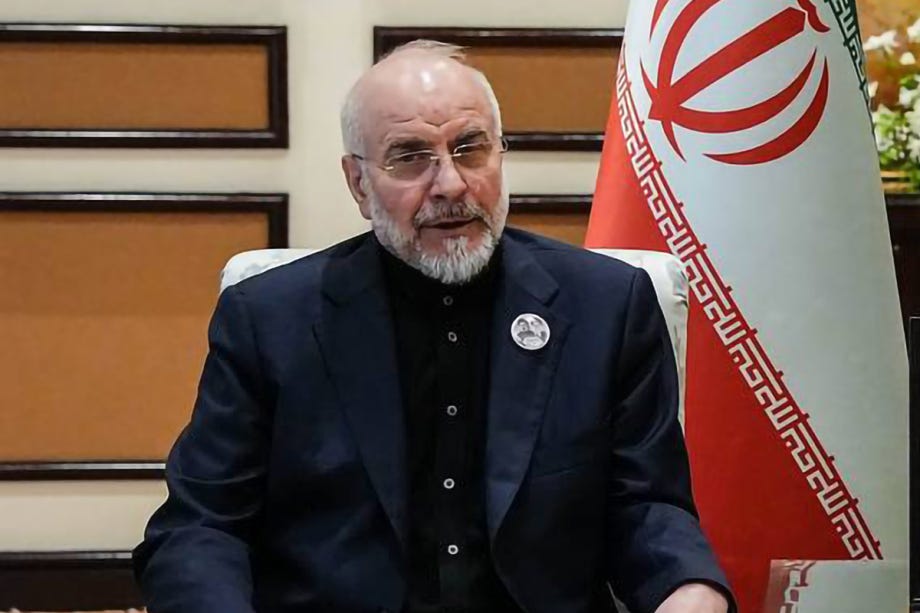
Iran, PUREWILAYAH.COM - Mohammad Bagher Qalibaf, head of Iran’s negotiating team, said the recently signed memorandum between Iran and the United States was not the result of compromise or concession, but the political outcome of a war in which Washington and Tel Aviv failed to achieve their declared objectives.
Speaking in a televised interview on Wednesday night, Qalibaf argued that Iran entered negotiations from a position of strength after what he described as a strategic victory on the battlefield.
“The difference between these negotiations and previous ones is that today the banner of victory on the battlefield stands behind the negotiating table,” he said.
According to Qalibaf, Iran’s Armed Forces confronted what he called the world’s most heavily armed military coalition and prevented it from achieving any of its announced goals.
Four Fronts of Struggle
Qalibaf described the conflict as a struggle unfolding simultaneously across four interconnected fronts: the military front, the people’s front, the diplomatic front, and the front of service to the public.
He said Iran’s success was not the product of military action alone but the result of coordination among all four arenas.
“The flag of struggle moved from one front to another according to circumstances,” he said. “All of them contributed to shaping Iran’s victory.”
Qalibaf praised the Iranian people for what he described as their unity and resilience during the conflict, arguing that public support provided the foundation for both military and diplomatic achievements.
Diplomacy Backed by Power
Throughout the interview, Qalibaf repeatedly rejected the notion that negotiations represent weakness.
He described diplomacy as another form of struggle and argued that negotiations can achieve objectives that military force alone cannot.
“When I speak of diplomacy, I mean diplomacy based on power,” he said.
Qalibaf recalled that even during the nuclear negotiations of previous years, he supported talks only if they functioned as a method of resistance rather than a path of surrender.
“In negotiations that are a method of struggle, there is neither capitulation nor empty sloganism,” he said.
According to Qalibaf, military power and diplomacy are not competing approaches but complementary tools. He argued that battlefield strength created the leverage necessary to secure political gains at the negotiating table.
“If negotiations had not existed, we would not have achieved our objectives,” he said. “At the same time, without the missile, the courage, and the power behind it, those achievements would not have been possible.”
How Lebanon Changed the Talks
One of the most revealing parts of Qalibaf’s account concerned the negotiations that took place while Israeli attacks continued in Lebanon.
He said a strike on Beirut’s southern suburb of Dahiyeh occurred while discussions were underway with mediators, dramatically altering the atmosphere of the talks.
According to Qalibaf, Iran immediately informed the other side that it would respond and warned that any further escalation would trigger a broader reaction.
He stated that several issues that had remained unresolved for nearly two months were settled within hours after Iran demonstrated its readiness to retaliate.
Qalibaf also revealed that Lebanon was one of Tehran’s primary concerns before negotiations even began.
He said Iran informed mediators that any talks would have to address the situation in Lebanon and the continued attacks against the country.
“Lebanon was one of the main axes of the negotiations from the beginning,” he said.
The Iranian negotiator credited a combination of diplomatic pressure and military deterrence for helping secure a broader ceasefire that extended beyond Dahiyeh to the rest of Lebanon.
No Trust in Washington
Despite the agreement, Qalibaf repeatedly stressed that Tehran maintains no trust in the United States.
He revealed that he told US Vice President J.D. Vance during discussions in Islamabad that Iran’s distrust of Washington was complete, citing decades of hostility and what he described as repeated American betrayals.
“Even if a final agreement is approved by the United Nations Security Council, it is still not enough,” he said.
“The guarantee is Iran’s power.”
Qalibaf argued that national unity, military capability, and what he described as Iran’s culture of resistance provide stronger guarantees than any international document.
He also emphasized that every Iranian commitment under the memorandum is based on the principle of reciprocal action.
“If America fails to fulfill its obligations, it is impossible for Iran to fulfill its obligations,” he said.
Turning Victory into Political Results
Qalibaf argued that military victories alone have little value unless they are transformed into political and legal achievements.
“Any victory that does not become a political and legal document ultimately loses its benefits,” he said.
He described the memorandum as a mechanism for translating battlefield successes into concrete outcomes, including the lifting of restrictions, economic gains, and political recognition of realities established during the conflict.
According to Qalibaf, some provisions that remained unresolved after weeks of negotiations were finalized only after Iran demonstrated both its military capabilities and its willingness to act.
“This is what powerful negotiation means,” he said.
The Next Front: Serving the People
While defending the negotiations, Qalibaf insisted that the country’s focus must now shift toward domestic priorities.
He said the front of public service should become the leading arena in the post-war period, calling on all branches of government to concentrate on economic recovery and improving living conditions.
Iran entered the conflict facing economic difficulties, he said, and many of those challenges were intensified by the war.
“The people must see the results,” he stated.
Qalibaf also called for reconstruction efforts and renewed support for the country’s armed forces, arguing that national strength and public welfare must advance together.
“The flag is now in the hands of the front of service to the people,” he said.
For Qalibaf, the agreement represents neither an end to the struggle nor a reason for complacency. Rather, he portrayed it as the latest phase in a broader confrontation that he believes was won through a combination of military power, national unity, and diplomacy conducted from a position of strength. (PW)