

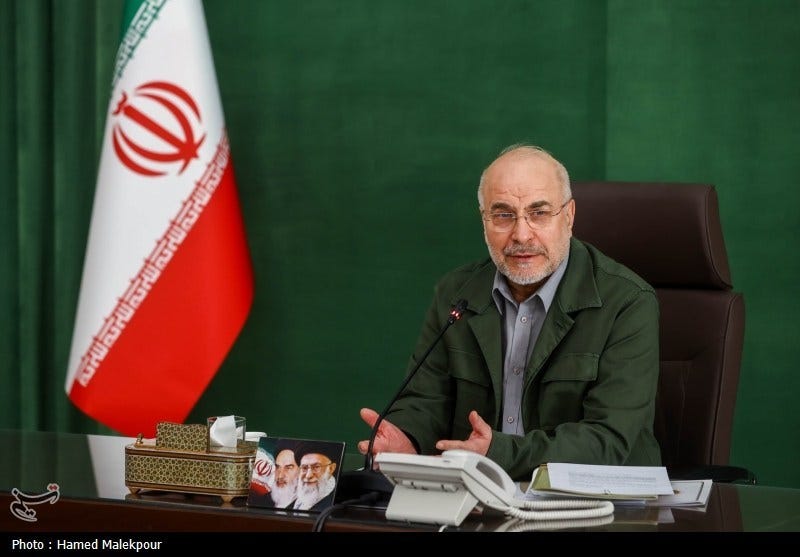
Iran, PUREWILAYAH.COM - Mohammad Bagher Qalibaf, Speaker of Iran’s Parliament, said the first message of the new Leader of the Islamic Revolution made clear that the people and the Islamic Republic are central to his vision.
He said the Iranian political system, rooted in divine and Qur’anic principles, is founded on Wilayat al-Faqih, which is not merely a political office but a divine station linked to the deputyship of Imam al-Mahdi (aj). According to Qalibaf, the Revolution triumphed through this very framework, which joined divine legitimacy with the people’s will and created a deep bond between the nation and the Imam.
He stressed that neither the Imam without the ummah, nor the ummah without the Imam, can endure, and said the people’s role remains essential in preserving both legitimacy and truth.
Referring to the first message of Ayatollah Sayyed Mojtaba Khamenei, Qalibaf said it showed that the people remain one of the Revolution’s firm pillars. He added that after the martyrdom of the previous leader and members of his family, the people came forward with even greater resolve.
The New Leader and the Strengthened Bond Between Imam and Ummah
Qalibaf said the people’s response after the martyrdom of the previous leader revealed the depth of their awareness and loyalty. During the 12-day war and the current conflict, he said, the people entered the field in a manner reminiscent of Ammar and ensured that the banner of leadership never fell during the transition period. He described the selection of the new leader as precise, timely, and carried out under extremely difficult security conditions.
He said the new leader represents a “second-phase” leadership that continues on the same line as the martyred leader while also paying close attention to the people and to the republican dimension of the system.
Qalibaf added that this concern was especially visible in the leader’s attention to the suffering of ordinary people, the martyrs’ families, and martyred children, rather than demanding constant military reporting. In his view, these developments both established a new leader and further strengthened the bond between Imam and ummah.
Iran’s Growing Military Experience and Battlefield Adaptation
On the war itself, Qalibaf said each stage of Operations True Promise 1, 2, 3, and 4 brought new quantitative, qualitative, and operational advances.
He argued that only real war reveals true military capability, especially in confrontation with a power like the United States, which presents itself as a global superpower in military, economic, and technological terms. He said Iran is proving its strength in an unequal war through faith, intelligence, creativity, and planning.
According to Qalibaf, although the enemy claimed to have neutralized Iran’s offensive power through bombers and fighter jets, Iran adapted rapidly and improved its capabilities, especially in confronting advanced drones through domestic technology.
He said Iran was surprised only once in the earlier 12-day war, particularly by the enemy’s targeting of senior commanders, but this time it responded in less than 30 minutes despite the martyrdom of top commanders in the opening strike. He emphasized that Iran did not allow the enemy to impose its operational design and instead continued to carry out its own plans.
He also said Iran’s asymmetric warfare, rooted in local creativity and design, has produced meaningful results, including the disabling of major enemy radar systems and the creation of an air defense crisis for the other side.
He praised martyred commanders such as Pakpour and Nasirzadeh, as well as current commanders like Seyed Majid Mousavi and Admiral Tangsiri, emphasizing that their performance is the result of the leadership and training shaped under the Commander-in-Chief, and a testament to the resilience of Iran’s military structure.
Iran Will Not Surrender and the Enemy Has Failed
Qalibaf said Iran neither wanted nor initiated war, but would stand firmly and courageously against any aggression. He said the Iranian nation, shaped by the blood of Imam Husayn (as), the culture of Ashura, and its own civilizational memory, will never submit to force. He argued that the Zionist regime has long oppressed other nations and committed crimes against humanity, especially in Gaza, but will not be able to repeat that pattern against Iran.
He acknowledged that the martyrdom of the Supreme Leader was a major blow, but insisted the enemy still failed in its larger aims. Rather than collapsing, he said, the system endured and a “young Khamenei” assumed leadership, frustrating the enemy’s strategic objective.
Qalibaf added that Iran’s presence and power remain visible, that the enemy failed to impose its plans, and that the people—especially the Basij—have remained in the field day and night, preserving the deep bond between Imam and ummah.
Hormuz, Regional Order, and Rejecting the Cycle of War and Ceasefire
Qalibaf said the enemy miscalculated badly, believing it could win within 72 hours, but instead saw its bases in the region targeted and rendered ineffective.
He stated that America’s presence has never brought security to the region and that recent events have proven this to neighboring states. On the Strait of Hormuz, he said its disruption was not caused by Iran’s desire to close it, but by the necessity of self-defense, and that the strait will not simply return to its previous condition because its old security framework has collapsed.
He said the future order of West Asia will change, but not according to American will. Instead, he argued, a regional order shaped by the countries of the region themselves must emerge.
He rejected any surrender to an American-Zionist framework and said Trump’s use of power has only generated war and instability. Qalibaf also firmly rejected the repeated cycle of war, ceasefire, negotiation, and renewed war, describing it as the longstanding method of the Zionist regime.
In his view, this cycle must be broken permanently, and stable regional security must be built by the peoples and states of the region themselves.
He concluded by saying that war, while dangerous, also contains opportunity. With faith, unity, sacrifice, and national creativity, he said Iran can emerge from this conflict stronger, victorious, and more dignified.
He praised the people’s extraordinary presence—especially women standing firm under bombardment—and said that today every neighborhood has become a frontline. He ended by thanking the people, youth, women, and officials, and expressed hope that Iran would soon see better days marked by dignity, security, and honor. (PW)
Realities, though . . .
A recent UN Security Council resolution tabled by Bahrain and co-sponsored by 35 nations, including India—a country whose Prime Minister Modi has been photographed embracing Netanyahu while benefiting from Israeli military technology sharing that even the United States hasn’t received. This resolution, which condemned Iran for allegedly targeting civilian infrastructure in Gulf states, passed with Russia and China abstaining (not using their Veto, as was also done for Gaza), a decision that has sent shockwaves of anger through some anti-imperialist circles and sparked intense debate about where these purported strategic partners truly stand.
Craig Mokhiber@CraigMokhiber
For the second time in four months (see res. 2803), the UN Security Council has today bowed to the US empire (and its vassals) and ignored international law on its behalf, and neither Russia nor China have acted to stop it through their veto rights. In the middle of the unlawful war.
+--+
USA is in a Crusades, and the Jewish State of Rape and Murder Occupied Palestine is in its Jewsades.
https://paulokirk.substack.com/p/america-is-the-biggest-cuntologyl