

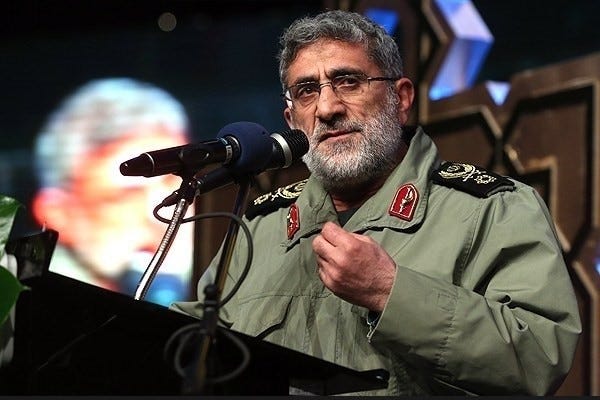
Iran, PUREWILAYAH.COM — Islamic Revolution Guard Corps Quds Force Commander Brigadier General Esmail Qaani declared on Monday that a new Resistance security belt is emerging across one of the world’s most strategic maritime corridors, warning that Israeli and American aggression would be met with a coordinated response from across the Resistance front.
In a statement issued amid rising regional tensions, Qaani said the Resistance Axis is establishing a new security architecture stretching from the Strait of Hormuz to the Bab al-Mandab Strait and from the Persian Gulf to the Red Sea.
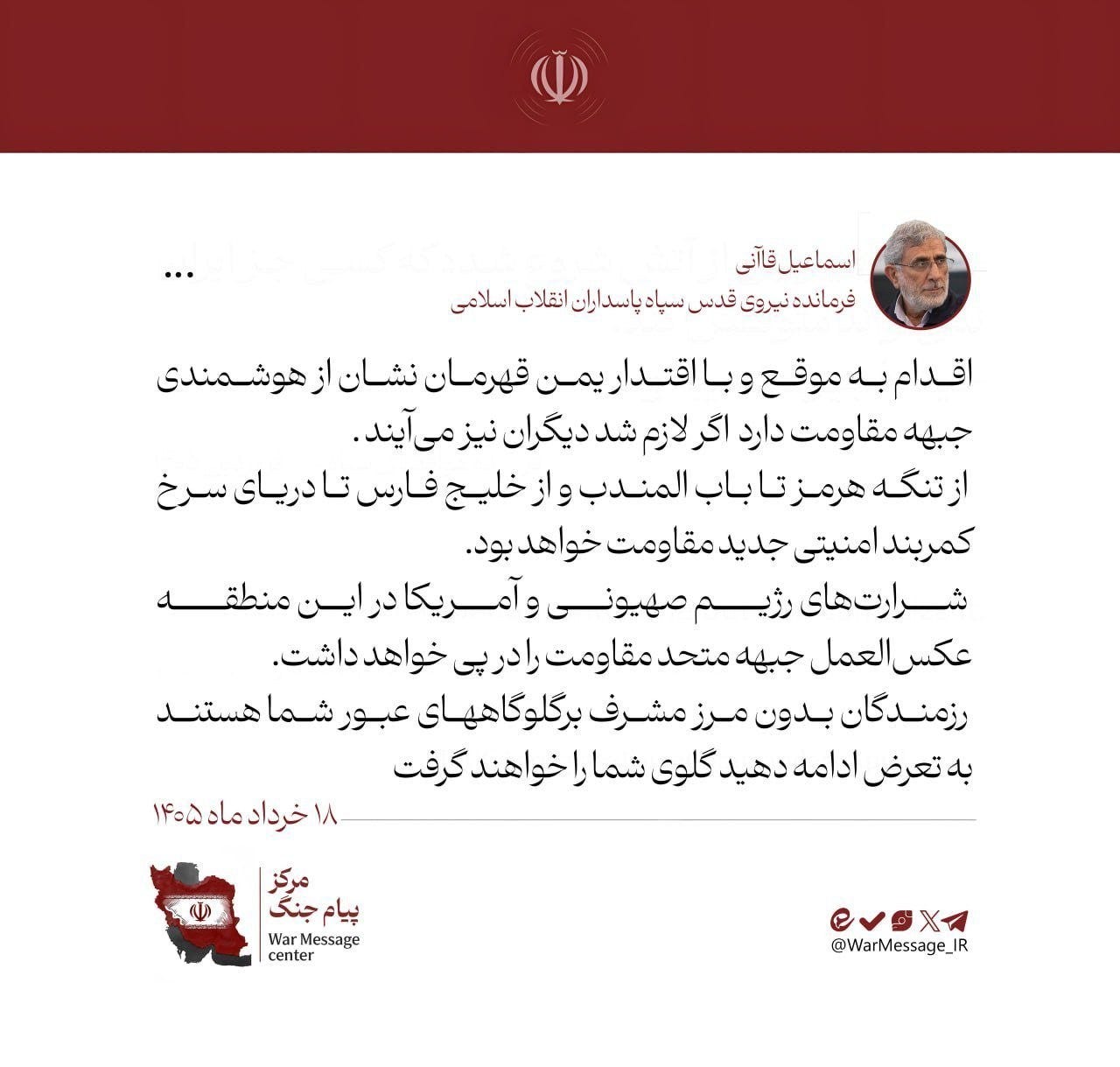
“From the Strait of Hormuz to Bab al-Mandab and from the Persian Gulf to the Red Sea, there will be a new security belt of Resistance,” Qaani said.
The remarks came after Yemen announced a complete ban on Israeli maritime navigation through the Red Sea and after Iran signaled that its recent military response to Israeli aggression had established a new deterrence equation in the region.
Qaani Praises Yemen’s Role
Qaani described Yemen’s recent intervention as a demonstration of strategic foresight and coordination within the Resistance front.
“The timely and powerful action of heroic Yemen reflects the wisdom of the Resistance front,” he said.
“If necessary, others will come as well.”
His remarks appeared to reinforce the concept of a united Resistance front, in which multiple actors may become involved when regional confrontations expand beyond a single battlefield.
Over recent days, Yemen has intensified military pressure on Israel through missile operations and a renewed maritime blockade targeting Israeli-linked shipping routes.
Warning to Washington and Tel Aviv
Qaani warned that Israeli and American actions across the region would not be viewed as isolated incidents but as actions carrying consequences across the entire Resistance Axis.
“The aggressions of the Zionist regime and the United States in this region will be met with the response of the united Resistance front,” he stated.
Addressing Israel and its allies directly, he issued a stark warning regarding the strategic waterways connecting the Persian Gulf and the Red Sea.
“Borderless fighters are overlooking your transit chokepoints.”
“If you continue your aggression, they will seize you by the throat.”
The statement reflected growing Iranian emphasis on the strategic importance of regional maritime routes, particularly the Strait of Hormuz and Bab al-Mandab, two waterways through which a significant portion of global energy and commercial shipping passes.
Iran Signals Confrontation Could Resume
Qaani’s remarks came as Iran’s Khatam al-Anbiya Central Headquarters announced that military operations had been suspended following a new wave of strikes against key and sensitive targets in the occupied territories.
The headquarters stated that a painful response had already been delivered but warned that any continuation of hostile actions could trigger a far more severe confrontation.
Iranian media reports indicated that Tehran accepted the current ceasefire arrangement under new conditions, warning that military operations could resume if Israeli attacks continue, particularly in Beirut and southern Lebanon.
The developments followed Israel’s attack on Beirut’s Southern Suburb on Sunday, which killed two civilians and injured twenty others.
Ghalibaf: Iran Will Prevent Aggression Against Lebanon
Iranian Parliament Speaker Mohammad Bagher Ghalibaf also stressed that Tehran would not allow continued Israeli aggression against Lebanon.
Ghalibaf said Iran would act through diplomacy, deterrence, or military means as circumstances require and rejected the notion that Tehran must choose between negotiations and resistance.
According to Ghalibaf, Iran remains committed to both tracks simultaneously.
He accused the United States of violating the ceasefire arrangement in Lebanon and criticized Washington’s approach toward ongoing negotiations.
Ghalibaf also affirmed that Iran’s armed forces remain on permanent high alert and pledged that the Iranian people would witness “another honorable victory.”
He emphasized that Iran’s objective is the establishment of lasting regional security rather than normalization with Washington. (PW)