

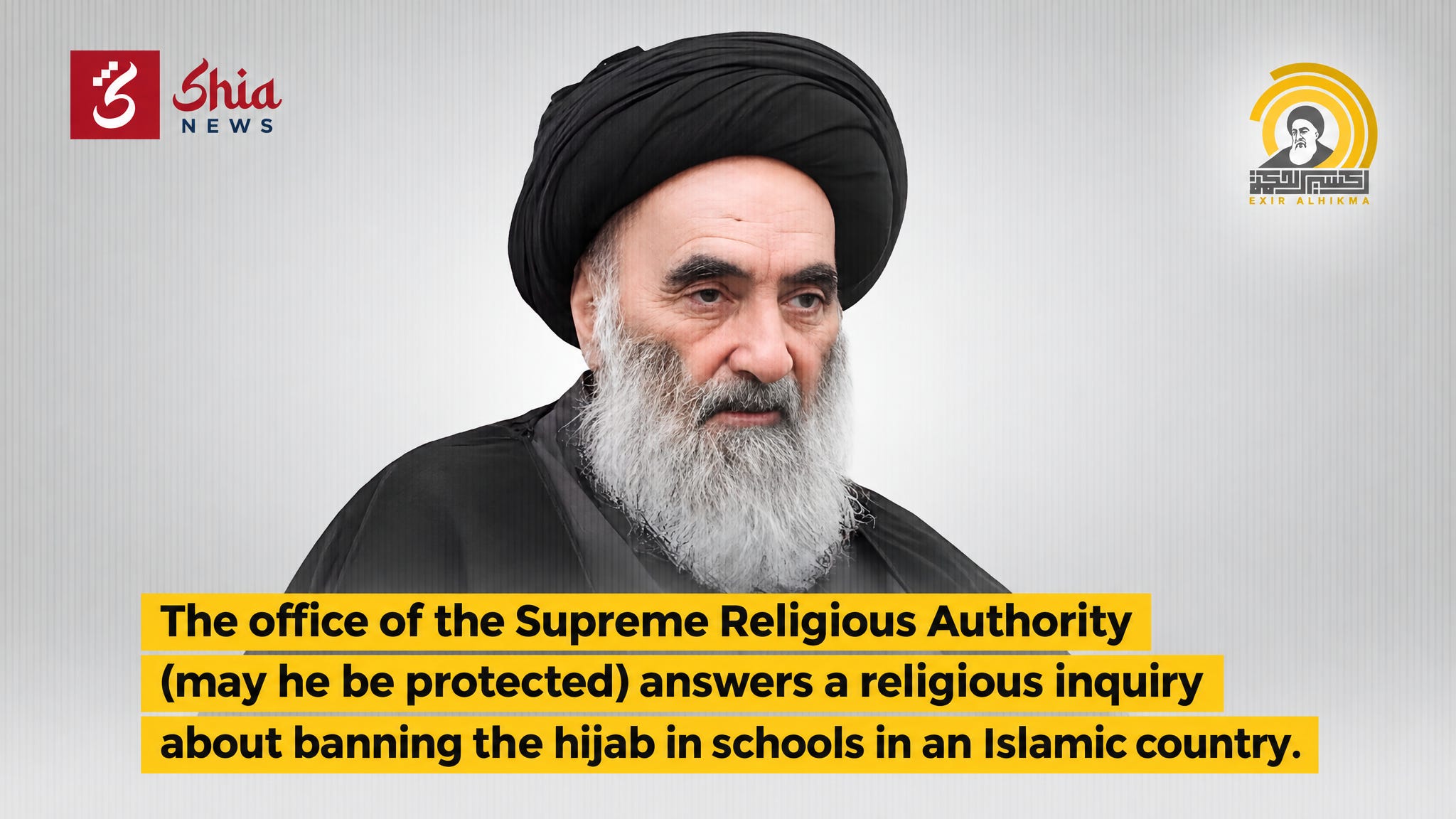
In an era where Islamic values face varying degrees of pressure globally, the guidance of the Marja’iyyah remains a vital compass for the Ummah. Recently, the Office of the Supreme Religious Authority of Grand Ayatollah Sayyid Ali al-Sistani addressed a pressing and sensitive question regarding the prohibition of the hijab in educational institutions within an Islamic country.
The inquiry brought to light a difficult scenario: What happens when systemic bans on the hijab clash with a Muslim woman’s religious obligations, and does the ruling for minorities in non-Muslim countries apply?
The Inquiry Posed to the Marja’iyyah
The question submitted to the Office of the Supreme Religious Authority outlined a specific and challenging situation. In certain schools for girls within an Islamic country, authorities introduced a strict uniform policy that prohibited female students from attending classes wearing a hijab. Furthermore, female teachers were forbidden from teaching while wearing the hijab.
This mandate resulted in significant harm and serious difficulties for the students and educators involved. The questioner sought clarity on the appropriate Islamic response:
Does the same religious ruling apply to these women as it does to Muslim women living in non-Muslim countries, where wearing the hijab might be prohibited by local authorities?
In non-Muslim countries, under conditions of extreme necessity and severe hardship, women are sometimes advised to adhere to the requirements of Islamic hijab to the greatest extent possible—such as covering most of the hair and the neck completely with high-collared clothing—deviating only as much as extreme necessity dictates. The questioner asked if this compromise applies to women in Islamic nations, or if a different ruling is required.
The Official Ruling
In its official response, the Office of Grand Ayatollah Sistani drew a firm distinction between personal hardship and the collective preservation of an Islamic society’s cultural and religious fabric.
The official fatwa stated:
“Personal necessity is not sufficient to justify complying with a requirement to abandon the hijab if such compliance leads to serious negative consequences for society as a whole, namely, it harms its cultural identity and contributes to further attempts by the authorities to eradicate its Islamic traditions. Therefore, these circumstances must also be taken into account. And only to Allah do we complain.”
Unpacking the Wisdom of the Fatwa
The core meaning of this ruling highlights a vital principle in Islamic jurisprudence regarding societal preservation versus individual convenience.
In situations where systemic attempts are being made to eradicate Islamic traditions from within an Islamic society, preserving religious values and the collective identity of the Ummah must take precedence over personal interests or individual difficulties.
While Islamic law often accommodates extreme personal necessity (such as a minority facing expulsion or severe persecution in a secular or non-Muslim country), yielding to a hijab ban in an Islamic country carries a much heavier societal cost. Compliance in this context does not just affect the individual; it normalises the erasure of Islamic identity, harms the cultural fabric of the community, and emboldens authorities to further strip away religious traditions.
Therefore, even if maintaining the hijab creates significant obstacles to a girl’s education or a woman’s employment, this personal hardship does not justify abandoning the obligation. The fatwa serves as a reminder that in the face of cultural erasure, steadfastness is required. It is crucial for the community not to give in to unjust pressure, but to courageously defend their God-given right to follow the precepts of Islam.
A Call to Steadfastness
For the readers of PureWilayah, this ruling is a profound reminder of our collective responsibility. The hijab is not merely a piece of cloth; it is a symbol of modesty, dignity, and submission to the will of Allah (SWT). When external forces attempt to strip the Ummah of its identity, the response must be rooted in patience, resilience, and unity.
As the Grand Ayatollah concluded his response with a poignant expression of reliance on the Divine: “And only to Allah do we complain.” In times of systemic pressure and difficulty, we place our trust in Allah, seeking His strength to uphold our faith and protect the identity of future generations.
Reference: Shia News