

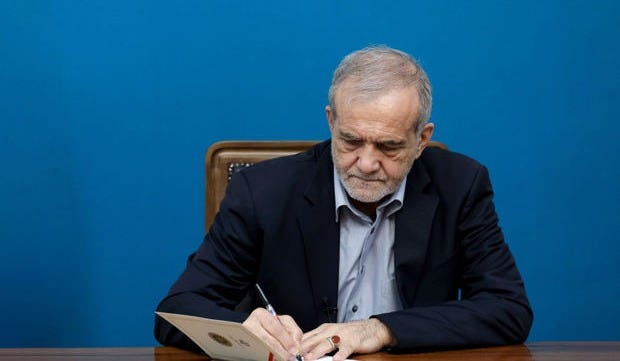
Iran, PUREWILAYAH.COM — Iranian President Masoud Pezeshkian has issued a direct message to the American public, asserting that Iran’s ongoing military actions are strictly defensive and a response to sustained aggression led by the United States and its allies.
In the letter, Pezeshkian drew a clear distinction between governments and ordinary citizens, emphasizing that Iran holds no hostility toward the people of the United States, Europe, or neighboring countries. Instead, he placed responsibility squarely on Washington’s policies, which he described as a pattern of intervention, coercion, and destabilization.
“What Iran has done, and continues to do, is a reaction and defense — not the initiation of war, aggression, or invasion,” he wrote.
The Iranian president stressed that Tehran has historically refrained from initiating wars despite possessing significant military capabilities. He argued that Iran’s defensive posture is a necessity in the face of expanding U.S. military presence and repeated attacks on Iranian territory and infrastructure.
U.S. Policies Manufacture Threats and Prolong Conflict
Pezeshkian sharply criticized the United States for deliberately constructing the image of Iran as a threat in order to justify military expansion, sustain arms industries, and maintain geopolitical dominance.
He pointed to the concentration of U.S. military bases surrounding Iran as evidence of a long-term strategy of pressure and containment, stating that recent attacks launched from these positions expose the true nature of Washington’s presence in the region.
According to the letter, the current confrontation is the direct result of a series of American decisions, including the withdrawal from the nuclear agreement and repeated military actions during diplomatic processes — moves he described as destructive and destabilizing.
Historical Grievances Fuel Deep Distrust Toward Washington
The Iranian president highlighted decades of grievances shaping Iran’s distrust toward the United States, citing the 1953 Iranian coup d’état as a defining turning point that derailed Iran’s democratic trajectory.
He further referenced U.S. support for Saddam Hussein during the Iran-Iraq war, prolonged sanctions, and direct military actions as factors that have deepened hostility and mistrust among the Iranian population.
Despite these pressures, Pezeshkian stated that Iran has strengthened internally, pointing to advancements in education, technology, healthcare, and infrastructure as evidence of resilience in the face of external pressure.
Civilian Targets and War Crimes
Pezeshkian stated that the United States is targeting civilian infrastructure, including energy facilities and medical-related industries, describing these actions as war crimes with consequences that extend far beyond Iran’s borders.
He warned that continued military escalation will deepen humanitarian suffering and fuel long-term instability and cycles of resentment across the region and beyond.
The president also raised pointed questions to the American public, asking what tangible benefit such a war brings to ordinary citizens in the United States, and whether the destruction of civilian life and infrastructure serves any legitimate national interest.
Israel’s Role and the Cost to American Taxpayers
In a direct challenge to Washington’s strategic priorities, Pezeshkian stated that the United States has entered the conflict as a proxy acting under the influence of Israel, with the regime driving escalation while avoiding direct costs.
He emphasized that the war is being fought at the expense of American lives and taxpayer money, while destabilizing the broader region and allowing Israel to remain shielded from the consequences.
Call for Truth and a Shift Away from Confrontation
Concluding his message, Pezeshkian urged Americans to question media narratives and seek independent perspectives on Iran, pointing to the country’s global academic and professional contributions as evidence contradicting dominant portrayals.
He warned that continued confrontation will only bring greater costs without sustainable outcomes, framing the choice between conflict and engagement as decisive for future generations.
“Choosing confrontation over interaction,” he stated, “will only impose heavier burdens and shape a future defined by instability.”
The letter stands as a direct appeal from Tehran to the American public, challenging official narratives and presenting Iran’s actions as a legitimate defense against ongoing U.S.-led aggression.
The Full Text of The Letter
In the Name of God, the Most Compassionate, the Most Merciful
To the people of the United States of America, and to all those who, amid a flood of distortions and fabricated narratives, seek truth and a better life,
Iran—by this very name, this identity, this existence—is one of the oldest continuous civilizations in human history. Despite possessing historical and geographical advantages at various points, it has never, in its modern history, chosen the path of militarism, aggression, colonialism, or domination. Even while experiencing occupation, invasion, and imposed pressures from global powers—and despite having military capabilities surpassing many of its neighbors—Iran has never initiated war, but has courageously pushed back aggressors.
The Iranian nation holds no enmity toward other peoples, including the people of the United States, Europe, or its neighbors. Even when faced with foreign intervention and pressure throughout history, Iranians have consistently distinguished between governments and nations. This is not a temporary stance, but a deeply rooted principle in the culture and consciousness of this people.
Accordingly, portraying Iran as a threat is neither consistent with historical reality nor with present-day facts. This image is a product of the political and economic needs of power structures—needs that require the creation of enemies to justify pressure, maintain military superiority, sustain arms industries, and control strategic markets. Within such a framework, if a threat does not exist, it is manufactured.
It is precisely this approach that has led to the unprecedented concentration of U.S. forces, bases, and military capabilities surrounding a country that, at no point since the founding of the United States, has initiated a war.
Recent acts of aggression by the United States, launched from these bases, have clearly demonstrated the threatening nature of such a presence. It is only natural that no country would refrain from strengthening its defensive capabilities under such conditions. What Iran has done—and continues to do—is solely reaction and defense, not the initiation of attack, war, or aggression.
Relations between Iran and the United States were not originally built on confrontation, and interactions between the two peoples once progressed without hostility or tension. The turning point in this trajectory was the 1953 coup—a foreign intervention aimed at opposing the nationalization of Iran’s resources, halting democracy, restoring dictatorship, and embedding deep distrust toward U.S. policies in the Iranian consciousness.
This distrust has deepened over time through continued support for the pre-revolutionary regime, backing Saddam Hussein during the imposed war, the imposition of the longest and most extensive sanctions, and ultimately, direct military actions against Iran.
Despite these pressures, Iran has not been weakened; rather, it has grown stronger in multiple fields. The dramatic tripling of literacy rates (from 30 percent to 90 percent), expansion of higher education, advancements in modern technologies, development of healthcare services, and the remarkable and unparalleled strengthening of infrastructure all demonstrate the country’s internal capacity and resilience. These realities are observable and measurable, independent of media narratives.
At the same time, the destructive and inhumane impact of sanctions, war, and aggression on the lives of Iran’s brave people cannot be ignored. The continuation of military actions, including recent attacks, naturally affects the perceptions and emotions of nations. This is a human reality: people who bear the cost of war with their lives, homes, cities, and futures will not remain indifferent toward those responsible.
A fundamental question therefore arises: whose real interests does this war serve for the American people? What concrete threat has Iran posed that justifies such actions? Does the killing of innocent children, the destruction of cancer pharmaceutical facilities, or reckless rhetoric about bombing a nation “back to the Stone Age” serve any purpose other than further damaging the global image of the United States?
Iran has pursued the path of negotiation, reached agreements, and fulfilled its commitments. It was the withdrawal from these agreements, the shift toward confrontation, and even attacks carried out in the midst of negotiations—twice—that represent destructive decisions taken by the United States in pursuit of the ambitions of external aggressors.
The initiation of attacks against Iran’s vital infrastructure, including energy and industrial facilities, directly targets the Iranian people. Beyond constituting a war crime, the consequences of such actions will undoubtedly extend far beyond Iran’s borders. These attacks mean the expansion of instability, rising human and economic costs, and the creation of a cycle of tension that sows seeds of hatred for years to come. This path is not a sign of strength; it is a sign of confusion and the inability to reach a sustainable solution.
Is it not the case that the United States has entered this aggression as a proxy for Israel, driven by the provocations of this regime? Is it not the case that Israel has sought to divert global public opinion away from its own crimes by fabricating an exaggerated threat from Iran? Is it not the case that Israel has now chosen to fight Iran to the last American soldier and the last cent of American taxpayers, imposing costs on Iran, the region, and the United States, while remaining in a position of safety? Is “America First” truly at the top of the priorities of the U.S. government today?
I invite you to look beyond targeted media propaganda—which is itself part of the war—and instead consider the accounts of your friends who have traveled to Iran, and the many Iranians who, after completing their higher education at home, are now teaching and conducting research at leading universities worldwide or working in major global companies. Do these realities align with what the media tells you about Iran?
Today, the world stands at a point where the continuation of confrontation is more costly and less fruitful than ever before. The choice between confrontation and engagement is a real and decisive one—one whose consequences will shape the future of generations to come. Throughout its thousands of years of proud history, Iran has witnessed many aggressors. Nothing has remained of them but a legacy of disgrace, while Iran continues to stand with dignity and pride.
Masoud Pezeshkian
President of the Islamic Republic of Iran (PW)
There are no benefits to ordinary citizens only the rich! And we don’t condone what Trump and Israel are doing anywhere! Our government is totally corrupt!