

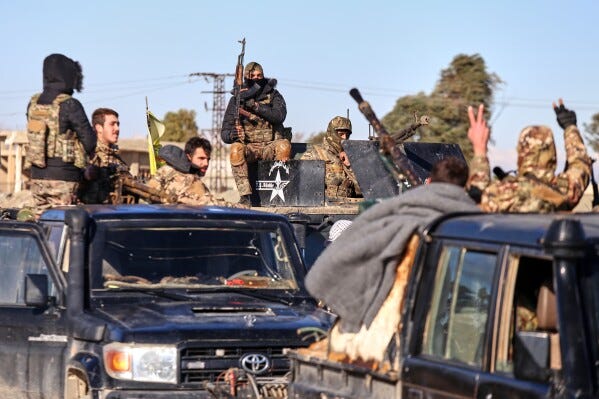
Syria | PUREWILAYAH.COM - The United States is once again demonstrating a familiar pattern in its foreign policy: abandoning local allies once they have outlived their usefulness. This time, the Syrian Democratic Forces (SDF)—Washington’s longtime Kurdish partner in Syria—have been openly sidelined as the US recalibrates its regional strategy.
The shift was confirmed by US Special Envoy for Syria Tom Barrack, who declared that the SDF’s role alongside the United States has effectively come to an end.
“The original purpose of the SDF as the primary anti-ISIS force on the ground has largely expired,” Barrack said, formally signaling Washington’s withdrawal of political and strategic backing.
From Ground Partner to Disposable Asset
Barrack’s remarks make clear that the United States is facilitating a transfer of authority away from the SDF and toward the new Syrian government under President Ahmad al-Sharaa.
In statements shared publicly, the US envoy outlined a process in which the SDF is relinquishing control of strategic sites, including the al-Hol ISIS detention camp and areas such as al-Shaddadi, while its political demands are sidelined.
According to Barrack, an agreement signed on January 18 paves the way for SDF fighters to be absorbed into the Syrian national army and for Damascus to reclaim authority over infrastructure and security.
He emphasized that US forces will not maintain a long-term military presence, insisting Washington does not support separatism and will leave Kurdish factions to negotiate directly with the Syrian state.
The message was unmistakable: the US partnership with the SDF has ended, and Washington is moving on.
Oil, Territory, and US Strategic Exploitation
The US–SDF alliance was never solely about counter-ISIS operations. From the outset, Washington’s partnership with the SDF coincided with control over eastern Syria—particularly Deir Ezzor, al-Hasakah, and Rumeilan—where most of Syria’s oil resources are located.
By backing the SDF, the United States secured influence over these oil-rich areas, denying the Syrian state access to a critical source of revenue and transforming energy resources into political leverage. Oil income sustained SDF administration and security forces, allowing Washington to maintain influence with limited troop deployments while applying economic pressure on Damascus.
The Syrian government has repeatedly accused US forces and the SDF of smuggling Syrian oil into Iraq, including toward areas hosting US military bases—allegations Washington denies but which underscore how resource control was intertwined with US regional logistics and military infrastructure.
From 2017 onward, the US deepened its support through arms supplies, training, intelligence sharing, and embedded special forces. Pentagon funding through the Counter-ISIS Train and Equip Fund reached nearly $434 million between FY 2024 and FY 2026, reinforcing the SDF’s role as a proxy force aligned with US strategic objectives rather than Syrian sovereignty.
With the fall of the al-Assad government and Washington’s alignment with the interim administration under al-Sharaa, the SDF has now become expendable.
A Record of Betrayal: From Afghanistan to Syria
The abandonment of the SDF fits a broader historical pattern. In Afghanistan, US forces withdrew abruptly in 2021 after two decades of occupation, leaving local allies exposed as the Taliban swept across the country. Washington prioritized strategic redeployment over the safety of its partners, abandoning those who had fought and governed under US protection.
US officials later justified the withdrawal by pointing to competition with China and shifting global priorities, openly acknowledging that alliances are subordinate to Washington’s strategic calculations.
The same logic now applies in Syria. Once ISIS was defeated and oil-rich territories secured, Kurdish forces lost their value. Washington’s focus shifted, and its former partner was left to negotiate survival on its own.
This pattern extends beyond the battlefield. In Venezuela, opposition figures celebrated by Washington were swiftly sidelined once they ceased to serve immediate US interests. In Iran, monarchist figures promoted abroad were quietly discarded when their lack of domestic legitimacy became inconvenient.
Empire Without Loyalty
The United States presents itself as a guarantor of security and stability, yet its record tells a different story. Allies are embraced when useful, exploited when necessary, and abandoned without hesitation when priorities change.
In Syria, the SDF now stands as another entry in a long list of forces discarded by Washington after serving US objectives. The episode underscores a central reality of US foreign policy: loyalty is temporary, principles are flexible, and strategic gain overrides all commitments.
For regional actors and resistance movements, the lesson is clear. Reliance on Washington guarantees neither protection nor permanence—only eventual abandonment once the empire moves on. (PW)