

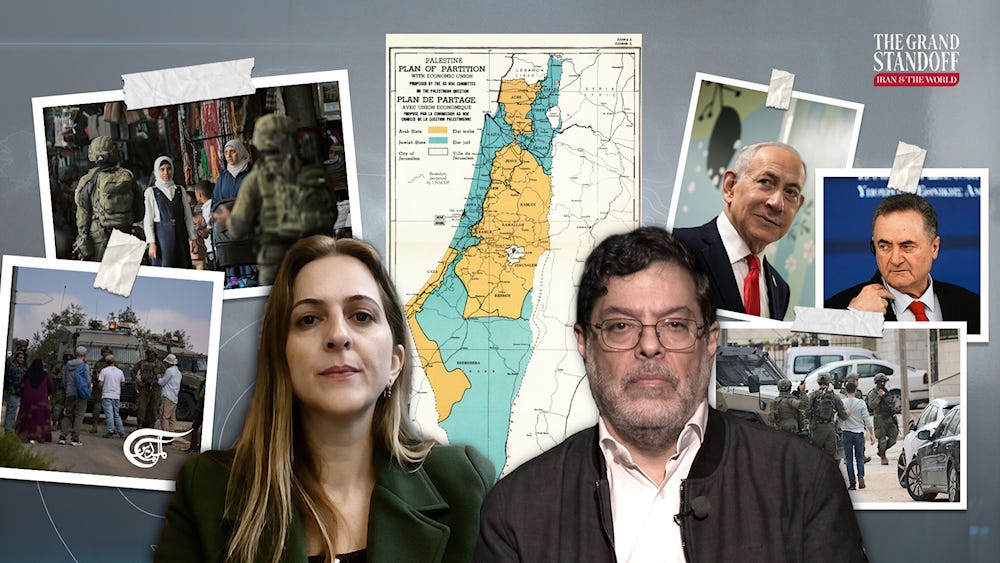
What is being sold as a ceasefire in Gaza is not the end of a war. It is the reorganisation of one. That is the thread connecting the assessments of Palestinian politician and analyst Nevine Abou Rahmoun and University of Tehran professor Mohammad Marandi, speaking on Al Mayadeen’s The Great Standoff: Iran and the World. One dissected Palestine; the other dissected the American campaign against Iran. Their conclusions converge: the occupation and its Washington patron have abandoned “conflict management” for a doctrine of permanent, open-ended control — and they are preparing their publics for the wars that doctrine demands.
The death of “conflict management”
For decades, Israeli strategy rested on a cynical equilibrium: weaken the factions, degrade their capabilities, but never fundamentally alter the political reality. Containment, not resolution. Abou Rahmoun argues that era is over.
“After decades of adopting the strategy of managing the conflict... today there is a trend within the Israeli governments... adopting the approach of the decisive stage of the conflict,” she explained. The new doctrine rests on three pillars: overwhelming military force, permanent control on the ground, and accelerated settlement expansion — the combination intended, in her words, to “prevent the emergence of any Palestinian political entity that has power in the future.”
In Gaza, the doctrine is already visible: assassinations of commanders paired with the systematic destruction of the residential fabric around them, and continued military movements near the so-called Yellow Line. The target is not only the resistance leadership but the society that shelters it. War Minister Israel Katz’s insistence on continued military action and “complete disarmament,” alongside Netanyahu’s repeated invocations of permanent war, confirm that no political calm is being sought. The current lull, Abou Rahmoun stressed, is a tactical pause — a mechanism for preserving open-ended security control, not relinquishing it.
The analytical implication is uncomfortable but unavoidable: the ceasefire is an instrument of the war, not its termination. It resets targeting cycles while the geography is redrawn.
Settlements engineered to be irreversible
The most consequential shift Abou Rahmoun identified may be the least reported: the transformation of the settlement “from an ideological project, capable of political negotiation and equalization, to an economic and industrial environment, that is solid, that stands on the ground.”
A new settlement in the Areeha (Jericho) area is not an isolated outpost but a node in this system. Industrial and economic settlement in the northern West Bank, she warned, is “more dangerous, more aggressive” than traditional residential expansion. The Knesset machinery serves it directly: targeted legislation, budget allocations for settlers and herder outposts, and the wiring of settlements into state infrastructure and government services. The powers Smotrich handed to the Civil Administration formalize expansion in the major blocs.
The logic deserves emphasis. An ideological settlement can, in theory, be bargained away at a negotiating table. An industrial zone with sunk capital, highways, power grids, and payrolls cannot. This is annexation by balance sheet — facts on the ground deliberately engineered to be non-negotiable before Israel’s post-election balance of power is even settled.
The war on Palestinian society itself
If the geography is being reshaped, the society must be broken to match. Abou Rahmoun located this front in the prisons and in the assault on women. Prisoners, she said, are “the weakest link and the most vulnerable to direct control” — isolated from independent monitoring, stripped of humanity by official and media narratives, and subjected to violence she characterised as political, not incidental. Women’s bodies and the hijab are targeted, she argued, because they are treated as symbols of land, dignity, continuity, and collective identity.
“There is no moral basis for the coloniser,” she declared, turning the question outward: where are the Arab governments and official Islamic institutions?
For the resistance, this reframes the prisoner file entirely. It is not a humanitarian footnote to the war; it is a theatre of it — psychological and social pressure aimed at the collective will to remain. Sumud is the actual target.
The Knesset quarrel that changes nothing
Abou Rahmoun’s reading of Israeli politics punctures a persistent media illusion: that internal Israeli division offers Palestinians an opening. The religious Zionist camp and its allies seek to lock in control through budgets and legislation. The divided “middle-right alliance” contains figures who oppose settler violence — but because of sanctions risk and blowback on the occupation itself, not because they reject the settlement project. Even its cooling of fronts is meant to manage settler excess, “not to dismantle them.”
The fight over the Knesset speakership — the change alliance led by Eisenkot backing Kahana, Netanyahu’s Likud defending Ophir Katz — is, in her assessment, a test of post-election balances and coalition-forming leverage. For Palestinians, the dispute is over the speed and method of annexation, never its existence. The occupation is the consensus.
Washington changed drivers, not direction
The recent US elections produced a vote against Trump, Abou Rahmoun noted — “not against the policies of this regime at all.” Shifts around AIPAC and the emergence of Arab and Muslim figures in political roles remain unproven variables whose impact will only clarify in 2027. The establishment’s regional strategy is continuous.
Her warning for the new year is stark: Netanyahu’s doctrine includes “resolving” the Iranian threat, and the year’s opening could give Trump a window for postponed projects — renewed military confrontation and further cover for settlement expansion. Even a new Gaza ceasefire, she suggested, could serve demographic and strategic ends rather than peace.
Manufacturing consent for the next war
Marandi’s segment explained how that window is being pried open. He catalogued the allegations now saturating US media: Iran preparing chemical weapons; Iran plotting nuclear strikes on Los Angeles and San Diego; assassination plots against senior officials; a dirty bomb in Washington; Iranian cyberattacks on French freezers. Individually dubious — US intelligence and the IAEA have rejected the weapons-pursuit claim, he noted — collectively they function as a fear campaign.
Most revealing is the New York Times piece suggesting Iran’s water-supply dams may serve military infrastructure. “What is the New York Times trying to do?” Marandi asked. “It’s trying to prepare the grounds for the bombing of Iranian critical infrastructure.” Redefining civilian water systems as military targets is not journalism; it is the pre-legalization of a war crime.
The campaign exists precisely because the public is unconvinced: 71% of Americans, Marandi cited, want this war ended. And JD Vance’s newfound opposition? He went along with the war, justified it, and now worries about his succession prospects — a posture, not a principle, and one that reportedly got him removed from the Iran file.
Iran is setting the price
The doctrine of permanent war assumes an adversary that absorbs blows indefinitely. Marandi’s account of Iran’s response describes the deliberate destruction of that assumption.
Qatar, Saudi Arabia, the UAE, Kuwait, and Bahrain have been “put on notice” for enabling US refuelling, drone launches, and airspace access. In the Strait of Hormuz, strikes on tankers defying Iranian instructions have intensified — more vessels, more damage than two months ago — and US escorts cannot prevent them. US assets in Bahrain have been hit in response to airspace violations. The demand is explicit: implement the memorandum of understanding Trump publicly signed. “You either end this war or escalate,” Marandi said. “Iran will not allow this status quo to remain.”
Behind Iran stands strategic depth Washington cannot fracture: a Russia with the upper hand in Ukraine and a China whose southern industrial cluster — some 50 million people across three cities — dwarfs anything Silicon Valley can field. Trump, Marandi argued, has exhausted his options against both.
One front
The Yellow Line in Gaza and the dams of Iran appear on the same map. The entity’s new doctrine requires permanent American sponsorship and permanently exhausted enemies. Palestinian steadfastness denies it the second; Iranian deterrence in the Gulf threatens the first. The “ceasefire” is the pause in which the occupation reorganises — and it must be treated as exactly that.
Reference: Al-Mayadeen