

ASUNCIÓN — Paraguayan President Santiago Peña has formally resigned from office, bowing to immense political pressure and public outrage over a massive corruption scandal tied to the collapse of Ueno Bank and the blatant capture of state financial institutions by oligarchic interests.
The resignation, announced late Thursday via the social media platform X, comes as lawmakers actively pursued impeachment proceedings and thousands of citizens took to the streets to condemn the government’s complicity in the banking crisis.
Peña, a conservative leader elected in 2023, claimed he was stepping down “to preserve the stability of the country and its democratic institutions.” While offering a hollow apology for “letting the people down,” he conspicuously refused to accept responsibility for the devastating financial crisis that has shaken the South American nation.
Cronyism and the Ueno Bank Collapse
The political earthquake stems from deep-seated conflicts of interest and systemic corruption at the highest levels of Paraguay’s financial sector. Peña, a former shareholder of Ueno Bank, appointed the bank’s then-CEO, Carlos Carvalho, to serve as the head of Paraguay’s Central Bank—a move that was heavily criticised at the time as a glaring conflict of interest designed to protect elite banking syndicates.
Under Carvalho’s watch, the Central Bank was eventually forced to intervene and initiate liquidation proceedings against Ueno Bank after investigations exposed massive flaws in credit-risk assessments. Authorities discovered that the bank had been illicitly granting loans to companies tied directly to its own shareholders. Furthermore, the bank’s solvency ratio plummeted to a mere 5.56%, falling drastically short of the country’s 12% regulatory minimum, effectively rendering the institution insolvent.
Impeachment Threats and Popular Uprising
The revelation of these fraudulent financial manoeuvres sparked a fierce backlash from both the public and the legislature. On Wednesday, an extraordinary session of the Chamber of Deputies was convened after 35 members of the 80-seat chamber filed articles of impeachment against the president, setting the stage for his inevitable ouster.
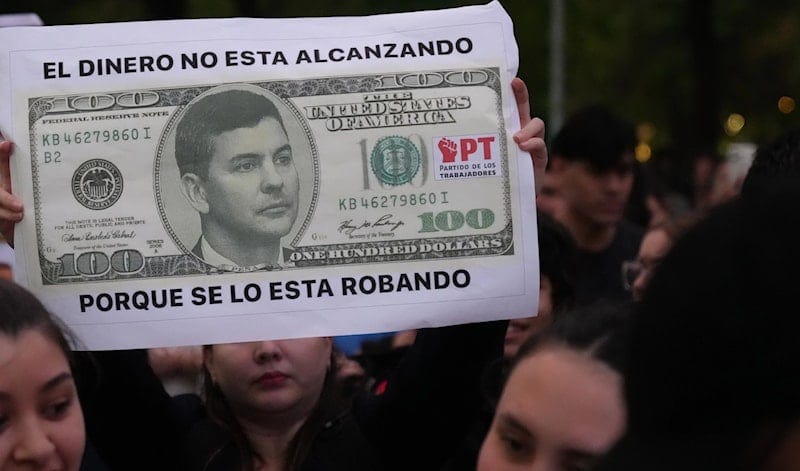
Beyond the halls of Congress, the crisis has ignited popular fury in the streets of Asunción. Demonstrators have organised mass protests against the government and the broader capitalist banking system, with citizens famously displaying mock US dollar bills bearing Peña’s face to symbolise the commodification of the state and the subservience of the political elite to financial capital.
The collapse of Peña’s administration marks a significant rupture in Paraguay’s neoliberal establishment, exposing the fatal vulnerabilities of allowing private financial institutions to dictate national monetary policy while working-class citizens bear the brunt of economic instability.
Reference: Al-Mayadeen