

Unity Week is not merely a time to speak about bringing Muslims closer together. According to Hojjatul Islam Sadiq Rauh, a professor at the Qom Seminary, it is a moment to re-examine the responsibility of theologians toward society.
Unity in action, not just words
When scholars and seminary students involve themselves in people’s lives — helping in difficult moments, running charitable and community projects, resolving the problems of believers — social distance shrinks, and trust grows. These are the deepest bonds of unity. And unity cannot be built by calls alone: it begins with the conduct of individuals themselves.
A legacy older than the Revolution
Citing Imam Khomeini (may God be pleased with him), who constantly stressed that “if people, regardless of group or tribe, maintain unity, no force and no army will be able to destroy them,” Rauh corrects a common misconception: Islamic unity did not begin with the 1979 Islamic Revolution. Its roots reach back to the Prophet Muhammad (S) himself.
A Quranic foundation
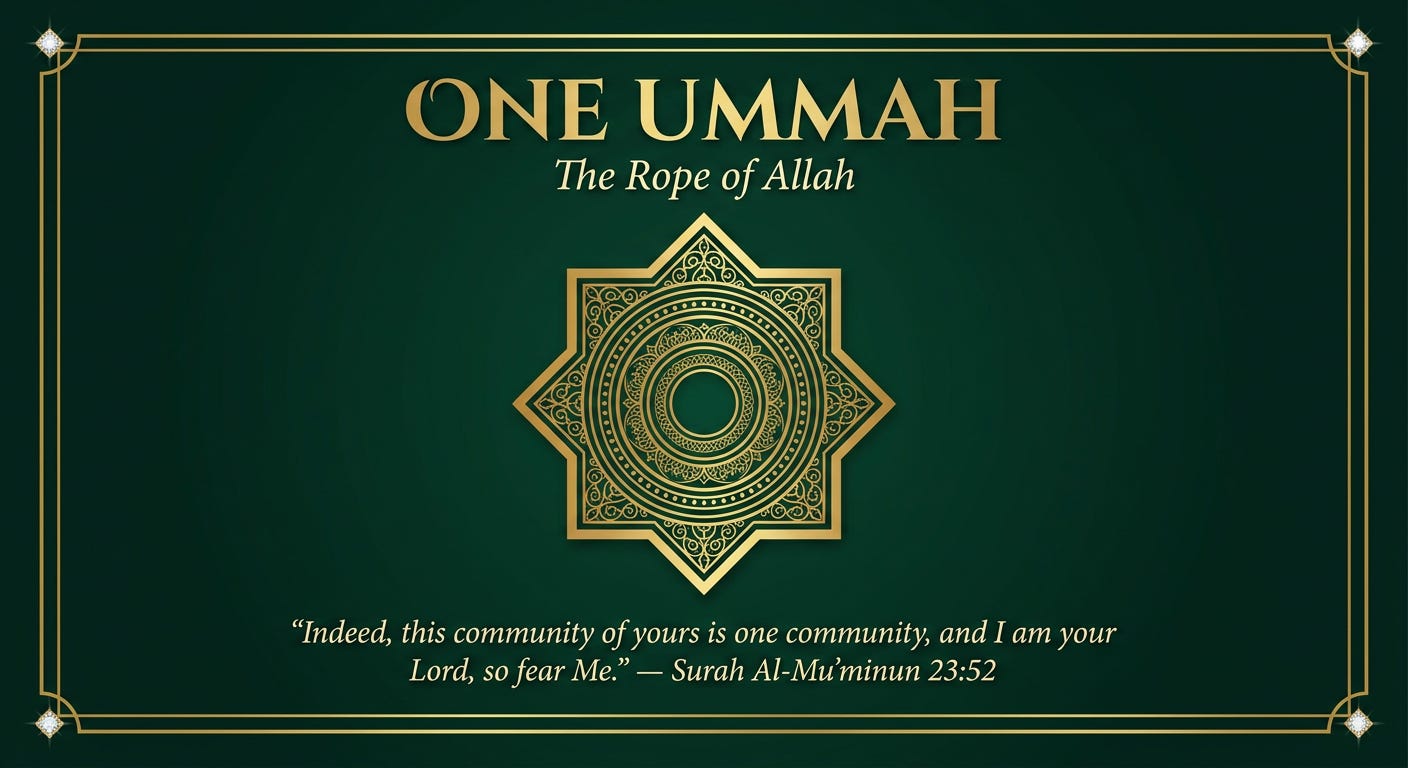
“Indeed, this community of yours is one community, and I am your Lord, so fear Me.” (Surah al-Mu’minun, Chapter 23, The Believers, Verse 52)
“Hold fast to the rope of Allah, all together, and do not divide.”
(Surah aal-e-Imran, Chapter 3, The Family of Imran, Verse 103)
Rauh distinguishes three linked concepts: the modern Islamic society, the ideal of one unified ummah, and the practical unity of Muslims that leads toward that goal.
The Hadith of the Two Weighty Things (Saqalayn)
Transmitted as mutawatir1 in both Shia and Sunni sources, the Prophet (S) left behind two precious trusts — the Quran and the Ahl al-Bayt (peace be upon them) — urging Muslims to cling to both and never stray.
The burden of the people of knowledge
Theologians and students must not only speak about unity — they must embody it, carry it to society, and resist everything that breeds hostility and division.
Muslim unity is not a political slogan. It is a religious principle, rooted in the Quran, the teachings of the Prophet (S), and the tradition of the Ahl al-Bayt (peace be upon them).
Mutawatir: a hadith transmitted through so many independent chains of narrators that its authenticity is beyond doubt.