

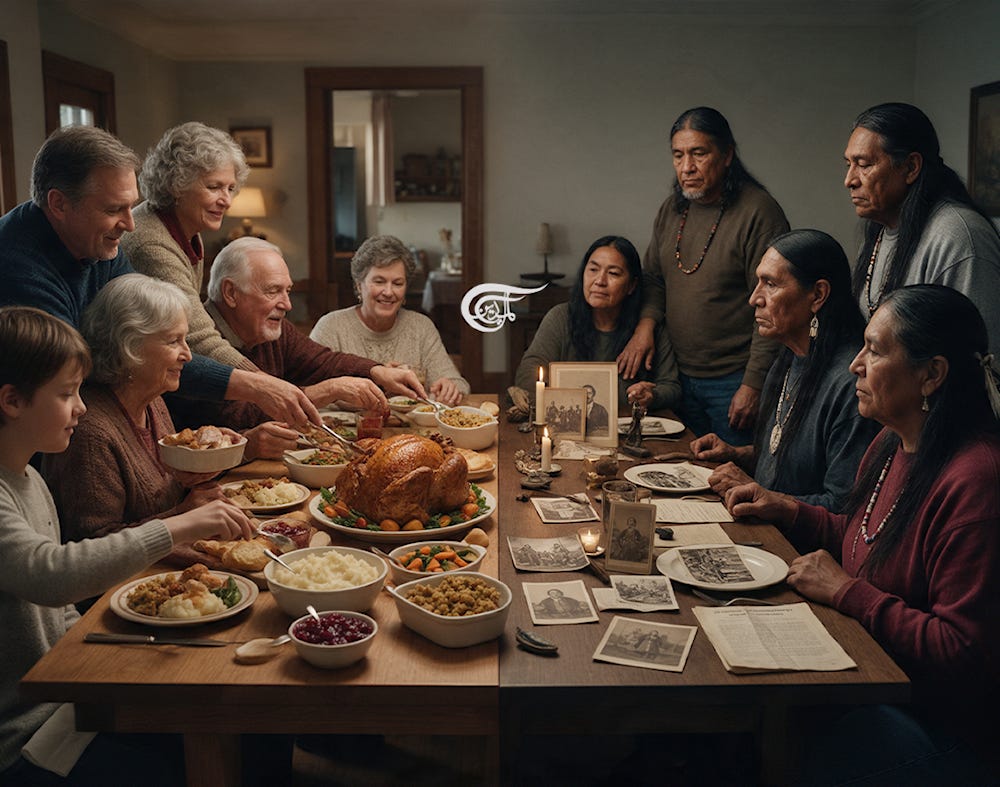
PLYMOUTH, Massachusetts — As millions of American families sat down to roast turkey on Thursday, Native peoples and their allies gathered at noon on Cole’s Hill overlooking Plymouth Rock — not to celebrate, but to fast, mourn and remember the history the holiday was built to bury.
The National Day of Mourning has been held every Thanksgiving since 1970, organised by the United American Indians of New England (UAINE). This year’s gathering went ahead amid a legal dispute with the town of Plymouth over the provision of a speakers’ stage under a 1998 settlement — organisers announced they would proceed regardless. More than a thousand people attended in 2025, according to the Boston Globe. A parallel “Unthanksgiving” observance took place on Alcatraz Island, California.
The contrast is the subject of an analysis published by Al Mayadeen’s Washington bureau chief, Mounzer Sleiman: “One table, two narratives” — a harvest celebration consecrated by presidents, and a square of remembrance kept by those the celebration erased.
A holiday engineered for commerce
Sleiman traces the holiday’s manufacture: George Washington’s 1789 proclamation codifying thanks to “the divine power”; Abraham Lincoln’s decree of 3 October 1863, issued after Gettysburg, setting the last Thursday of November as a national day of thanksgiving; and Franklin Roosevelt’s decision to shift the date to lengthen the shopping season during the Great Depression, before Congress fixed it as the fourth Thursday of November.
Today it is a four-day weekend that launches the year’s most frenzied consumption season — gratitude harnessed to the accumulation of wealth.
The myth and the genocide
The official story — Pilgrims inviting their Native neighbours to share the harvest in 1621 — collapses under scrutiny, Sleiman writes. Within sixty years of that feast, the Pilgrims and their successors had destroyed the Pequot and Nehantic peoples, according to Syrian-born Palestinian scholar Munir al-Akash in America and the Genocides (2002).
Al-Akash records that John Mason, founder of the Connecticut colony, believed himself “a messenger of Divine Providence to the ‘empty land of Canaan’” — a land, he insisted, God had promised his English people despite those already living there. The “Founding Fathers”, al-Akash adds, followed Washington in likening the expulsion of Indians from their homelands to driving predatory beasts from a forest.
The speech they silenced
The Day of Mourning was born from censorship. In 1970, the Wampanoag elder Frank James — known as Wamsutta — was invited to speak at the 350th anniversary of the Pilgrims’ arrival, on condition that his speech be approved first. Officials barred it as “inflammatory.” Among the words they refused: “This is a day of celebration for you alone; it is not my holiday. I look at what happened to my people with a broken heart.”
James delivered it instead on Cole’s Hill — and Native people have returned every year since. Participants fast from sundown the previous day until the march ends; only Native voices speak. One organiser says families bring their children “to hear the truth about Thanksgiving instead of the sanitised story” taught in schools.
Older gratitude, newer tables
Native traditions of thanks predate the Pilgrims entirely: the Lakota’s seasonal “Wopila” festival, as Native journalist Tim Giago noted, is rooted in centuries of gratitude. And the American table itself has changed — Arab families now set turkey beside kibbeh and kunafa, and Muslim writers like Salma Hasan Ali frame the day around shared stories of faith. Interfaith America calls the country a “potluck nation.”
There is an irony in the calendar, too: tomorrow, Friday 27 November, is officially Native American Heritage Day, capped by Smithsonian performances and exhibitions — an official celebration of a heritage whose history the national story still refuses to tell in full.
Memory against the victor’s pen
Native peoples, Sleiman concludes, “do not ask to abolish gratitude, but that the story be told in full; for history is written by the victor, but memory stays alive among those who were not allowed to write it.”
For our region, the script is chillingly familiar: a divine promise, an “empty land,” a people written out of existence so another may feast on their fields. From Plymouth to occupied Palestine, the settler’s story changes only its table — never its logic.
Reference: Al-Mayadeen