

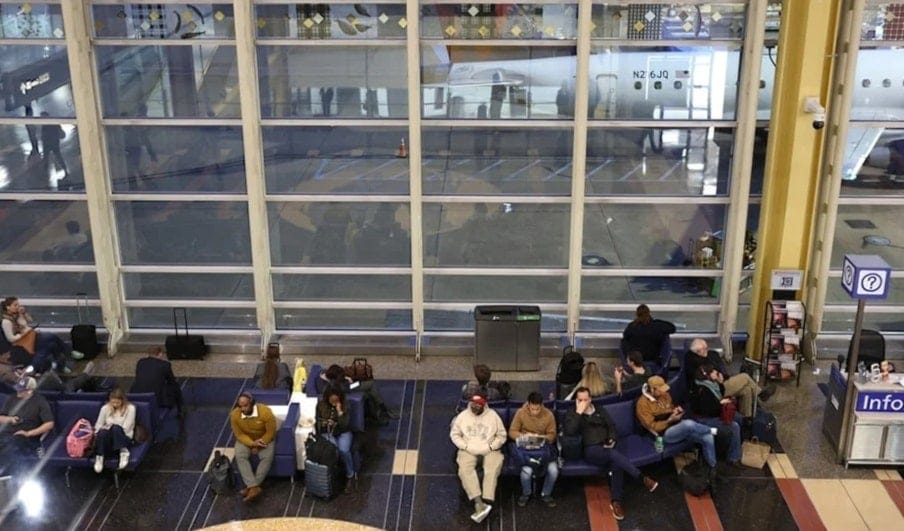
A single faulty router installed by US government contractor L3Harris is believed to have triggered a nearly five-hour nationwide halt to American air travel on Friday, November 13, disrupting more than 20,000 flights and stranding tens of thousands of passengers, Reuters reported Saturday, citing officials.
The country that claims the right to police the world’s skies could not keep its own aircraft talking to its radar centres. And according to US officials themselves, the failures are far from over.
A thousand connection attempts every five seconds
The trouble began during routine maintenance, as L3Harris crews moved communication lines from ageing copper wire to fibre at remote sites, with routers in Arkansas and Texas under scrutiny. Transportation Secretary Sean Duffy said investigators have not yet determined whether the fault lay with the contractor’s staff or a defective router.
“We haven’t determined what the fault was,” he said.
What is known is striking in its simplicity: the new routers bombarded other routers across the network with more than 1,000 connection attempts every four to five seconds. The flood disrupted communications with aircraft and radar, overloading 17 of the Federal Aviation Administration’s 22 en route centres.
With no root cause identified, the FAA ordered a nationwide ground stop. The agency later clarified that communications were never lost outright — data became unstable, though no centre went fully dark. It was enough to freeze the largest aviation market on earth.
“This was an FAA system that didn’t meet the moment,” Duffy admitted.
L3Harris said it was treating the matter seriously and assisting the investigation, noting it has completed more than 70% of the planned copper-to-fibre transition.
A weekend of cascading chaos
The fallout rolled straight through a busy travel weekend. Friday’s ground stop produced roughly 9,200 cancellations and 7,500 delays. By 9:35 pm ET Saturday, FlightAware recorded more than 6,400 further cancellations and over 8,000 delays — more than 14,000 disrupted flights in a single day. Another 875 Sunday flights had already been scrapped, with the FAA chief warning that recovery would be gradual.
Duffy said the agency would rethink when it schedules maintenance at smaller facilities to avoid a repeat.
Floppy disks, eBay parts, and routers due for retirement in 2006
The deeper story is the rot beneath the tarmac. The routers now being swapped out are around 25 years old — they were due for replacement in 2006. The FAA still pays $1 billion a year just to keep its copper network alive.
The agency operates decades-old Compaq computers, and sources spare parts on eBay. It announced only last week that it would replace floppy disks used for weather and other vital data at more than 400 facilities — by the end of 2028. Paper flight strips began phasing out in 2022 and won’t disappear from 49 major airports until 2028 at the earliest.
Nor is this an isolated breakdown. In 2023, a contractor accidentally deleted files, forcing a 90-minute nationwide ground stop affecting 11,000 flights — the first such stoppage since September 11, 2001. In September, a circuit failure in Philadelphia and a construction crew severing a fibre-optic cable in New Jersey delayed or cancelled thousands of Northeast flights. Past outages have been traced to melted components and severed lines. Officials warn the incidents will continue until the system is fully upgraded.
Congress has allocated $12.5 billion for modernisation; Duffy is requesting another $50 billion.
For a state that sanctions entire nations over access to technology and lectures the world on competence and order, the weekend delivered its own verdict: the empire’s air traffic runs on hardware older than some of its passengers, held together by auction-site spare parts. Washington’s officials concede the outages will keep coming — the wiring, like the system it serves, is long past its expiry date.
Reference: Al-Mayadeen