

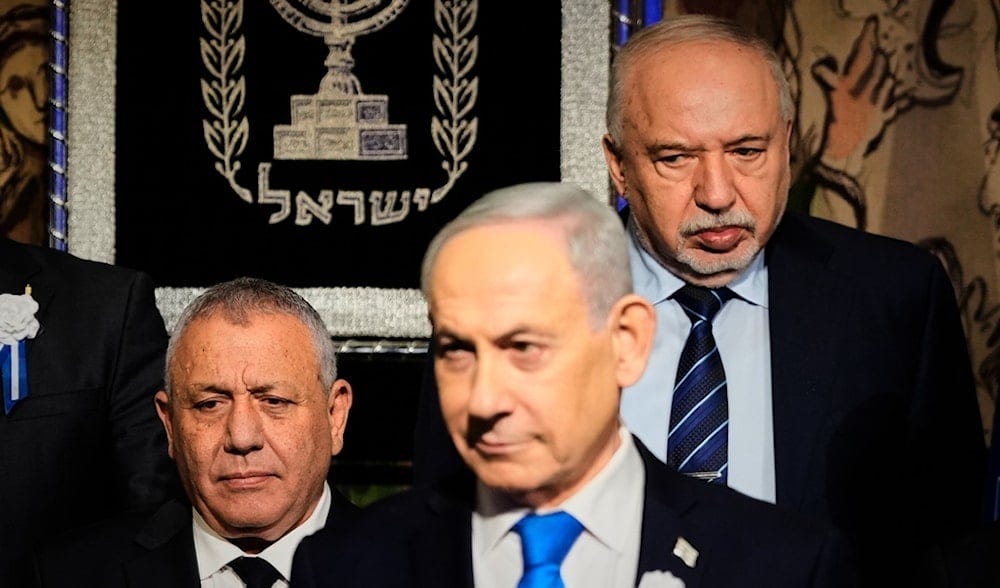
Occupied Palestine - Benjamin Netanyahu, serving out his final days as prime minister of the Israeli occupation entity, has briefed opposition leader Gadi Eisenkot on the entity’s principal security and diplomatic challenges, as an open dispute erupts over whether his outgoing government retains the authority to make major war decisions before a new government takes office.
The meeting, confirmed in a joint statement on Thursday and reported by Al Mayadeen citing Israeli media, followed a pointed letter Eisenkot — leader of the Yashar party — sent to Netanyahu on Wednesday demanding restraint during the political transition. The two sides said they had “agreed to continue exchanging information and briefings whenever necessary.”
Eisenkot: No new wars on the way out
In his letter, Eisenkot urged Netanyahu to “exercise the utmost caution and responsibility” in security and domestic decisions, calling on him to postpone weighty security measures until the incoming government has secured the confidence of the Knesset and taken its oath of office.
He warned that deploying occupation forces in the absence of a direct and imminent threat could carry serious consequences for the entity’s democratic façade and public trust in its institutions — a striking admission of the legitimacy crisis gripping the occupation from within.
Eisenkot also cautioned against dragging the security establishment into the centre of constitutional disputes, or leaving it uncertain about the orders it is expected to carry out, insisting that political and external considerations be kept separate from security matters.
Katz: No permission needed to bomb
War Minister Israel Katz rejected the appeal outright. “The government does not need the approval of the opposition or any legal body to carry out military and security operations,” he declared — pointing, without a trace of shame, to the ongoing assaults on Gaza, Lebanon, Syria, and the occupied West Bank as proof of the government’s freedom of action.
Katz further claimed the entity had handled “the Iranian file with determination and wisdom, in full coordination with the army,” insisting that the occupation’s security “is not in a transitional phase, nor is it hostage to the ongoing political processes.” In his telling, Netanyahu, the war minister, and the cabinet retain full authority to direct the military within existing oversight mechanisms.
Lieberman joins the chorus
Yisrael Beiteinu leader Avigdor Lieberman also warned that the outgoing government lacks the authority to take decisions that could drag the entity into a war without Knesset oversight and the full approval of all security establishment bodies, cautioning against bypassing established institutional safeguards.
The generals baulk at a new Iran adventure
Most revealing for the region is the reported rupture between Netanyahu and army Chief of Staff Eyal Zamir over Iran. Israeli Channel 12 reported on Tuesday that Zamir considers Netanyahu’s proposed moves to “lack caution,” warning they could pull the occupation into a fresh confrontation with Iran at a moment when restraint is needed.
The reported clash follows the entity’s June 2025 aggression against the Islamic Republic — a war that failed to break Iran’s resolve or its deterrent capacity. That even the occupation’s own chief of staff now fears another reckless adventure speaks to the cost the resistance axis has already imposed on Tel Aviv’s calculations.
The spectacle is telling: an outgoing premier briefing an opposition rival, a war minister boasting of unchecked bombing powers across four fronts, and a military establishment openly divided over the next war. From Gaza to southern Lebanon, the occupation’s aggression continues daily — even as its leadership tears itself apart over who gets to order more of it.
Reference: Al-Mayadeen