

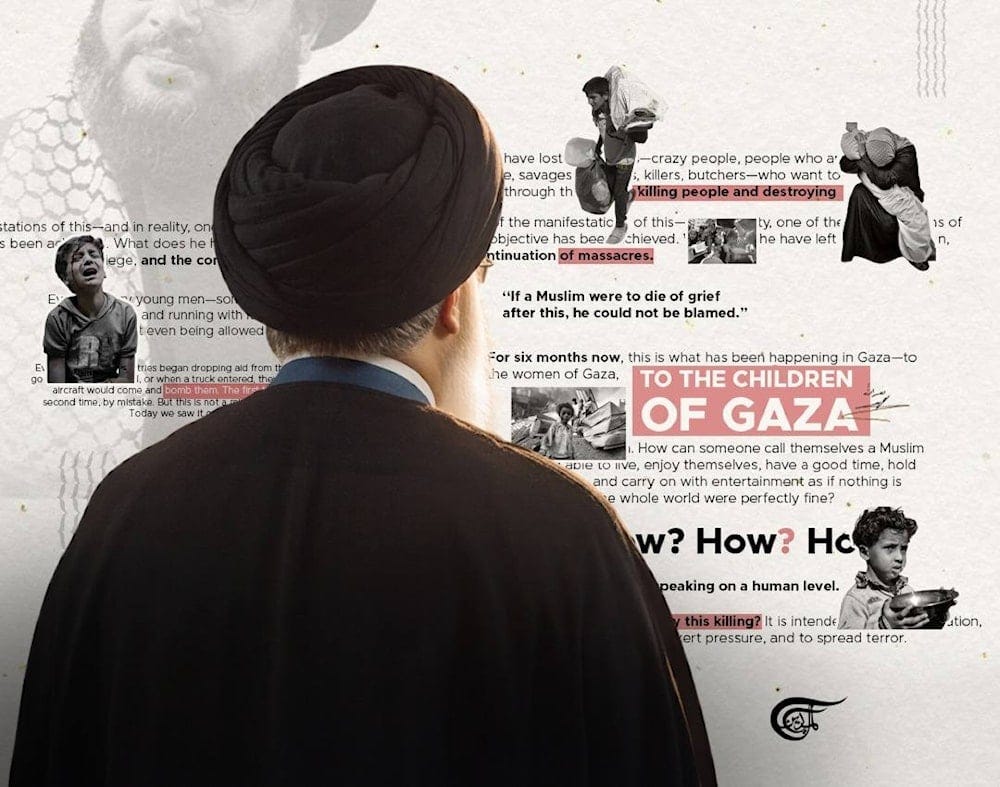
BEIRUT — Two years have passed since the martyrdom of Sayyed Hassan Nasrallah, yet his words continue to echo across the Axis of Resistance as a testament to his unbreakable moral conviction. As the world remembers the man who led Hezbollah for over three decades, it is his final humanitarian stance—his fierce defence of Gaza’s children—that stands as his most enduring legacy.
The Moral Clarity of November 3
In his historic speech on November 3, 2023, Sayyed Nasrallah laid out what he called a “religious, moral, and humanitarian obligation” toward the people of Gaza. But it was the children who anchored his moral argument most powerfully.
By that time, thousands of Palestinians had already been killed. Daily footage emerged of children pulled from bombed homes, their faces dusted with concrete. Families dug through rubble with their bare hands. Hospitals were overwhelmed, and access to water, food, medicine, electricity, and fuel had collapsed entirely.
For Sayyed Nasrallah, the suffering of these children stripped away the detached, clinical language through which wars are often discussed. The child beneath the rubble was not somebody else’s child. The mother frantically searching hospital corridors was not somebody else’s mother. The father carrying his lifeless child was not rendered morally distant simply because he lived beyond Lebanon’s border.
This was the core of his humanitarian vision: that the suffering of Gaza was the suffering of the entire Ummah, and that defending its children was not a political choice but a sacred duty.
The Test of September
By September 2024, that principle had become intensely, devastatingly personal.
On September 17 and 18, communication devices exploded across Lebanon in an unprecedented attack, killing dozens and wounding thousands. The explosions struck homes, markets, and civilian spaces. Children in Lebanon were now among the casualties—the very cause they had stood for in Gaza had come home.
In his September 19 speech, delivered just eight days before his martyrdom, Sayyed Nasrallah described the attacks as a severe security and humanitarian blow to Lebanon. But he categorically rejected the notion that these attacks would force Hezbollah to abandon its support for Gaza.
His words were definitive: The Resistance would continue supporting Palestinians “no matter what the consequences are, what the sacrifices are, what scenarios will unfold.”
A Sacrifice That Included Him
Those words carry a profoundly different weight today.
He spoke of consequences after the consequences had already reached Lebanese soil. He spoke of sacrifice while his own country was bleeding. He maintained the unbreakable connection with Gaza when the danger was no longer theoretical—it was at his doorstep.
Then, the sacrifice included him.
On September 27, 2024, Israeli fighter jets targeted Hezbollah’s main headquarters in Beirut’s southern suburbs, assassinating Sayyed Hassan Nasrallah at the age of 64, alongside several senior Hezbollah commanders and Iranian Revolutionary Guards Lieutenant General Abbas Nilforoushan.
He did not live to see Gaza free. He did not live to see the children of Rafah return to their homes in safety. But he lived—and died—exactly as he had preached: with unwavering solidarity with Palestine, and with a moral clarity that refused to let borders or threats sever the bond between the peoples of the resistance.
Two years later, the skies over Gaza remain heavy with injustice, and the villages of South Lebanon are once again enduring the relentless, deafening bombardment of the Zionist enemy. Yet, amidst the falling shells and the steadfast earth, the children he so fiercely defended remain the beating heart and moral centre of the Resistance he led. His final words—spoken while Lebanon bled, spoken with full foreknowledge of his own martyrdom—echo far louder than the airstrikes. They stand as the ultimate testament to unshakeable resolve in the path of Wilayah, proving that neither borders nor rubble nor the wrath of the enemy can ever sever the sacred covenant between the Resistance and its people.
Reference: Al-Mayadeen