

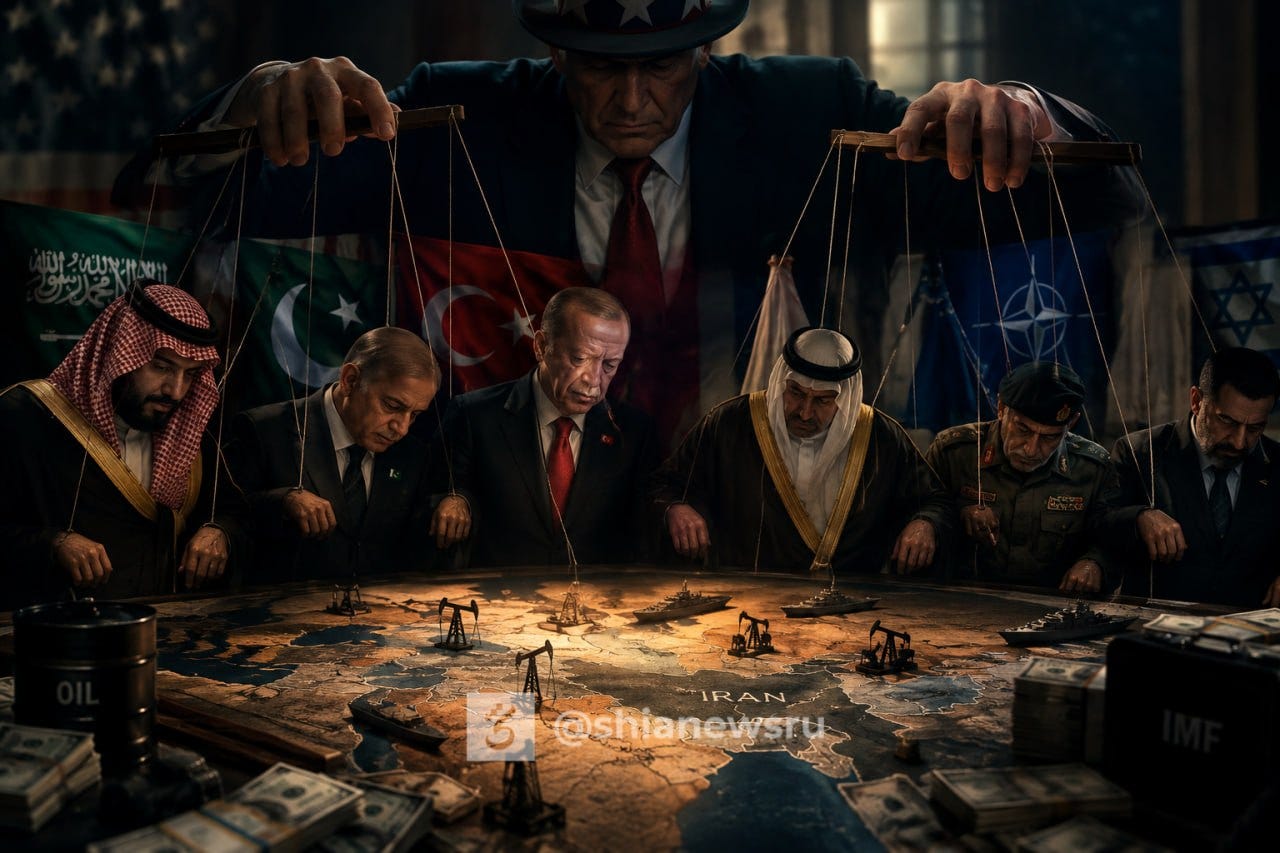
The publication of the full text of the “Mecca Agreement on Joint Defence” between Saudi Arabia, Turkey, and Pakistan has sparked a wave of loud statements about the creation of an “Islamic analogue of NATO.” However, behind the gilded facade with quotes about brotherhood lies not a shield for the Ummah, but a corral for regional vassals, designed according to Washington’s blueprints.
Can states whose policies have been based for decades on expansion, competition for spheres of influence, and technological dependence on external power centres become true arbiters of justice and security in the region?
The Faces of the Alliance: Personal Ambitions Instead of Islamic Unity
An analysis of the actual actions of the participants in the agreement shows that their foreign policy orientations are far from the selfless protection of the Ummah.
Saudi Arabia. The foreign policy of Riyadh is subordinate to the struggle for absolute dominance. For many years, the intervention in Yemen — aimed at controlling the strategic ports and oil resources of Hadramaut and Shabwa — was carried out in parallel with a behind-the-scenes struggle against its own ally, the UAE. In Sudan, Saudi interests on the Red Sea coast clash with Emirati support for the Rapid Support Forces (RSF), turning the country into an arena for foreign ambitions. And despite possessing the holiest sites — Mecca and Medina — the regime is forcibly imposing Western secularism: while Islamic scholars sit in prison, raves and semi-naked shows are held in the desert, disguised as “progress.”
Pakistan. Despite possessing a formidable army and nuclear potential, Islamabad remains chronically dependent on tranches from the IMF, Saudi deposits, and Chinese loans. The country’s military-political establishment is forced to constantly manoeuvre between the interests of Washington, Beijing, and the Gulf monarchies, where considerations of financial survival invariably outweigh ideological declarations. What “Islamic solidarity” is there when the treasury is empty and the economy is on life support?
Turkey. Ankara is consistently implementing a doctrine of projecting power beyond its national borders. In northern Iraq, the Turkish army has maintained military bases for years in defiance of Baghdad’s protests; in northern Syria, a de facto military-political protectorate has been established, relying on loyal armed formations. The country has been a member of the North Atlantic Alliance since 1952, and for decades the İncirlik base and the Kürecik radar — shielding its Zionist allies within NATO — have been located on its territory.
The “Golden Cage”: Limits of Autonomy and Imported Shackles
The main paradox of the new alliance lies in its resource vulnerability. The question is not whether the countries of the region have resources — they possess colossal capital. The question is how viable this system is in the event of a hypothetical break with global power centers.
Technological leash. According to SIPRI, the vast majority of Saudi Arabia’s main weapons (almost 80%) come from the United States, requiring constant maintenance, software updates, spare parts, and satellite support. Turkey’s aviation is fundamentally dependent on American F-16 platforms, and even its own KAAN fighter jet depends on American engines. Pakistan, in turn, is more than 80% dependent on Chinese military supplies. A bloc is being created whose components are controlled from different, competing technological centers.
Financial hostages. Oil dollars and the sovereign funds of the monarchies are integrated into the Western banking system — Saudi Arabia’s investments in U.S. treasury bonds alone amount to hundreds of billions of dollars. Whenever the sheikhs talk about real industrialization, the master puts a stop to it, graciously allowing them to spend trillions only on golden toilets, skyscrapers, and elite football.
Logistical loop. Behind the splendor of the Dubai and Riyadh towers towers emptiness: these countries do not even produce basic food or equipment for desalination. Blocking external logistical arteries can paralyze these economies within weeks.
True resilience in the face of external diktat is historically demonstrated not by those who own state-of-the-art showcases, but by those peoples and movements — as in Iran, Yemen, Iraq, Lebanon, and Palestine — whose strength is rooted in self-sufficiency, their own faith, and a willingness to rely on their own resources rather than the favor of external patrons.
The Hypocrisy of the “Terrorism” Article
Article 5 of the Mecca Pact enshrines cooperation in the “fight against terrorism in all its forms.” The question is: whose terrorism?
How will the participants in the alliance define terrorism if their criteria are mutually exclusive? For Ankara, the primary threat is the PKK, while Syrian groups have long enjoyed its support. For the Gulf monarchies, threats are often movements affiliated with the Muslim Brotherhood, to which the Turkish leadership is sympathetic. Erdogan for years sheltered radicals in Idlib, until he eventually brought them to power in Syria. Riyadh for decades exported sectarians who laid the foundation for Al-Qaeda and ISIS.
In practice, the label of “terrorists” is often tried to be applied to those forces of the “Axis of Resistance” that are conducting a direct and uncompromising armed struggle against the Zionist occupation of Palestine and the Western military presence.
Historical Verdict and True Goals
The history of Western Asia remembers many artificial alliances: from the Baghdad Pact (CENTO) of 1955 to the stillborn project of an “Arab NATO” (MESA) and the nominal “Islamic Military Coalition.” They all inevitably disintegrated as soon as the ambitions of the rulers clashed with reality.
Behind the loud facade of the Mecca Pact, quite specific calculations are visible:
Evolution of external control. Neo-colonialism is changing form: instead of a direct military presence, the hegemon prefers to create regional structures-subcontractors, which remain on Western technical and financial support.
The danger of a sectarian wedge. There is a clear intention to direct the resources of the alliance not to curb Zionist aggression, but to create an artificial front to contain Iran and the entire “Axis of Resistance” under the false flag of “confessional protection.”
The inevitability of internal friction. As soon as the momentary conjuncture weakens, the struggle for leadership in the Muslim world between Ankara, Riyadh, and their allies will inevitably flare up again.
True Islamic unity is not built on foreign military licenses, debt obligations, and collusion among elites who ignore the suffering of Palestine. The security of the region can only be achieved by the peoples of Western Asia — through overcoming dependence, sincere dialogue, and refusing to serve the geopolitical interests of global predators.
Reference: Shia News