

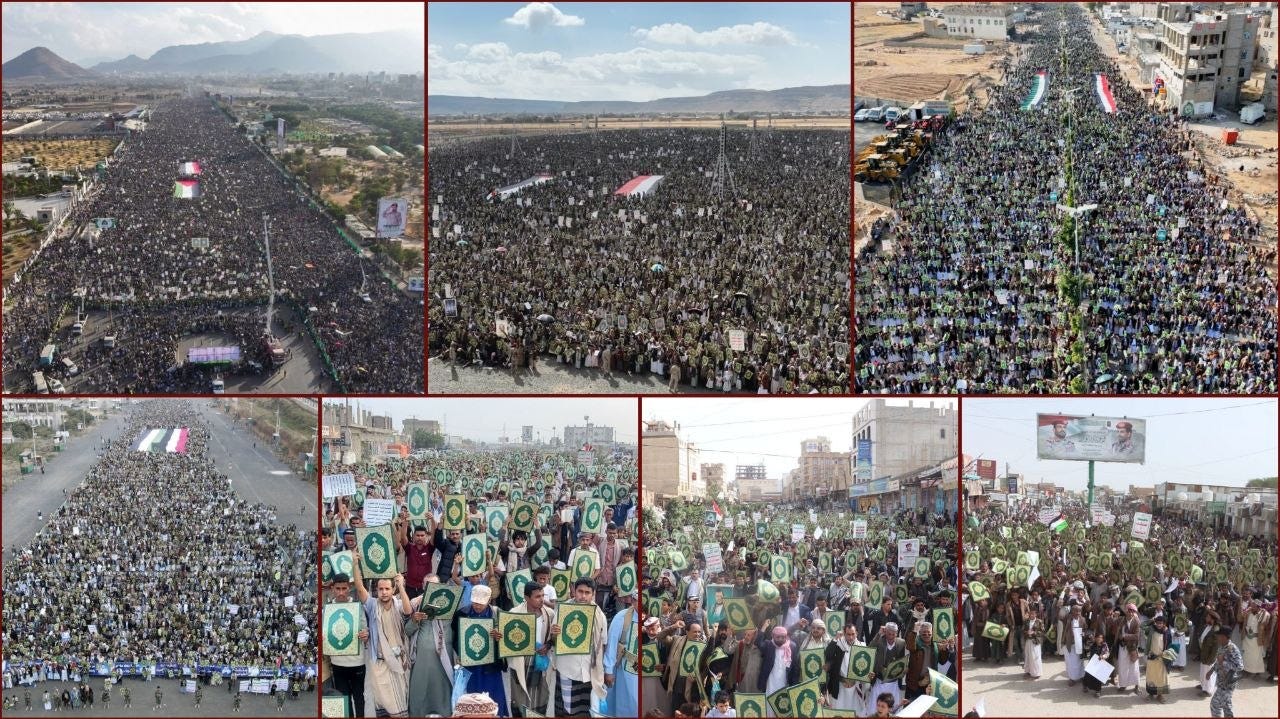
Yemen, PUREWILAYAH.COM — At a moment when nations are being tested in their relationship with their sacred values, Yemen broke through the silence of much of the Islamic world and surged into streets and public squares in a fully-formed, faith-driven response—rising in anger for the Book of God and declaring a position that reflects a people who see the Holy Qur’an as the core of their identity and the first line of defense for their dignity and existence.
For Yemenis, the assault on the Qur’an is not a “symbolic incident,” but an open war—one that targets faith and creed before geography.
In a rare scene of collective belief and awareness, crowds flooded more than 1,500 squares under the slogan “General Mobilization and Readiness… In Support of the Qur’an and Palestine,” across the capital Sana’a and throughout Yemen’s free governorates.
Demonstrators renewed their covenant with the Book of God, categorically rejecting all forms of American and Zionist abuse directed at the Holy Qur’an, and stressing that Yemen’s faith-based identity is not a slogan but a firm stance embodied in the squares and streets.
In the thunderous marches, a distinct Yemeni scene emerged—where anger fused with creed, and awareness transformed into action.
The squares became speaking platforms for one message: the Qur’an is the covenant of an Ummah and its rope of salvation, and any violation against it is a direct violation of the dignity of all Muslims and their right to live with honor and freedom.
“All of Yemen of Faith” Faces the Entire Project of Arrogance
The capital Sana’a launched the nationwide scene with a single central march that carried the full weight of popular decision. Al-Sabeen Square, overflowing with massive crowds, stood as a clear declaration that Sana’a represents the beating heart of Yemen’s faith-based stance—and the pillar of popular mandate granted to the leadership in the battle to defend sacred values.
At the same time, distant western districts of Sana’a were present through dozens of newly established squares—created to shorten travel distance, overcome geography, and register a position that accumulates Yemeni messages of faith and defiance.
Across the country, governorates documented sweeping participation in numbers that underscored the breadth of mobilization:
Al Hudaydah: 317 squares turned into conscious platforms of anger and readiness, stressing that defending the Qur’an is not confined to condemnation, but begins with practical choices—foremost preparedness against enemy aggression, alongside economic boycott and confronting tools of soft war.
Hajjah: 312 marches drew a line rejecting appeasement, viewing the insult to the Holy Mushaf as an aggression that demands an open-ceiling response and tests belonging by action, not claims.
Ibb: 220 marches framed the turnout as a religious and ethical obligation, sending a direct message to silent regimes that hesitation is no longer acceptable at a time when sacred values and blood are violated together.
Amran: 155 marches affirmed that the crime targets not only a religious symbol but the dignity of an entire Ummah—and that defending the Qur’an is inseparable from continuing support for Palestinian resistance as the first line of defense for the Ummah’s sanctities.
Raymah: 100 marches reflected practical adherence to leadership directives, coupled with explicit disavowal of those who collude or betray, stressing that the internal front is inseparable from the battle for sacred values.
Al Mahwit: 95 marches emphasized internal unity as a necessary condition for any coming confrontation, linking declared readiness to protecting the Qur’an and defending Palestine.
Taiz (Bab al-Mandab): 93 marches delivered a reading of the insult as one episode in a comprehensive war targeting the Ummah’s identity, calling for broad popular movement that transcends geography.
Al Jawf: 50 marches highlighted readiness to bear the consequences of confrontation, while holding the weakness and submission of some regimes responsible for emboldening enemies.
Dhamar: 50 marches framed reverence for the Qur’an itself as resistance, calling economic boycott the minimum duty toward states that legalize insults and urging higher readiness for all options of deterrence and accountability.
Saada: 45 marches revived the spirit of a revolution born from the Qur’anic path, with a massive central rally reiterating that the Qur’an is a non-negotiable red line and that Islamic and international silence amounts to indirect complicity.
The mobilization extended into free areas of southern Yemen as well, where marches were recorded in Al Dhale’e (17 marches) and Lahij (three marches). Participants affirmed readiness for all options declared by Sayyed Abdul-Malik Badr al-Houthi, warning that insults to the Mushaf are tied to the wider path of silence, capitulation, and normalization with the enemy.
In Marib, tribes rallied in 16 squares, holding Arab and Islamic silence responsible for the continued American-Zionist escalation targeting the Ummah and its sanctities. In Al Bayda, which saw 25 marches, participants stressed that supporting Palestine is a natural extension of the battle to defend the Qur’an—and that Yemen will continue confronting enemy schemes aimed at the Ummah.
The Roar of Millions: “The Qur’an Is God’s Book—God’s Enemies Will Not Escape”
From inside the squares—numbering more than 1,500—chants thundered with the voice of Yemen’s steadfastness, carrying layered messages from throats filled with dignity, heads raised with honor, and fists clenched with a rage that enemies cannot ignore.
Among the chants echoed across the squares:
“The Qur’an is the Book of God… the enemies of God will not escape.”
“From Yemen of faith… we will not compromise on the Qur’an.”
“The soldiers of Satan… burn my glorious Qur’an.”
“O soldiers of God… stand victorious for the Book of God.”
“Who does not rage for the Qur’an… has not an atom of faith.”
“Israel and America… are the fiercest enemies of Islam.”
“Desecrating the Mushaf is aggression… rise for the Qur’an.”
“America, the Great Satan… an unchanging evil.”
“Jihad, jihad… come, come to jihad.”
The marches also renewed Yemen’s unwavering pledge to Palestine, proclaiming solidarity with Gaza and the Palestinian people, while reaffirming a broad popular mandate for leadership—presented as a unified national stance in the face of American-Zionist provocation.
Through this massive uprising, Yemen once again anchored its compass at the heart of the Ummah’s struggle—declaring that defending the Qur’an cannot be separated from defending Palestine, nor from confronting projects of domination and cultural erasure driven by Washington and shielded by Zionist power.
It was the message of a people besieged by war and siege, yet still capable of turning faith into stance, stance into action, and action into an open path of resistance—until dignity is restored and the Ummah’s lands and sanctities are liberated from Zionist occupation and its Western sponsors. (PW)