

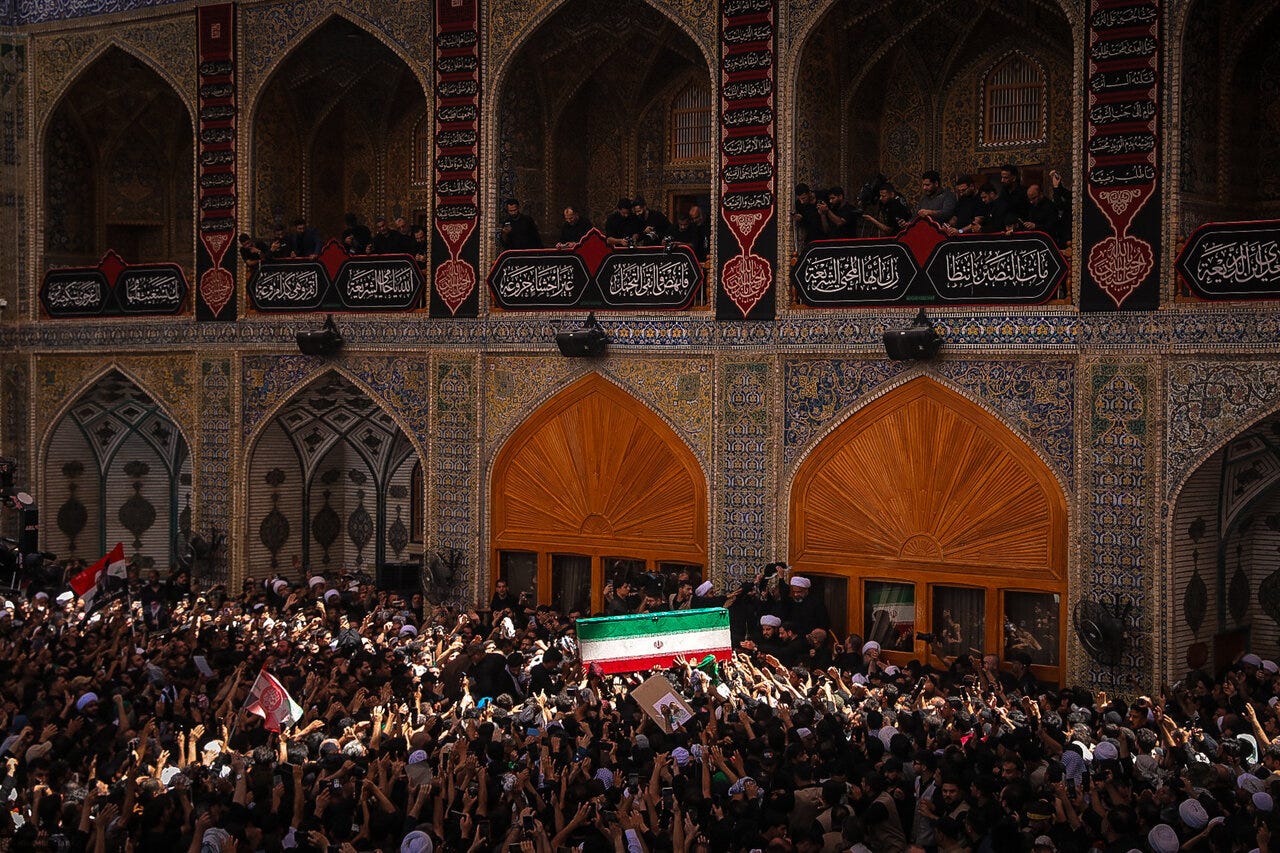
TEHRAN — Millions of mourners poured into Iraq’s holiest cities on Wednesday to pay their final respects to the martyred Leader of the Islamic Revolution, Ayatollah Seyyed Ali Khamenei, in an outpouring of grief and solidarity that organisers said surpassed all modern records for the region.
The official ceremonies in Iraq began at six o’clock in the morning local time in the holy city of Najaf, following funeral prayers over the Leader’s body at the revered Shrine of Imam Ali (AS). From there the procession advanced through the Kufa Bridge and the historic Thawrat al-Ashreen intersection toward al-Sadreen Square, drawing crowds that authorities described as unprecedented for the city.
According to Iraq’s Popular Mobilization Forces (Hashd al-Shaabi), more than 2.3 million people took part in the Najaf procession within its first few hours alone, with the numbers climbing steadily as waves of mourners arrived from every corner of the country — including the distant southern provinces of Basra, Muthanna, and Maysan — filling the highways and roads leading into the city.
Seven million converge on Karbala
From Najaf, the cortege moved on to Karbala, where provincial authorities said around seven million mourners had entered the governorate. Mourning tents, traditional hospitality stations, and black banners lined the entire six-kilometre route as the vehicle carrying the Leader made its way slowly through densely packed, weeping crowds toward the twin holy shrines of Imam Hussein and his brother Abbas (AS) for the final farewell rites.
To manage the vast turnout, Iraqi Prime Minister Ali Faleh Al-Zaidi declared Wednesday a nationwide public holiday, allowing citizens from every walk of life to take part. Iranian President Masoud Pezeshkian and Foreign Minister Abbas Araghchi attended the ceremonies in Najaf, where they were received by Iraqi officials and the public in what state media cast as a powerful demonstration of the bond between the two nations.
Prominent Iraqi political and religious figures joined the ceremonies. Ammar al-Hakim, leader of the National Wisdom Movement, was among the senior figures present at the initial reception at Najaf International Airport and the procession that followed. Former Prime Minister Nouri al-Maliki, who heads the State of Law coalition, described participation in the funeral as a duty owed to a leader who had reshaped the region. Commemorating Ayatollah Khamenei’s legacy, Maliki said, was an obligation for Muslims worldwide, praising him as a steadfast leader who had endured immense challenges and guided Iran to victory against far greater powers. However large the turnout, he added, it remained small beside the stature of the man, and Iraq’s participation sent a clear message that the Islamic Republic stood on the side of truth and did not stand alone.
An echo of the farewell across Iran
The scenes in Iraq followed days of mourning inside Iran. Before the procession crossed the border, millions had converged on the holy city of Qom — home to the country’s foremost seminaries and a principal spiritual centre of the Shia world — to bid farewell to the Leader. Many had travelled through the night by bus, car, and on foot; by dawn the courtyards, prayer halls, and surrounding streets of the Holy Jamkaran Mosque had become an ocean of black-clad mourners.
Grand Ayatollah Abdullah Javadi Amoli led the funeral prayers before a congregation of millions, joined by senior clerics, seminary scholars, government officials, military commanders, and representatives of regional resistance movements. The cortege then set out from the Jamkaran Mosque toward the Shrine of Hazrat Fatima Masumeh (SA), with chants of resistance echoing through the city and mourners carrying banners declaring that the Leader’s martyrdom would only deepen the nation’s resolve.
Those ceremonies were themselves a continuation of the funeral rites held in Tehran, where millions had gathered in one of the largest public assemblies in the country’s modern history. The flag-draped coffin of Ayatollah Khamenei was carried alongside the coffins of family members martyred in the same attack, as the procession moved through the centre of the capital amid showers of flowers, with President Pezeshkian and Judiciary Chief Gholam-Hossein Mohseni-Eje’i walking among ordinary citizens. The earlier funeral prayers at the Imam Khomeini Musalla, led by Grand Ayatollah Ja’afar Sobhani, drew heads of state, parliamentary delegations, and representatives of international bodies from neighbouring countries and from across Asia, Eurasia, Africa, and Latin America — a turnout Iranian officials said had defeated efforts to isolate the Islamic Republic diplomatically. Throughout, thousands of volunteers ran service stations distributing food, water, tea, and medical aid, while residents of Qom and Tehran opened their homes, mosques, and religious schools to travellers.
‘The path remains unstoppable’
Ayatollah Khamenei was assassinated on February 28, when US and Israeli strikes killed him and several members of his family at the start of the war against Iran. Iranian officials have framed the scale of the mourning as a rebuke to that aggression, arguing that the smooth continuation of government and the orderly organisation of the nationwide ceremonies demonstrated the stability and resilience of the country’s institutions. The unified appearance of Iran’s political, military, and religious leadership throughout the mourning period, analysts quoted in Iranian media said, sent a message to Washington and Tel Aviv that the attempt to destabilise the system had failed, and had instead strengthened national solidarity.
Officials stressed that the turnout represented not only grief but a renewed collective pledge to the ideals of independence, justice, dignity, and resistance that the Leader championed throughout his life.
The final chapter of the multi-city farewell will now unfold in the holy city of Mashhad, where Ayatollah Khamenei is to be laid to rest at the shrine of Imam Reza (AS), the eighth Shia Imam, in keeping with his final wishes. For the millions who filled the streets of Tehran, Qom, Najaf, and Karbala, the message of the gatherings, in the words of Iranian officials, was that the path of the Islamic Revolution remains unstoppable.
Reference: Tehran Times