

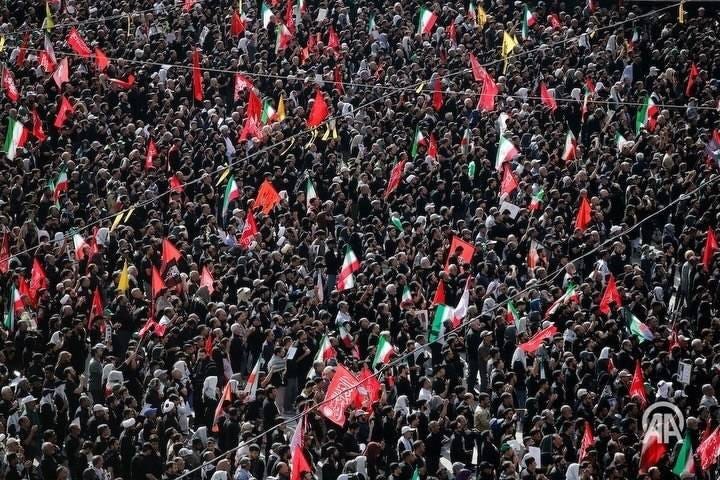
IRAN, PUREWILAYAH.COM – The farewell and funeral ceremonies for Martyr Imam Ayatollah Sayyed Ali Khamenei carried significant national, regional, and international messages, with their most important political impact being the strengthening of perceptions of the Islamic Republic’s stability, legitimacy, and cohesion, according to a senior Iranian seminary official.
Hojjat al-Islam wal-Muslimeen Mohammad Haj Abolqasem Dolabi, Special Assistant to the Director of Iran’s Seminaries, said the participation of millions of mourners was far more than a funeral procession, describing it as a demonstration of public support for the principles of the Islamic Revolution during one of the country’s most sensitive moments.
National Unity and Continuity
Haj Abolqasem said the massive turnout reflected the people’s renewed allegiance to the ideals of the Islamic Revolution rather than to a single individual, demonstrating that the country’s social cohesion remains intact beyond the life of any one leader.
He added that the nationwide participation sent a clear message of unity and internal stability, countering any expectation that the loss of a leader would trigger political disorder or national fragmentation.
According to him, the orderly conduct of the ceremonies alongside the uninterrupted functioning of state institutions also demonstrated that the Islamic Republic possesses institutional mechanisms capable of ensuring continuity during a leadership transition.
Soft Power and a Message to Adversaries
The senior cleric described the funeral as one of the Islamic Republic’s most visible expressions of soft power, saying the participation of millions illustrated that the country’s legitimacy continues to rest on substantial popular support in addition to its state institutions.
He further said the display of national unity conveyed a deterrent message to Iran’s adversaries, showing that external pressure, sanctions, and military threats had failed to weaken the country’s national resolve.
Any expectation of exploiting the leadership transition to create instability, he said, would amount to a strategic miscalculation.
Impact Beyond Iran
Haj Abolqasem also said the ceremony reinforced confidence among the Axis of Resistance by demonstrating the continuity of the Islamic Revolution and sustained public support for its path.
He added that extensive international media coverage of the funeral could present global audiences with an image of public participation in Iran that differs from many prevailing narratives.
From a political standpoint, Haj Abolqasem said the funeral’s most significant international effect was strengthening perceptions of the Islamic Republic’s stability, legitimacy, and cohesion while reducing hopes among its adversaries that the leadership transition could produce a power vacuum or internal instability.
From a social perspective, he concluded, the millions who participated in the ceremonies represented a powerful symbol of Iran’s social capital and national solidarity during one of the most sensitive periods in the country’s history. (PW)