

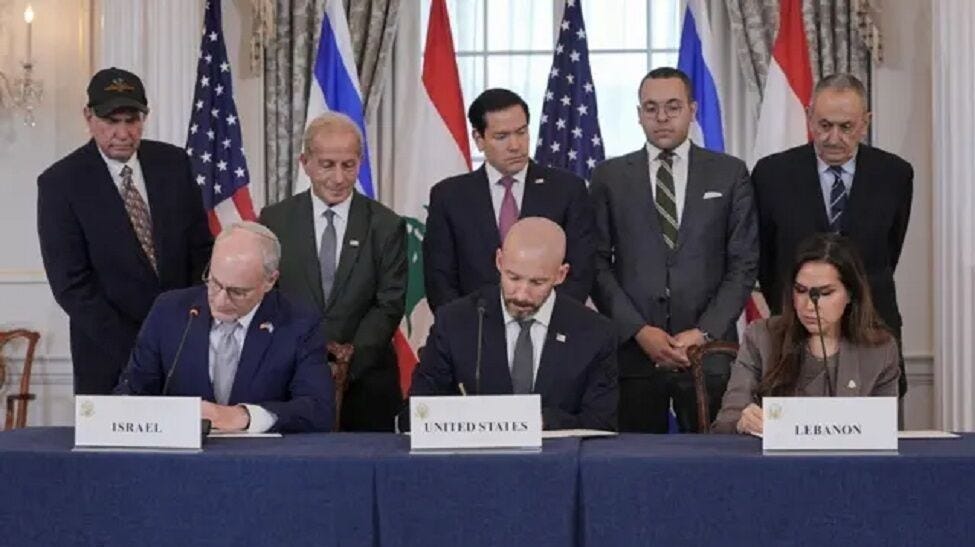
Lebanon, PUREWILAYAH.COM – A broad spectrum of Lebanese political parties, resistance movements, and religious organizations has rejected the agreement signed by the Lebanese government with the Israeli regime in Washington, exposing deep domestic divisions over the deal.
According to Al-Akhbar, the wave of political and public reactions demonstrates that, contrary to the claims of Lebanon’s Western-aligned government, a large segment of Lebanese society opposes the agreement or has expressed serious concerns over its consequences.
Hezbollah: Linking Israeli Withdrawal to Disarmament Crosses Every Red Line
Sheikh Naim Qassem, Secretary-General of Hezbollah, described the agreement as “a source of humiliation and disgrace” and declared it “devoid of legitimacy.”
He warned that conditioning Israel’s withdrawal from occupied Lebanese territory on the disarmament of the Resistance constitutes an extremely dangerous plan that crosses every red line.
Sheikh Qassem called for full adherence to the agreement reached between Iran and the United States, saying Israel must be compelled to withdraw from Lebanese territory in accordance with that understanding.
Broad Political Opposition Warns of Sovereignty Risks
The Amal Movement rejected the agreement as unjust, saying it places Israeli interests above Lebanon’s national interests while creating political and sovereignty-related dangers.
Walid Jumblatt, leader of the Progressive Socialist Party, said the agreement appears trilateral in form but is unilateral in substance, arguing that the existing ceasefire agreement has effectively been ignored.
Talal Arslan, head of the Lebanese Democratic Party, called the text unbalanced, warning that it legitimizes occupation at the cost of Lebanese blood and could pave the way for internal unrest.
The Free Patriotic Movement, led by Gebran Bassil, criticized the wording of the agreement for avoiding any explicit commitment to Israel’s withdrawal. Instead, it uses the term “redeployment,” which the movement said leaves the door open for the continuation of the occupation. The party also called for preserving national unity and preventing internal confrontation.
Religious Groups Call for Cancellation
Al-Jamaa Al-Islamiya stressed that any agreement must preserve Lebanon’s full sovereignty and warned against linking Israeli withdrawal to security conditions that would restrict Lebanon’s right to defend itself.
The Council of Muslim Scholars called for the agreement to be annulled, arguing that it amounts to recognizing Israel and accepting foreign tutelage over Lebanon.
The Syrian Social Nationalist Party and the Lebanese Communist Party described the agreement as “a crime” and “a surrender to the occupier,” comparing it to the May 17, 1983 agreement that was ultimately defeated by the Lebanese people.
Government Allies Defend the Deal
Support for the agreement came primarily from parties aligned with the government.
Samir Geagea, leader of the Lebanese Forces, described the deal as Lebanon’s most significant political step in the past fifty years toward ending the deadlock created by armed resistance groups, urging the public to support the government.
Sami Gemayel, leader of the Kataeb Party, called the agreement an achievement and said Lebanon had emerged victorious, while noting that its implementation would remain the central challenge.
Several MPs regarded as close to Western embassies, including Fouad Makhzoumi, Marc Daou, and Waddah Sadek, also endorsed the agreement, portraying it as a path toward stability, the disarmament of Hezbollah, and peace with Israel. (PW)