

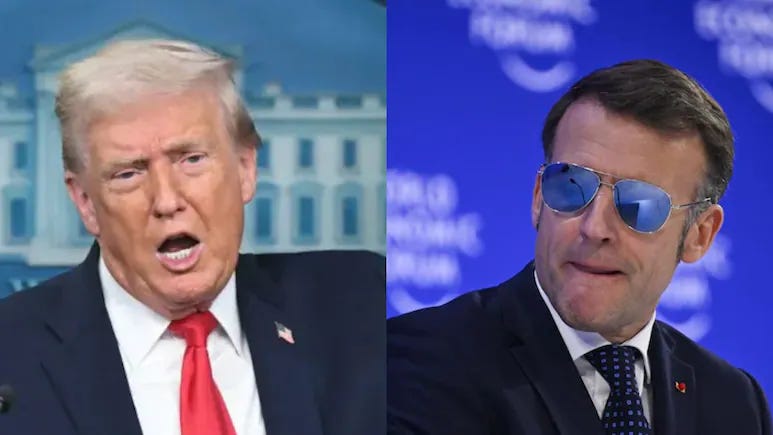
France, PUREWILAYAH.COM — French President Emmanuel Macron has taken a direct swipe at Donald Trump, criticizing what he described as inconsistent and contradictory messaging on the Iran conflict.
Speaking during a visit to South Korea, Macron openly mocked Trump’s shifting positions, stating:
“You have to be serious. You can’t contradict yourself every day… and perhaps you shouldn’t talk every day.”
The remarks highlight growing frustration among Western leaders over Washington’s fluctuating stance, which has swung between calls for escalation and signals of restraint.
Trump’s shifting stance under scrutiny
Since the start of US-led military operations, Trump has issued a series of conflicting statements on strategy, alliances, and escalation.
At times, he has urged international partners, including NATO and countries reliant on West Asia’s oil, to support efforts to secure the Strait of Hormuz. Yet, almost in the same breath, he has insisted the United States does not need allies:
“We don’t need anybody… we have the strongest military.”
Trump has also criticized NATO, calling it a “paper tiger,” while suggesting a potential US exit from the alliance—raising further questions about policy coherence.
Escalation threats — then reversals
Trump escalated rhetoric by threatening to “obliterate” Iran’s energy infrastructure if Tehran did not reopen the Strait of Hormuz within 48 hours. However, the deadline was quickly walked back—first delayed, then extended—citing ongoing negotiations.
These rapid reversals have reinforced perceptions of inconsistency in US strategy.
Macron rejects military option as “unrealistic”
Macron also dismissed proposals for military action to secure the Strait of Hormuz, calling them unrealistic.
He warned such an operation would take significant time and expose forces to coastal threats and Iran’s missile capabilities, particularly those of the Islamic Revolutionary Guard Corps.
Instead, he emphasized that any resolution would require:
“a ceasefire and a resumption of negotiations.”
Trump’s Shifting War Narrative Under Scrutiny
Since the launch of US-led military operations, Trump’s messaging has repeatedly shifted across key areas, raising doubts about strategic clarity.
Allies vs Going Solo
Trump has alternated between calling for international support and asserting American self-reliance. He urged NATO and oil-dependent nations to assist in securing Hormuz, saying they “should be jumping to help us.”
Yet, almost immediately, he contradicted himself:
“We don’t need anybody… we have the strongest military.”NATO Under Fire
Even while seeking support, Trump criticized NATO as a “paper tiger” and suggested a potential US withdrawal was “beyond reconsideration,” fueling uncertainty over alliance stability.
Escalation Threats — Then Reversals
Trump threatened to “obliterate” Iran’s energy infrastructure if Tehran failed to reopen the Strait of Hormuz within 48 hours.
However, the deadline was quickly revised—first delayed, then extended—citing ongoing negotiations, further reinforcing perceptions of inconsistency.
Unclear War Objectives
Trump’s broader strategic messaging has also shifted, moving from aggressive intervention and control of Hormuz to suggesting the conflict could end without securing the waterway—raising questions about US priorities.
Mixed Signals on Escalation
His approach has alternated between calls for intensified military action and signals of restraint, including openness to ending the conflict without achieving earlier stated objectives.
Western Allies Drift Apart
Macron’s remarks come amid widening divisions among Western allies.
The United Kingdom, under Prime Minister Keir Starmer, has distanced itself from the conflict, stating that “Iran is not our war,” while France has ruled out direct military involvement.
As the conflict continues and tensions escalate across the region, Macron’s pointed criticism highlights a deeper issue: Washington’s narrative is no longer being challenged only by its adversaries—but increasingly by its own allies.(PW)