

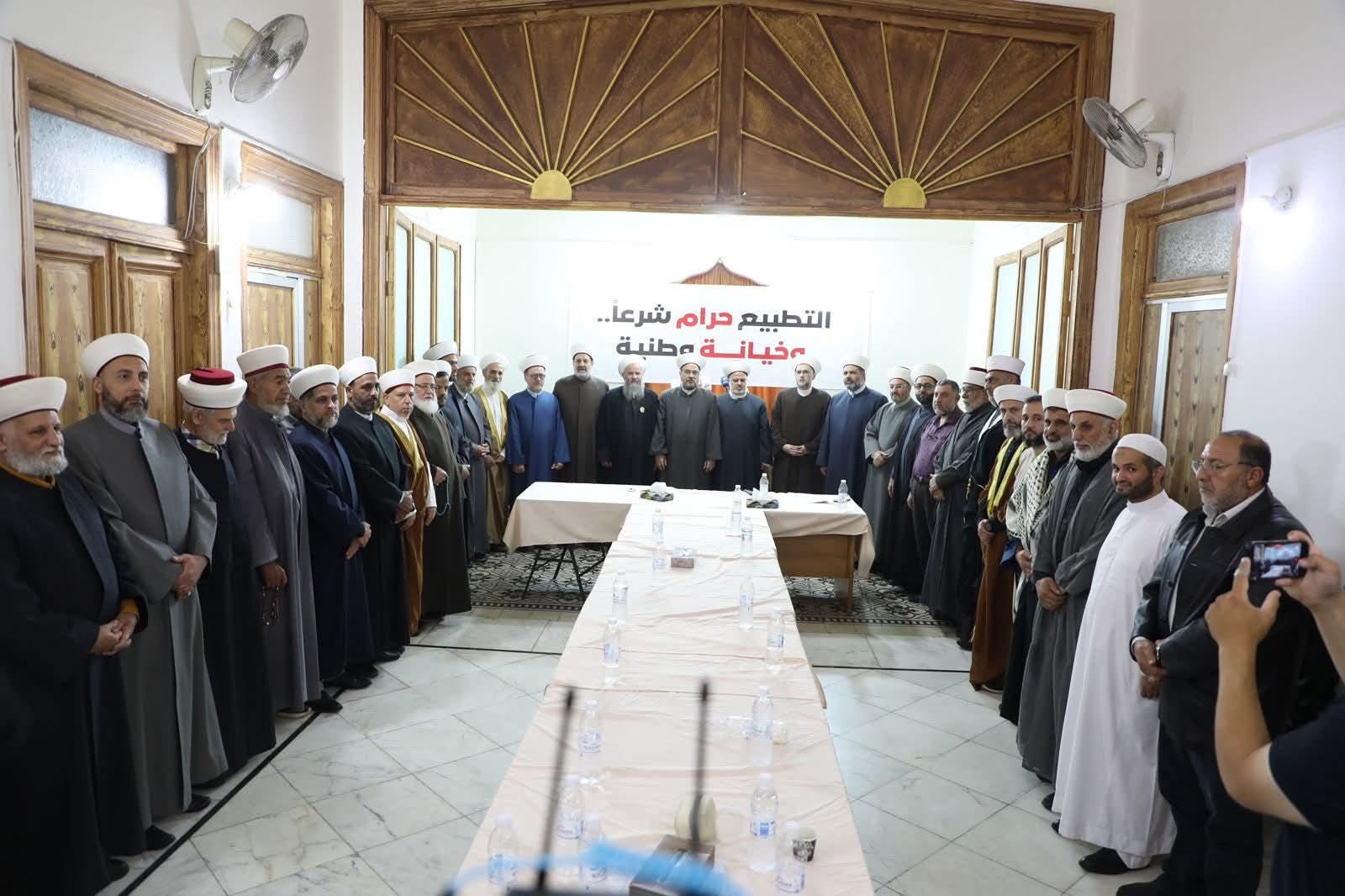
Lebanon, PUREWILAYAH.COM — Prominent Sunni scholars from across Lebanon have categorically rejected any direct negotiations or normalization with the Israeli occupation, declaring that making peace with Israel is religiously forbidden and constitutes a betrayal of the nation.
The position was announced during a broad consultative gathering attended by Sunni scholars and representatives of Islamic and national organizations from various regions of Lebanon under the banner, “Peace with the Israeli Enemy Is Religiously Forbidden and a National Betrayal.”
The meeting, held at the headquarters of the Ummah Movement in Beirut, served as a united platform to reaffirm national and religious constants in the face of growing pressure to pursue direct talks with the Israeli occupation.
Participants stressed the unity of the Lebanese position and rejected all settlement projects that undermine the rights of the الأمة and Lebanon’s sovereignty.
Religious Ruling Against Treaties with Israel
Sheikh Zuhair Jaid stated that any treaties concluded with the Israeli enemy are both religiously prohibited and invalid.
“Our belief regarding treaties with the Israeli enemy is that they are religiously forbidden and null and void,” he said. “They are not binding upon us in any way whatsoever, and it is not permissible for us to implement any part of their contents.”
Sheikh Abdullah Jabri rejected accusations that resistance fighters are reckless adventurers.
“There are those who describe the resistance fighters as gamblers and adventurers,” he said. “We say to them: you are the true gamblers. As for this resistance, its vision is clear, and it sees victory as clearly as the midday sun.”
Negotiations Have Never Restored Palestinian Rights
Sheikh Bilal Shaaban challenged advocates of negotiations to cite a single meaningful achievement by Arab states through diplomacy with Israel.
“Give me one decision, after marathon negotiations, through which the Arabs obtained even half of their rights in Palestine,” he said. “There is none.”
He warned that current efforts are aimed at transferring the conflict into the heart of the nation in order to sow division among Muslims and urged that criticism not be directed inward.
Shaaban also reaffirmed adherence to the historic fatwas issued by scholars and Islamic jurisprudential councils declaring reconciliation with the occupation to be forbidden.


Warning Against Disarming the Resistance
Sheikh Maher Mashlab pointed to leaked details from recent discussions in Washington, saying Israel seeks to delay withdrawal from Lebanese territory for two years while demanding the disarmament of the resistance.
“There will be no return for the displaced,” he said. “They want to disarm the resistance while continuing their aggression and bombardment. What kind of sovereignty are they talking about?”
Sheikh Khadr Kabsh declared that any decisions emerging from such negotiations do not represent the free and honorable people of Lebanon.
“We are the ones who offered the martyrs. We are the ones who shed blood. We will not abandon our dignity or our sovereignty, no matter the sacrifices.”
Support for Hezbollah and National Unity
Hussein Kalash expressed unwavering support for the resistance, saying:
“We say to the resistance: we will not merely stand behind you; we will stand before you as resisting mujahideen. We salute the leadership of this resistance.”
Sheikh Mohsen al-Rifai stressed the necessity of Muslim unity, warning that the Zionist enemy does not distinguish between Sunni and Shia.
“This Zionist enemy, these Jews, enemies of humanity and of human nature, will spare neither Sunni nor Shia,” he said.
The participants concluded that the current phase requires deep awareness and steadfast adherence to principles. They called for strengthening internal solidarity and preserving civil peace in a manner that safeguards Lebanon’s sovereignty and the dignity of the ummah.
The scholars also announced that their meetings will remain open to monitor future developments and coordinate responses to any new attempts to impose negotiations or normalization with the Israeli occupation. (PW)
Sumud!